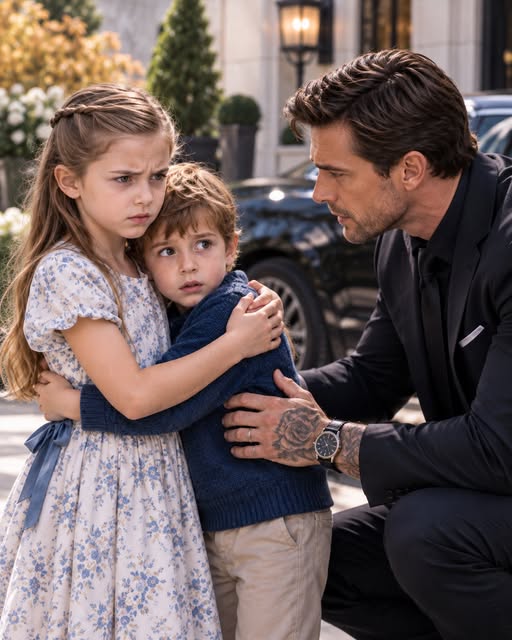
Greg confessed.
Not dramatically.
Not out of morality.
His attorney negotiated.
But the facts remained the facts.
He had abandoned Emma.
He had forged paperwork.
He had taken Rebecca’s insurance money.
He had lied about searching for Emma.
And the statement he made outside the church became part of the case.
For weeks, I had imagined I would feel satisfaction when Greg finally lost control of the story.
I felt almost nothing.
Revenge had seemed important when Emma was merely a child I had found.
Now that I loved her, punishment mattered less than what came next.
The final placement hearing arrived in December.
Portland was cold and gray.
Joshua wore a tiny navy suit because he insisted court required “business clothes.”
Emma wore the pale-blue dress Laura bought her.
She still carried the wooden music box.
Laura sat on one side of the hallway.
I sat on the other.
Not opponents.
Something stranger.
Family without a name.
Natalie approached.
“The judge wants to speak to Emma privately again.”
Emma grabbed my hand.
“Do I have to?”
“You should.”
“What do I say?”
“The truth.”
“What if the truth is complicated?”
Natalie smiled.
“Judges hear complicated truths all day.”
Emma looked at Laura.
“Will you be mad?”
“No.”
Then at me.
“Will you?”
“No.”
“Even if I don’t pick you?”
That sentence hurt.
But love was not ownership.
“Even then.”
She disappeared behind the courtroom doors.
Forty minutes later, we were called inside.
The judge, a woman named Helen Park, had spent twenty-three years in family court.
Her expression suggested very little surprised her anymore.
“This case presents unusual circumstances,” she began.
That was one way to describe it.
“Emma Carter’s mother clearly expressed a preference for placement with her sister, Laura Carter.”
Laura lowered her eyes.
“Ms. Carter has passed every evaluation.”
My stomach tightened.
“She provides a stable home, no concerning history, and has demonstrated strong commitment to Emma.”
I prepared myself.
“Mr. Anderson…”
Here it came.
“Your circumstances are less conventional.”
A few people almost smiled.
I didn’t.
“However, the court cannot ignore the bond Emma formed with your son or with you during a period of severe trauma.”
I looked at Emma.
She was drawing on a piece of paper Natalie had given her.
“The court also considers Emma’s own wishes.”
Judge Park paused.
“Emma does not want to choose.”
Emma stopped drawing.
The judge’s voice softened.
“She told me choosing one family feels like abandoning the other.”
Something in my chest broke.
Because that was what adults had taught her.
Love meant someone got left behind.
Judge Park continued.
“No child should have to believe that.”
Laura began crying quietly.
“Therefore, Ms. Carter will receive legal kinship guardianship, consistent with Rebecca Carter’s documented wishes.”
I closed my eyes briefly.
It was the right decision.
It still hurt.
“However…”
I opened them.
“…the court approves an extended shared-care arrangement requested jointly by Ms. Carter and Mr. Anderson, subject to continuing review.”
I stared at Michael.
He smiled.
Laura had requested it.
Without telling me.
Judge Park explained.
Laura and her family would remain in Portland.
Emma would legally live with Laura.
But she would spend substantial time at my home.
Weekends.
Holidays.
School pickups.
Vacations.
Joshua’s birthdays.
Ordinary Wednesdays if she wanted.
“This is not traditional,” Judge Park said. “But neither is every family.”
Emma raised her hand.
The judge blinked.
“Yes, Emma?”
“Can I still have my star room?”
Judge Park smiled.
“You will have to ask Mr. Anderson.”
Every person in the courtroom looked at me.
I cleared my throat.
“It’s hers.”
Emma smiled.
“Forever?”
“Yes.”
The judge closed the file.
“Then perhaps we’re done.”
Outside, Joshua demanded an explanation.
“Does Emma live with us?”
“Sometimes,” I said.
“And Aunt Laura?”
“Sometimes there.”
He frowned.
“So she gets two houses?”
“Yes.”
“That’s not fair.”
Emma’s face fell.
Then Joshua added, “I only get one.”
Everybody laughed.
Even Emma.
The arrangement should have been awkward.
Instead, it became strangely natural.
Laura rented a house twelve minutes from mine.
Her husband, Mark, moved from Seattle with their daughter Mia.
Mia was ten, outgoing, and within three days had taught Emma how to braid hair properly.
Joshua disliked losing Emma on school nights and compensated by video calling her until everyone became annoyed.
Rosa started packing enough food into Emma’s overnight bags to survive winter in Alaska.
Laura returned the bags full because she understood why.
Nobody mentioned it.
Christmas approached.
I expected Emma’s first Christmas after Rebecca’s death to be difficult.
I underestimated how difficult.
One evening, she disappeared from dinner.
Not outside.
We found her in the star room holding the music box.
I sat beside her.
“Bad night?”
She nodded.
“Mama liked Christmas.”
“So did Sarah.”
“Joshua’s mama?”
“Yes.”
“Do you still get sad?”
“Every year.”
“Does it stop?”
I thought.
“No.”
Her face fell.
“But it changes.”
“How?”
“At first, missing someone feels like carrying something heavy every second.”
She listened.
“Later, you still carry it, but you get stronger.”
“Do you forget?”
“No.”
“I’m scared I’ll forget Mama’s voice.”
I understood.
There were nights I struggled to remember exactly how Sarah laughed.
That terrified me too.
“Then we remember on purpose.”
“How?”
I took out my phone.
“Tell me everything you remember.”
She looked confused.
“Now?”
“Now.”
I recorded her.
Mama hated tomatoes.
Mama sang in the car even when she got the words wrong.
Mama called me bug.
Mama wore purple socks.
Mama cried at dog movies.
Mama smelled like vanilla.
Mama burned toast.
Mama said stars were holes in heaven where love could shine through.
Emma talked for forty minutes.
At the end, she was crying.
So was I.
She looked at me.
“Tell me about Sarah.”
So I did.
By the time Joshua found us, we were laughing.
He climbed onto the bed.
“What?”
“Your dad dances terribly,” Emma told him.
“You dance?”
Joshua looked horrified.
“I used to.”
“Show us.”
“No.”
They both began chanting.
“Dance! Dance! Dance!”
I threatened to cancel Christmas.
Nobody believed me.
Three days before Christmas, another problem appeared.
Not from Greg.
From my own world.
One of my companies came under federal investigation involving former partners.
Nothing connected to Emma.
Nothing connected to children.
But my name returned to headlines.
Laura called.
“Are you in trouble?”
“Possibly.”
“Did you do what they say?”
“Some of the accusations involve people I did business with years ago.”
“That wasn’t my question.”
I went silent.
The truth was complicated.
I had built my empire in shadows.
Not every deal had been clean.
Not every relationship could survive daylight.
For the first time, I saw those decisions through another lens.
Not money.
Not power.
Emma.
Joshua.
“What happens if they charge you?” Laura asked.
“I don’t know.”
“Daniel.”
“I’m fixing it.”
“You can’t fix everything.”
“No.”
I looked through the window.
Emma and Joshua were outside building a terrible snowman from Portland’s thin layer of snow.
“But I can fix what I control.”
That week, I did something my older self would have considered impossible.
I began dismantling the hidden part of my organization.
Partnerships ended.
Businesses were sold.
Questionable accounts were turned over to attorneys.
I agreed to cooperate with lawful investigations regarding former partners.
Marcus walked into my office during the process.
“You’re really doing this.”
“Yes.”
“Fifteen years.”
“I know.”
“For what?”
I pointed toward the window.
Emma was helping Joshua put a hat on the snowman.
Marcus watched them.
Then nodded.
“Fair enough.”
It wasn’t redemption.
Life wasn’t that simple.
You couldn’t erase years by signing documents.
But you could decide which direction you walked next.
On Christmas Eve, Emma stood beside the tree holding two ornaments.
One said Rebecca.
One said Sarah.
“Can we put them together?”
Joshua nodded.
“Because they know each other now.”
I smiled.
“How?”
He looked at me as if I were stupid.
“In heaven.”
Emma placed the ornaments side by side.
Then she turned.
“Daniel?”
“Yes?”
“Do you think Mama knows I’m okay?”
My throat tightened.
“I think if there’s any way for her to know, she does.”
Emma looked at the tree.
“I hope she knows you found me.”
I shook my head.
“I didn’t.”
She frowned.
“You found me at the park.”
“No.”
I looked at Joshua.
“You found him.”
Then I looked back at her.
“And somehow, both of you found me.”
For once, Emma didn’t look like a child waiting to be left.
She looked like exactly what she was.
A six-year-old standing beside a Christmas tree.
Safe.
Loved.
Home.
But one final decision remained.
Laura found me after the children went to sleep.
“I’ve been thinking,” she said.
“Dangerous.”
She ignored that.
“Guardianship is temporary.”
“I know.”
“I want to adopt Emma.”
I had expected those words eventually.
They still hurt.
Laura continued.
“But I spoke to my attorney about something else.”
“What?”
She slid a document toward me.
I read the heading.
My eyes lifted.
“Laura.”
“She wants two families.”
“This isn’t common.”
“Neither are we.”
The document proposed that Laura become Emma’s legal adoptive mother while granting me permanent recognized guardian status with extensive parental rights permitted under a negotiated arrangement.
It would require approval.
Evaluations.
More hearings.
But it was possible.
“Why would you do this?”
Laura smiled.
“Because loving Emma means caring about what she needs, not just what I want.”
My own words.
Returned to me.
I looked toward the staircase.
Above us were two sleeping children.
One born into my family.
One who had walked into it through the rain.
“When do we start?”
Laura smiled.
“Tomorrow.”
For the first time in months, tomorrow sounded like something worth waiting for.
---