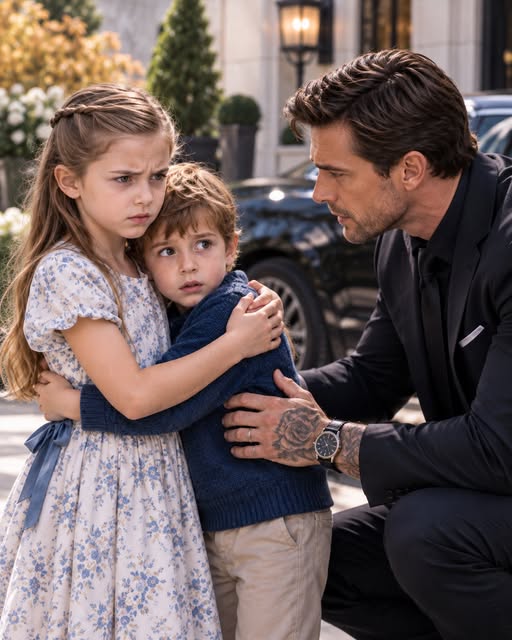
One year later, rain fell over Portland again.
Not the violent November rain from the night Joshua disappeared.
This was softer.
Steady.
The kind that made windows shine and streets glow beneath headlights.
I stood beneath the same tree where I had first seen Emma.
Joshua stood beside me.
He was six now.
Emma was seven.
She wore a yellow raincoat and bright blue boots.
Not because they were all she owned.
Because she had chosen them that morning and refused everyone’s opinion.
A small crowd gathered near the fountain.
Laura.
Mark.
Mia.
Rosa.
Marcus.
Natalie.
Even Judge Park had sent a card.
We were there for a reason Emma had chosen.
A plaque had been installed beside a new covered bench.
It read:
FOR EVERY CHILD WAITING TO BE SEEN.
Below that:
Rebecca’s Light Project.
The foundation had been Emma’s idea.
Not exactly.
Her original idea was, “Can we make a place where kids can get sandwiches without money?”
Laura and I expanded it.
Within a year, Rebecca’s Light had opened three small family resource centers across Portland.
Hot meals.
Temporary shelter.
Child outreach.
Counseling.
Medical referrals.
No complicated questions before food.
No child was ever required to apologize for taking a second cookie.
That rule came directly from Emma.
The foundation wasn’t charity designed for photographs.
I refused publicity whenever possible.
Emma had received enough publicity for one lifetime.
Instead, local churches, schools, businesses, and outreach workers coordinated quietly.
Because the lesson that stayed with me wasn’t how difficult Emma had been to find.
It was how easy she had been to overlook.
Hundreds of people had probably passed her.
Some had given food.
Some blankets.
Most never realized she was six years old and alone.
Systems had failed.
Adults had failed.
A city had failed.
We couldn’t rewrite those months.
We could make the next child harder to miss.
“Daddy.”
I looked down.
Joshua tugged my sleeve.
“Yes?”
“Emma says I’m standing too close.”
“You’re literally two feet away.”
“She says this is her speech spot.”
Emma glared.
“It is.”
Joshua moved six inches.
“Better?”
“No.”
I hid a smile.
Emma had changed dramatically over the year.
Physically, she was healthier.
Her cheeks had color.
Her hair had grown.
She had gained weight.
But the biggest changes couldn’t be measured.
She stopped hiding food.
Mostly.
She stopped sleeping in her clothes.
She no longer asked every visitor whether they were coming to take her.
Sometimes storms still woke her.
Sometimes unexpected car doors outside made her freeze.
Sometimes she packed a bag when adults argued.
Healing was not a straight road.
But each time, someone unpacked the bag with her.
Not for her.
With her.
Laura completed the adoption six months earlier.
I became Emma’s permanent legal guardian under the unusual but carefully negotiated arrangement our attorneys had constructed.
What did Emma call me?
That evolved.
At first, Daniel.
Then D.
Then occasionally Dad when she was sleepy.
The first time happened by accident.
She had fallen asleep on the couch.
I carried her upstairs.
Halfway there, she murmured, “Dad, my music box.”
I almost dropped her.
The next morning, neither of us mentioned it.
Three weeks later, she said it again.
This time awake.
“Dad?”
I looked up so quickly she laughed.
“You make a weird face when I call you that.”
“I do not.”
“You do.”
She kept doing it.
Laura never minded.
Emma called her Mom Laura.
Children apparently had more room in their hearts than adults gave them credit for.
Greg Mason pleaded guilty to several charges.
The court ordered restitution from whatever recoverable assets remained.
He served time.
Emma never visited.
We never encouraged or prevented future contact beyond what therapists recommended.
That decision would eventually belong to Emma.
She stopped asking whether he would return.
That was enough.
My own life changed too.
The investigation into several businesses ended with fines, restructuring, and more lawyers than I ever wanted to see again.
I sold two nightclubs.
Closed several questionable partnerships.
Expanded legitimate logistics and hotel operations.
Men who knew the older version of Daniel Anderson claimed fatherhood had made me soft.
Marcus once repeated that accusation.
I asked what he thought.
He shrugged.
“You’re still terrifying.”
“Thank you.”
“You just attend more school plays.”
Fair.
Emma approached the plaque.
The small audience quieted.
She held a sheet of paper.
Then lowered it.
“I don’t want to read this.”
Laura whispered, “You don’t have to.”
“I know.”
Emma looked around.
“I remember this park.”
My chest tightened.
“I used to know where all the warm places were.”
Nobody moved.
“The library steps were warm because air came from underneath. The café threw away bread after closing. The church had a roof that didn’t leak.”
Laura pressed her fingers against her mouth.
Emma continued.
“I thought grown-ups knew everything.”
A few people smiled sadly.
“But they don’t.”
She looked at me.
“My mom died.”
Then toward Laura.
“My aunt didn’t know where I was.”
Then Joshua.
“Greg left me here.”
Silence.
“I waited for him.”
Rain tapped softly against umbrellas.
“He didn’t come.”
Joshua moved closer despite her earlier complaints.
Emma didn’t object.
“Then Joshua got lost.”
She smiled at him.
“He cried a lot.”
“I was five!”
“You’re six now.”
“I know.”
People laughed.
Emma continued.
“I knew how being lost felt.”
That sentence silenced everyone again.
“So I stayed with him.”
She looked toward the tree.
“I sang him the star song.”
Joshua nodded.
“Badly.”
Emma shoved him.
“Quiet.”
More laughter.
“And then Daniel came.”
She looked at me.
“Dad came.”
There it was.
That word.
Even after a year, it could stop my heart.
“He thought he rescued me.”
I raised an eyebrow.
Emma smiled.
“But I think Joshua rescued me first.”
Joshua beamed.
“And maybe I rescued him.”
She paused.
“And everybody rescued everybody.”
That sounded exactly like a seven-year-old explanation.
It was also better than anything adults had written for the ceremony.
Emma touched the plaque.
“This bench is for kids who are waiting.”
She looked toward the foundation volunteers.
“If you see somebody, don’t think someone else will help.”
Then she stepped back.
“I’m done.”
Applause rose.
Emma immediately looked embarrassed and hid behind Joshua.
Later, we walked to the café across the street.
The same one.
The owner remembered us.
Of course she did.
Not because I was Daniel Anderson.
Because Emma had eaten five cookies.
“They were small,” Emma insisted.
“They were enormous,” I said.
“Lies.”
The owner placed a plate on the table.
“House rule. Emma gets as many as she wants.”
Emma selected two.
Then pushed the plate toward Joshua.
I watched her.
A year earlier, she had apologized for eating three.
Now she knew there would be more tomorrow.
That might have been the clearest definition of safety I had ever seen.
Laura sat across from me.
“You’re staring.”
“I’m allowed.”
“You look sentimental.”
“Careful.”
She smiled.
My phone buzzed.
Marcus.
I ignored it.
It buzzed again.
Emma pointed.
“Aren’t you answering?”
“No.”
“What if it’s important?”