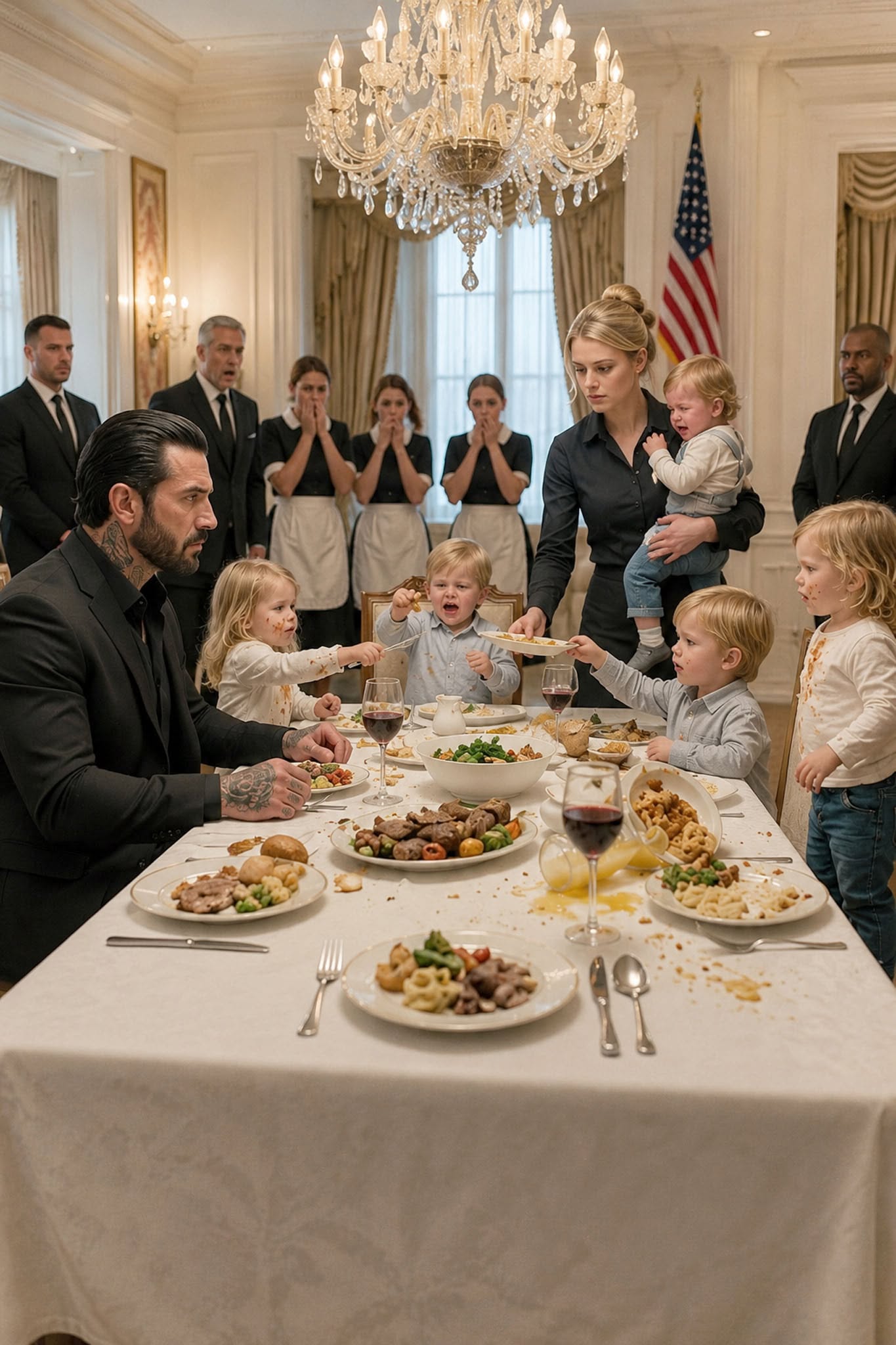
Clara ignored the stunned silence hanging in the air and marched straight toward the massive, sub-zero stainless-steel refrigerator. She pulled open the door and began taking inventory with the cold, focused precision of a trauma surgeon assessing a triage unit.
Eggs. A block of aged Parmigiano-Reggiano. Pancetta tucked away in the deli drawer. Heavy cream. Fresh garlic bulbs. A massive sack of artisan rigatoni sitting abandoned in the pantry.
Enough to make a proper carbonara, she thought, assuming the stove actually functions beneath the layer of psychological warfare.
She set the ingredients down on the island. Instantly, Mason stepped forward, planting his bare feet firmly on the sticky floor and crossing his arms over his chest.
“You’re not allowed to use the stove,” Mason declared, channeling every ounce of inherited executive authority his six-year-old body could muster.
Clara paused, holding a heavy iron skillet in her hand. “Says who?”
“Says us,” Cole chimed in, stepping up beside his brother. “The stove is off-limits. Dad said so.”
Clara turned her gaze toward Victor. The billionaire was still leaning against the far counter, watching the scene unfold with an expression that hovered somewhere between clinical fascination and morbid curiosity. He took another slow sip of his whiskey and said nothing, offering neither confirmation nor denial. Your test, Ms. Bennett, his silence seemed to say. Figure it out.
Clara turned back to the boys. “Your father said no such thing. He said if I get you fed by eight, I’m hired. He didn't exempt the stove.”
Ryder grabbed a crisp, red apple from a decorative fruit bowl sitting near the edge of the counter. He weighed it in his hand like a baseball pitcher lining up a fastball. “We don't like dinner. Nannies always try to make us eat green things. Broccoli. Spinach. Mushy carrots that look like dead worms.”
“I’m not making green things,” Clara said, pulling a cutting board toward her. “I’m making pasta.”
“We hate pasta!” Mason yelled defiantly.
Cole grabbed a second apple from the bowl. Without breaking eye contact with Clara, he cocked his arm back and hurled the fruit directly at her head.
The apple whistled through the air, missing Clara’s cheek by a fraction of an inch before exploding against the white subway tile backsplash behind her with a sickening thwack, sending pieces of red skin flying across the counter.
Victor’s voice dropped into a low, terrifying register. “Cole.”
Clara didn’t flinch. She didn't blink. She didn't drop her hands.
With maddening, deliberate calm, she picked up a chef’s knife and began slicing an onion with rhythmic, flawless precision, her blade whispering against the wooden board.
Cole blinked, momentarily disarmed by her lack of reaction. “You’re... you’re supposed to scream,” the boy stammered, his bravado stuttering for the first time.
“Everyone screams,” Clara replied evenly, not looking up from her knife work. “Your last nanny screamed. The one before that threw a stapler. Yelling just proves to you that I care more about your behavior than you do.”
Mason frowned, his forehead wrinkling in confusion. “What does that mean?”
“It means right now, my only priority is dinner.”
Ryder growled in frustration and launched his apple. It struck Clara squarely on the shoulder, leaving a soft, yellow-green bruise mark and smearing sticky fruit juice across the fabric of her cheap cotton blouse.
Clara brushed the debris away with the back of her wrist, swept the diced onions into a bowl, and reached for the pancetta.
The boys exchanged uncertain, uneasy glances. Their entire universe—every adult they had ever encountered—was built on a predictable cycle of action and reaction. They misbehaved; adults became emotional, shouted, threatened punishments, called their father, or broke down in tears.
Clara did none of those things. She moved through the wreckage of the kitchen with the detached, immovable calm of a woman who had already survived far worse than spoiled children and spilled juice.
And indeed, she had.
She had survived an eighteen-month custody war against a man with bottomless financial resources. She had survived eviction notices tacked to her front door in the middle of January. She had survived sitting in a freezing car counting out nickels and dimes to buy a single box of macaroni and cheese, smiling brightly so her daughter Lily would think they were having an indoor picnic rather than facing poverty.
Four rich, spoiled boys throwing fruit were nothing. They were just noise.
By the pantry door, the fourth boy—Theo, the quiet one—uncoiled his legs and slowly stood up. He walked across the sticky floor, avoiding the orange juice puddles with practiced agility, and stopped two feet from the kitchen island.
“What are you making?” Theo asked, his voice small, hesitant, and entirely devoid of the theatrical hostility of his brothers.
Clara looked down at him, softening her gaze. “Carbonara.”
Theo’s dark eyes widened slightly. A ghost of a memory seemed to flicker across his pale face. “My mom made that,” he whispered, the words slipping out before he could catch them.
The heavy, combative air in the kitchen instantly shifted.
Across the room, Victor Hale’s whiskey glass paused halfway to his mouth. The amber liquid inside stilled. His dark eyes locked onto his youngest son, his chest tightening as if he had been struck in the ribs.
Clara didn't rush the moment. She leaned against the counter, looking down at Theo with profound, aching gentleness. “Then you know the secret, don't you?”
Theo swallowed hard. “What secret?”
“You can’t rush it,” Clara said softly, pitching her voice so the other three boys naturally drifted closer to listen. “If you turn the heat up too high, the eggs scramble and turn into a mess. If you’re patient, if you keep stirring and watching the temperature just right, they melt together into silk.”
Theo stared up at her for a long, quiet moment. Then, slowly, a tentative, almost desperate curiosity replaced the wariness in his eyes.
He stepped closer, resting his small hands on the edge of the marble counter. “I want to help.”
Mason instantly bristled, stepping forward to block his brother. “Theo, no! We’re supposed to make her quit! We’re supposed to make her run away like the lady with the missing shoe!”
Theo ignored his older brother completely. He looked up at Clara. “Can I stir?”
Clara pulled up a sturdy wooden step stool, placed it beside the stove, and handed him a heavy wooden spoon. “Wash your hands first, chef.”
Theo scrubbed his hands at the sink in record time, climbed onto the stool, and took the spoon.
Clara tossed the artisan rigatoni into a boiling pot of salted water, rendered the pancetta until it crisped into savory perfection, and began whisking farm-fresh egg yolks with a generous mound of grated Pecorino and black pepper. The kitchen filled with a warm, rich, intoxicating aroma—garlic, rendered pork fat, toasted cheese, and boiling pasta. It was the smell of home, of warmth, of a real family sitting down to break bread together.
It was a smell the Hale mansion hadn’t experienced in over two years.
Ryder drifted closer, his nose twitching like a rabbit smelling carrots. “That... that smells pretty good,” he mumbled defensively.
“It smells amazing,” Cole corrected him under his breath.
Clara strained the pasta, folding it directly into the hot skillet with the crispy pancetta, then motioned to Theo. “Off-heat now, Theo. Gentle circles. Keep it moving just like we talked about.”
Theo concentrated with the intense, laser-like focus of a bomb disposal technician defusing a live wire. Under his careful guidance, the Nextce emulsified into a glossy, velvety sheen that coated every single piece of rigatoni in golden perfection.
Clara grabbed four mismatched ceramic bowls from the cabinet—she didn't care about the matching crystal china—and portioned out steaming, fragrant servings of the carbonara.
She turned to the boys, who were now standing in a semi-circle around the island, their mouths slightly open, their hostility entirely disarmed by biological hunger.
“Ryder, grab the forks from the drawer by the sink,” Clara commanded in a tone that brooked no argument. “Cole, fill four glasses of water. Mason, grab the cloth napkins.”
For three seconds, Mason stood frozen, torn between his duty as the ringleader of chaos and the overwhelming olfactory evidence sitting right under his nose.
Then, slowly, Mason turned, pulled open the silverware drawer, and reached for the forks.