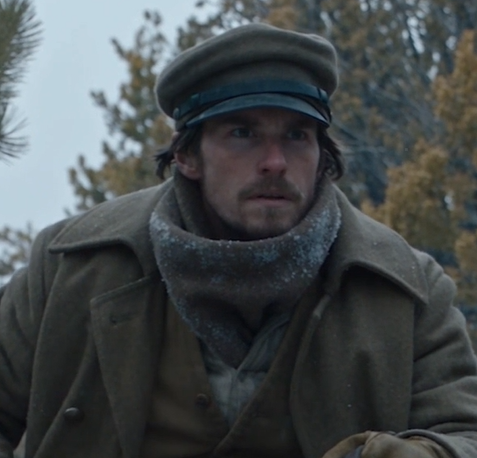
He stepped over the fallen fir, planting his right boot firmly in the blood-soaked slush beside the warrior’s crushed limb.
The smell was sour—the iron tang of spilled blood mixed with the pine sap and the faint, sweet decay of flesh that had been pinched off from circulation for eighteen hours.
The warrior’s foot was purple-black, bloated where it was exposed above the cut hide of the moccasin.
“Hold onto something,” Caleb muttered.
He stood directly over the trap, straddling the warrior’s pinned leg.
He placed his left boot squarely onto the wide flat of the northern leaf spring, putting his entire hundred-and-ninety-pound weight onto the iron.
The spring gave a fraction of an inch, groaning against the cold.
“Come on, you bastard,” Caleb grunted.
He brought his right foot down onto the opposite spring, balancing precariously on the two narrow strips of forged steel like a man walking a grease-slicked wire.
The iron bit through the soles of his boots.
He bent his knees, dropped his center of gravity, and reached down with his bare hands to grip the iron jaws themselves, seeking to pull them apart before the springs could fight back.
The cold of the iron scorched his palms like red-hot embers.
Skin adhered to the rusted metal; he felt the top layer tear with a dull, painless ripping sound that would only begin to burn later.
“Now!”
Caleb roared.
He drove his legs down with every ounce of strength left in his thighs and lower back.
His spine creaked; his breath blew out in a white, ragged blast against the warrior’s face.
The leaf springs compressed.
One notch.
Two.
The teeth shifted in the warrior’s leg.
The Apache did not scream like a white man screams.
He did not cry out for God or his mother.
He threw his head back against the limestone cliff, his throat swelling into a thick, corded column, and let loose a sound that was half battle-cry, half death-song—a deep, vibrating roar that echoed down the draw like the rumble of a rockslide.
His hands clawed into the frozen earth, his fingernails peeling back against the shale, leaving ten red streaks in the white frost.
“Pull it out!”
Caleb screamed, his vision going grey at the edges as the strain turned his muscles to liquid fire.
“Pull your leg out, damn you!”
The warrior understood the tone if not the words.
Gritting his teeth until the enamel cracked, he reached down with both hands, seized his own mangled calf, and wrenched his leg backward through the half-open teeth.
The bone scraped against iron with a dry, sickening screech.
Caleb’s right foot slipped on the frost-coated spring.
SNAP.
The jaws slammed shut with the force of a sledgehammer striking an anvil, missing Caleb’s boot heel by the width of a coin.
The shockwave of the iron hitting iron shot up through Caleb’s legs, throwing him backward into the slush.
He hit the scree hard, knocking the wind from his chest in a great, hollow whoosh.
He lay there for three heartbeats, staring up through the bare grape vines at the grey sky, his palms bleeding, his chest heaving, his left knee throbbing with a bright, blinding sickness.
Beside him, the Apache lay face down in the snow, his arms outstretched, unconscious.
The silence returned to the draw, heavier and more terrible than before.
Caleb rolled over onto his elbows.
The warrior was still breathing.
His back rose and fell in shallow, irregular hitches.
The left leg was a ruin—the bone of the lower calf was cracked, splintered longitudinal-wise, and the skin hung in ragged grey flaps where the teeth had pulled away.
If he were left here, the cold would stop his heart within an hour; if the cold did not, the gangrene would turn his blood to swamp water by the third day.
“You should have stayed in the valley, Caleb,” he whispered to his bleeding palms.
He crawled through the snow, gathered his mittens, and pulled them over his raw hands with a hiss of pain.
Then he went to work.
He used his skinning knife to slice the remnants of the warrior’s moccasin away.
He packed the open, gaping tears with clean, dry snow to staunch the dark venous oozing, then reached into his saddlebags on Rust and pulled out his spare wool shirt—a heavy, grey flannel garment he had washed in the Verde until it was soft.
He tore it into wide, three-inch strips with his teeth and knife.
He bound the leg tightly, working from the ankle up to the knee, using two straight pieces of scrub oak branch as splints to keep the cracked tibia from grinding itself to meal.
Every time he pulled the knots taut, the warrior’s unconscious body twitched, his heels drumming faintly against the dirt, but the dark eyes remained closed.
When the bandages were secured, Caleb sat back on his haunches, breathing hard.
The wind had shifted.
It was coming directly out of the northwest now, bringing with it the true blizzard—a wall of white that was already obscuring the mouth of the draw, turning the tall pines into shadowy, wavering wraiths.
The temperature was plunging; Caleb could feel his eyelashes freezing together every time he blinked.
The warrior was shivering violently now, the uncontrollable, convulsive tremors that signal the body’s final surrender to the frost.
His skin was cold to the touch, like tallow left in a cellar.
Caleb looked at his own coat.
It was a fine coat.
An old army-issue sheepskin shearling, double-breasted, with deep pockets and a wool collar that stood three inches high around the ears.
It had kept Caleb alive through the freezing mud of northern Virginia and three winters on the Mogollon plateau.
Without it, a man had about as much chance against an Arizona blizzard as a trout thrown onto a skillet.
He unbuttoned the bone toggles.
He slid his arms out of the sleeves, feeling the instant, shocking bite of the mountain air through his thin cotton undertunic and greasy leather vest.
It was as if someone had laid a slab of river ice across his bare shoulder blades.
He knelt over the Apache warrior, lifted the man’s heavy, slack shoulders, and worked the sheepskin coat onto him.
He pulled the warrior’s arms through the sleeves, buttoned the front toggles, and turned the high wool collar up around the scarred neck.
“There,” Caleb muttered, his teeth already chattering so hard he could barely shape the word.
“You look… you look like a goddamn colonel now.”
Then came the labor that nearly broke him.
Getting a two-hundred-pound unconscious man onto the back of an eight-hundred-pound gelding on a forty-degree scree slope in a snowstorm is a task that defies simple muscle.
It requires the stubbornness of a mule and the desperation of a drowned man.
Caleb backed Rust up to the limestone ledge.
The dun stood like an iron statue, his ears pinned back against the stinging pellets, snorting softly as the scent of blood filled his nostrils, but he did not kick.
He knew his master’s voice.