The kind of story that changes your understanding of strength doesn’t begin with a roar of engines or a dramatic rescue—it begins in silence, in the kind of quiet where something wrong has been allowed to exist for far too long, and the only reason anyone notices is because someone finally refuses to look away.
The morning those ninety-seven riders set out, the desert air still held the cold from the night, and the horizon stretched wide and indifferent as if it had seen too many things like this to care anymore, but the men and women on those bikes carried something that had nothing to do with territory or pride, something that couldn’t be explained in a sentence because it wasn’t built in a moment—it had been growing, quietly, in fragments of conversations, in late-night calls, in the kind of anger that settles deep when you hear about a child being hurt and realize the system that should have protected her had instead chosen convenience over truth.
The call had come in three nights earlier. Not loud. Not urgent in tone. But urgent in everything it implied. A man named Russell “Graves” Dalton had been the one to answer it, sitting in a garage that smelled like oil and metal, half-listening to a game on the radio when his phone buzzed with a number he didn’t recognize, and by the time the voice on the other end finished speaking, he wasn’t listening to anything else at all.
“There’s a girl,” the caller had said, voice tight, controlled. “She’s in a hospital in Colorado. They’re saying she fell down the stairs.”
Graves didn’t respond right away. He had learned, over the years, that the way people described things often told you more than the facts themselves.
“And you don’t believe that,” he said finally.
A pause.
“No. I don’t.”
That was enough. He didn’t ask for proof. He didn’t ask for details that could be argued over. He asked one question that mattered more than anything else.
“Is she alone?”
Another pause, longer this time.
“Yes.”
That was when the decision was made. By sunrise the next morning, messages had already spread across three states, not with explanations, not with speeches, but with a simple instruction that carried more weight than any long story could: **Ride.**
No one asked why. They didn’t need to. Because in that world, there were certain things you didn’t debate. Certain lines that, once crossed, demanded an answer. And a child being hurt without anyone stepping in was one of them.
The ride itself stretched across miles that blurred into each other, highways turning into smaller roads, desert giving way to towns that barely noticed them passing through, but the formation never broke, the engines never softened, and the silence between them wasn’t empty—it was full of purpose, the kind that builds when everyone understands exactly what they are showing up for, even if they don’t yet know what they’ll find.
By the time they reached the hospital, the sun had climbed high enough to cast sharp reflections off the glass entrance, and the sudden arrival of nearly a hundred motorcycles shattered the routine calm of the place, drawing attention in the way something unusual always does, not because it announces itself loudly, but because it refuses to fit into the expected rhythm of the day.
Nurses paused mid-step. Security shifted, uncertain. And Graves stepped off his bike without hurry, removing his gloves one finger at a time as if he were preparing for something that required precision rather than force.
“Where is she?” he asked at the front desk.
The woman behind the counter hesitated, caught between protocol and instinct, before finally answering. “Room 412.”
He nodded once. “Thank you.”
He didn’t wait for permission. He didn’t offer explanation. He simply walked. Behind him, the others followed—not in a rush, not in chaos, but in a steady, controlled movement that filled the hallway with presence rather than noise, the kind of presence that made people step aside without being asked.
As they reached the fourth floor, the sterile smell of antiseptic seemed to sharpen. Outside Room 412, two men in expensive suits stood talking to a doctor. They were polished, confident—the kind of men who were used to directing the narrative. They were the "family friends," the ones who had explained the "accident" to the police.
When they saw the sea of leather and denim approaching, their conversation died. The doctor looked up, his brow furrowed in confusion.
"You can't be here," one of the suits said, stepping forward to block the door. "This is a private matter."
Graves didn't stop until he was inches from the man's face. He didn't raise his voice. He didn't have to. The ninety-six riders behind him stood like a wall of living stone, their boots heavy on the linoleum, their eyes fixed and unblinking.
"The girl," Graves said softly. "Is she awake?"
"That's none of your concern," the man replied, his voice wavering slightly despite his best efforts. "The authorities have already taken her statement. She fell. It’s over."
Graves looked at the man, really looked at him, and for a second, the man saw something in Graves' eyes that wasn't anger; it was a deep, ancient sorrow for a world that allowed people like this to speak for people like her.
"She didn't fall," Graves said.
"And how would you know?" the doctor asked, trying to reclaim his authority. "You weren't there."
"Because I know what fear sounds like when it's forced to lie," Graves answered.
He turned his gaze back to the door. "We aren't here to fight you. We aren't here to break any laws. We are here to be the witnesses she didn't have."
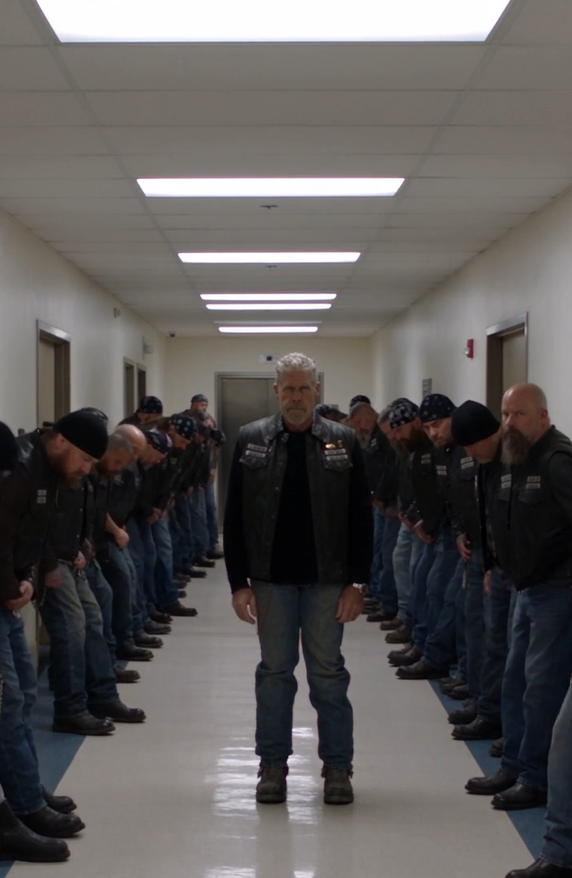
Graves gestured to the hallway. One by one, the riders began to line the walls. They sat on the floor, they leaned against the railings, they stood guard by the elevators. They didn't speak. They didn't check their phones. They simply existed in that space, creating a corridor of protection that the "story" could no longer penetrate.
An hour passed. Then two. The hospital staff, initially terrified, began to realize what was happening. A nurse brought out a tray of water. A young resident whispered to Graves that the girl, Lily, had been asking why it was so quiet outside.
"Tell her the family she didn't know she had is waiting for her," Graves told the nurse.
Finally, the door to Room 412 opened. A social worker stepped out, looking exhausted, followed by a small, frail figure in a hospital gown, her arm in a cast and a dark bruise blooming across her cheek like a cruel flower.
She stopped at the threshold. She saw the hallway. She saw the men with the grey beards and the women with the tattooed arms. She saw the heavy jackets and the silver chains. And for the first time in a long time, she didn't see people she had to hide from. **She saw a shield.**
Lily took a trembling step forward. As she did, every single rider—all ninety-seven of them—slowly took off their caps and bowed their heads. It was a gesture of profound respect, an acknowledgment of her survival.
Graves knelt down so he was at her eye level. He didn't reach out to touch her; he let her choose the distance.
"Lily," he said, his voice as gentle as the desert wind. "No one is going to tell your story for you anymore. You tell the truth. We’ll hold the door."
The girl looked at the men in suits who were still hovering near the elevators, then she looked back at Graves. The silence in the hallway was absolute. It was a silence that demanded an answer.
"He pushed me," she whispered.
It was a small sound, barely a breath, but in that hallway, it echoed like thunder. The men in suits turned pale. The doctor lowered his clipboard. The "story" they had spent days crafting crumbled into dust.
Lily's voice grew stronger. "He pushed me because I wouldn't stay quiet. He said no one would believe a kid like me over a man like him."
Graves smiled, a sad, proud thing. He looked up at the suits, then back to the girl.
"Look around, Lily," Graves said, gesturing to the ninety-seven riders who filled the hall from end to end. "Does it look like you're standing alone?"
Lily looked down the long line of faces—hard faces, scarred faces, faces that had seen the worst of the world but had chosen to remain kind. She saw a woman in the back row wink at her. She saw a man with a "Veteran" patch wipe a tear from his eye.
She didn't cry. Instead, she took a deep breath, her small shoulders squaring for the first time. She walked down the center of that hallway, through the corridor of leather and steel, and as she passed, the riders stood tall, forming a phalanx of silent, unbreakable support.
The authorities were called again. This time, there were ninety-seven witnesses to the truth. This time, the "accident" was recorded as a crime.
As the sun began to set, the riders prepared to leave. The job was done. The truth was out, and the girl was safe in the hands of those who would actually care for her. Graves was the last to go. He stopped by the girl’s room one last time. She was sitting up, eating a bowl of soup, looking out the window at the bikes lined up below.
"Why did you come?" she asked.
Graves put on his leather gloves, the metal studs catching the evening light.
"Because," he said, "someone had to remind the world that the loudest thing in a building shouldn't be the lie. It should be the person telling the truth."
He walked out, his boots clicking on the floor. A few minutes later, the silence of the hospital was broken—not by a scream or a lie, but by the low, rhythmic thrum of ninety-seven engines starting in unison. It was a beautiful, heavy sound. It was the sound of a promise kept.
And as the riders disappeared into the twilight, leaving the hospital behind, the echo of Lily’s voice remained, protected by the memory of ninety-seven strangers who had decided that a single child was worth a three-state ride. They didn't change the whole world that day, but they changed hers—and sometimes, that is exactly the same thing.
Please follow us if you like this story 💞💞💞