The Leash at the Altar
Snow was still falling the night Maren Whitfield chose to lead her mother-in-law into the wedding hall on a black dog leash, and the lanterns above the pine trees lit the path for the man who had come to cut it loose.
Chapter 1 — Lanterns in the Snow
Snow was still falling the night Maren Whitfield chose to lead her mother-in-law into the wedding hall on a black dog leash, and the lanterns above the pine trees lit the path for the man who had come to cut it loose.
He stood at the edge of the driveway until snow gathered along the shoulders of his burgundy velvet blazer.
Beyond the lodge, the forest was a wall of black trunks and white branches.
Ahead, warm light bled through the tall windows, gilding the drifts around the stone entrance.
Music throbbed faintly behind the glass, too polished and cheerful for the weather clawing at the mountainside.
The man’s graying beard was powdered with snow.
His left hand flexed once at his side, the face of his watch catching a lantern’s glow.
Then he started forward.
Deep snow resisted every step.
It packed around his dark trousers and soaked his shoes, but he did not look down.
His eyes stayed fixed on the lodge doors.
Guests moved in silhouettes beyond them: raised glasses, turning shoulders, heads thrown back in celebration.
The sight should have made the building look alive.
Instead, it looked sealed tight, like warmth had become something people inside had to earn.
A burst of laughter reached him through the wind.
It died suddenly.
He passed the first stone pillar, close enough to see ribbons of ice along its base.
Yellow and white flowers had been wired to the porch railings, their petals stiff with cold.
Someone had spent hours making the entrance beautiful.
Someone had decided beauty could stand guard while something ugly happened behind it.
At the doors, he paused.
His reflection stared back from the darkened glass: wet hair, hard mouth, a stranger carrying winter in with him.
For one measured breath, he listened.
The music had stopped.
A woman’s voice, clear despite the thick doors, said, “If she wants dinner, she can wait like the dogs.”
No one answered at first.
The man’s jaw tightened.
He pressed the door open.
Heat struck his face, rich with evergreen boughs, candle wax, roasted food, and too many perfumes.
The reception hall rose around him in dark logs and exposed beams.
Wrought-iron chandeliers hung below the vaulted ceiling, each candle-shaped bulb casting unsteady light across formal clothes and stunned faces.
Stone pillars divided the room.
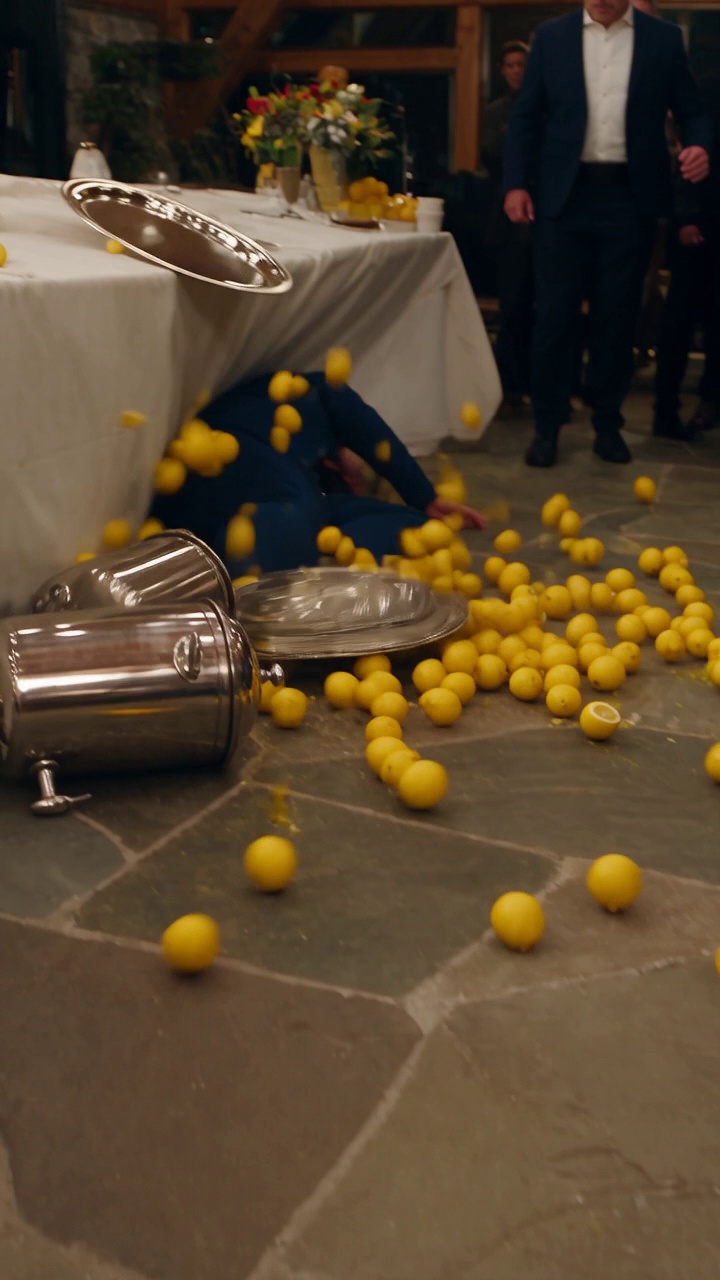
Along one wall, white linen covered catering tables crowded with silver urns, floral arrangements, and a glass bowl piled high with yellow lemons.
Nobody looked at the food.
The first guest to notice him was a mustached man in a dark tuxedo and bow tie.
Concern tightened his face, then sharpened into alarm.
His gaze moved from the newcomer’s wet blazer to the space at the center of the hall.
The man followed it.
Maren Whitfield stood in white beneath the chandeliers, her red hair pulled into a high ponytail that showed every hard line of her expression.
Her fitted square-neck gown and diamond necklace made her seem almost painfully bright against the timbered room.
One hand was raised, her white sleeve stark against the shadows.
The other rested near her hip with the casual certainty of somebody used to being obeyed.
Beside her, the younger man in the navy suit wore an unbuttoned black shirt and a careless half-smile.
He looked as though the stopped music were an inconvenience, not a warning.
Around them, guests in blue and burgundy gowns, tuxedos, and pearls had arranged themselves in a loose, horrified circle without seeming to realize they had done it.
At the circle’s edge stood a light-haired girl in a cream cardigan over a pink dress.
Her hands were balled beneath her chin.
She was staring past Maren, not at the newcomer.
“Dad,” she cried.
The word cracked through the hall.
The man did not move toward her.
Not yet.
His attention had already found the elderly woman near the center of the floor.
Her white-silver hair was pinned in a careful updo.
A deep teal V-neck dress fell around her slight frame, elegant despite the way her shoulders had folded inward.
Pearls circled her throat, ending in a small gold pendant that trembled with every shallow breath.
She was upright for the moment, but not steady.
Her eyes were lowered as if the stone floor had become safer to study than the people watching her.
“Dad,” the girl said again, louder now.
“They’ve been starving Grandma for five days.”
The younger man’s smile flickered.
Maren did not look at the girl.
Her gaze remained trained on the older woman with icy patience.
“She eats last,” Maren said.
“Whatever’s left.”
The air seemed to leave the room all at once.
A woman in a burgundy gown covered her mouth.
The tuxedoed man took one uncertain step forward, then stopped.
No one contradicted Maren.
No one touched the elderly woman.
The chandeliers hummed above the silence.
The man at the door felt something cold settle beneath his ribs, colder than the snow melting through his collar.
He had crossed the driveway expecting cruelty.
He had not expected an audience willing to stand still for it.
The elderly woman finally lifted her face.
Her eyes traveled over the crowd, passed the girl, and found him at the entrance.
Recognition moved through her expression so quickly that it might have been pain.
Maren saw it too.
For the first time, her control slipped.
Her gaze snapped toward the doors, landing on the snow-drenched man in the burgundy blazer.
The room watched them look at each other.
The groom’s half-smile vanished.
The girl drew a breath that sounded almost like relief.
Then the man pushed the lodge door wide behind him, letting a blade of snow-filled wind cut across the polished stone floor, and stepped inside.