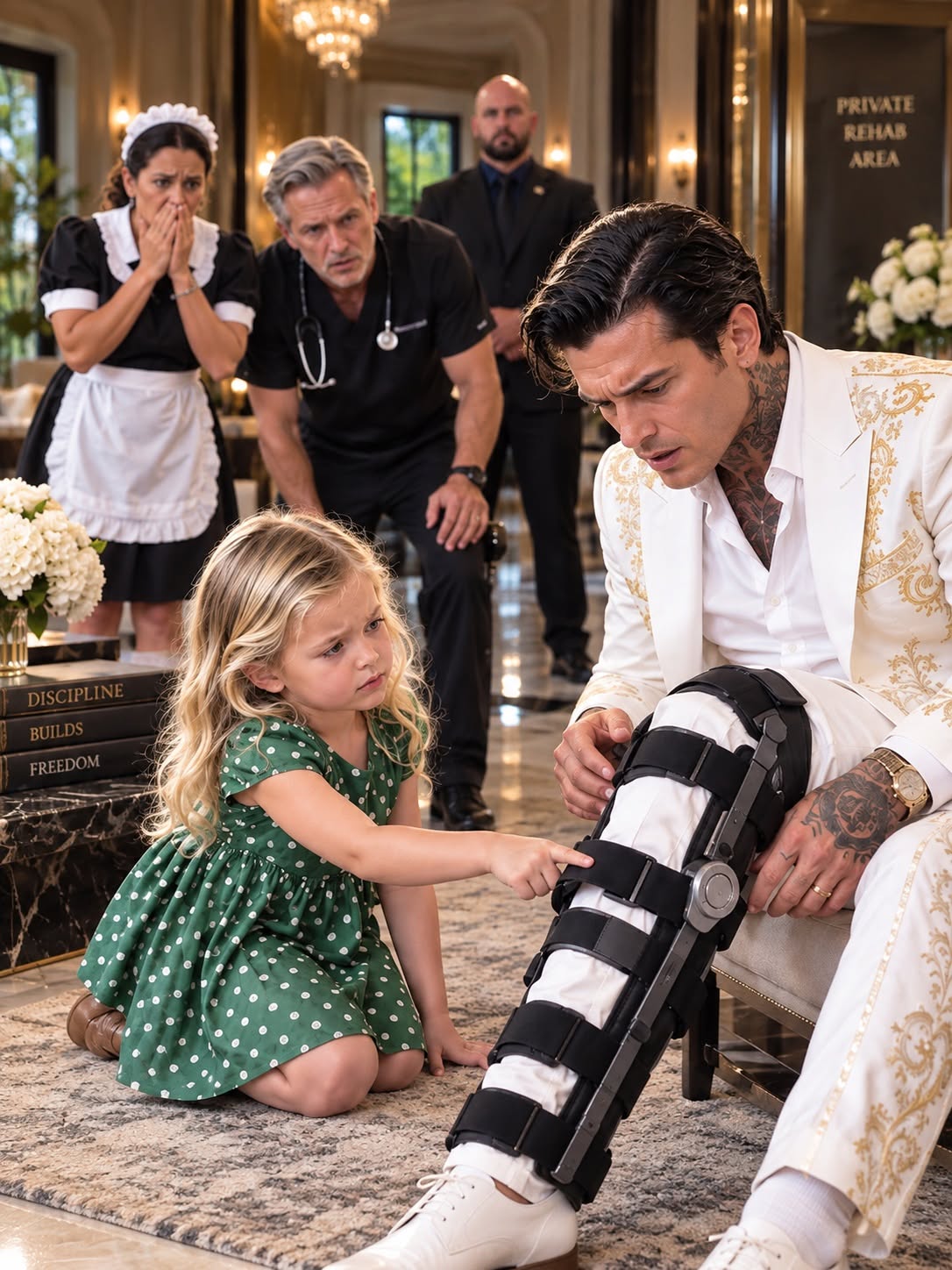
Chapter 01 - The Lock That Faced the Wrong Way
My daughter was supposed to stay in the kitchen with Mrs. Alvarez and a plate of butter cookies.
That was the arrangement. I cleaned the private rehabilitation wing of Dominic Romano’s penthouse, Ellie stayed where the staff could see her, and by midnight we would both be back in our tiny apartment above the laundromat, pretending this was an ordinary job in an ordinary house.
But nothing about Dominic Romano’s house was ordinary.
It had white marble floors that swallowed footsteps. It had guards at the elevator and cameras hidden behind antique mirrors. It had a rehabilitation room brighter than most hospitals, with chrome bars, leather therapy benches, and an entire wall of locked cabinets filled with equipment I was not allowed to touch.
And in the center of that room sat Dominic himself.
He wore a white suit that would have looked theatrical on another man. On him, it looked like armor. His right leg was strapped into a heavy black orthopedic brace from thigh to ankle, the metal hinges thick as knife handles. His hand rested on the arm of his chair. Gold watch. Scarred knuckles. Tattoos peeking past his cuffs.
Even seated, he made the room feel smaller.
Dr. Harris stood beside him, gray-haired and smooth-voiced, reviewing rehabilitation notes as if he were reading the weather. Two guards waited near the door. I kept my head down, a spray bottle in one hand, a cloth in the other, because women like me survived in houses like this by becoming part of the furniture.
Then I saw Ellie.
She was kneeling right beside Dominic Romano’s injured leg.
For one second, I could not move. My six-year-old daughter in her green polka-dot dress was close enough to touch the man everyone in Chicago whispered about but never named too loudly. Close enough to his brace. Close enough to his temper. Close enough to be hurt by a world she did not understand.
“Ellie.”
Her name came out too soft to save her.
One guard reached beneath his jacket. Dr. Harris snapped, “Sweetheart, step away from him.”
Ellie did not even look up. She pointed one small finger toward the outside hinge of Dominic’s brace.
“That piece is backwards.”
The room went still.
Dominic lowered his eyes to her, not angry yet. That was somehow worse. His gaze had the patience of a closed door.
“What did you say?”
Ellie leaned closer, studying the metal without touching him. She had always noticed small things. Screws turned the wrong way. Cabinet doors that did not sit level. The tiny cough in our old refrigerator before it finally died. Her father had been a mechanic, and sometimes I saw him in her hands more than in her face.
“That lock,” she said. “It’s facing the wrong way. If you stand up, it can open.”
Dr. Harris laughed once, but there was no humor in it.
“It’s probably just an adjustment error.”
Ellie shook her head.
“No. Someone turned both pins around.”
That was when Dominic looked at the doctor.
It was a small movement. A shift of his eyes. Nothing more. But Dr. Harris’s face changed as if a light had gone out behind it.
I rushed forward and put one hand on Ellie’s shoulder.
“I am so sorry, Mr. Romano. She loves machines. She doesn’t understand boundaries.”
Dominic’s attention moved from the doctor to me.
For a terrible moment, I thought he would blame us. Fire us. Throw us out before payday. I thought of the rent folded in an envelope at home, still short by sixty-three dollars. I thought of Ellie needing new shoes. I thought of how easily one rich man’s irritation could become our entire disaster.
Then Dominic lifted his hand.
“Do not touch the child.”
The guard who had started forward stopped instantly.
Dr. Harris cleared his throat. “Mr. Romano, this is unnecessary. The brace was checked this morning.”
“By you.”
“Yes.”
“And she found what you missed.”
The doctor’s mouth tightened.
Dominic leaned down, ignoring the pain that crossed his face like a shadow. He studied the hinge. The locking pin did look odd to me now, though I knew nothing about braces. The latch faced outward at a strange angle, as if it were waiting for a twist from the wrong direction.
Ellie looked up at him.
“If you stood fast,” she said, “it would come apart. Like my scooter did when the handle bolt was loose.”
Dominic’s jaw hardened.
He did not shout. He did not demand. He simply pressed two fingers to the arm of his chair and said, “Lock the doors.”
One guard obeyed without hesitation.
Dr. Harris stepped back.
“Mr. Romano—”
“Nobody leaves.”
The lock clicked.
Ellie slipped her hand into mine, finally sensing that the air had changed. I squeezed her fingers, trying to tell her with pressure alone not to speak again, not to look scared, not to give this house any more reason to notice us.
But Dominic had already noticed.
He looked at my daughter as if she had not interrupted his rehabilitation at all.
As if she had just saved his life.
Then he looked at me and asked the question that would pull both of us into the center of his dangerous world.
“Who taught your little girl how to read a locking mechanism?”
And for the first time in five years, I had to say my dead husband’s name out loud.