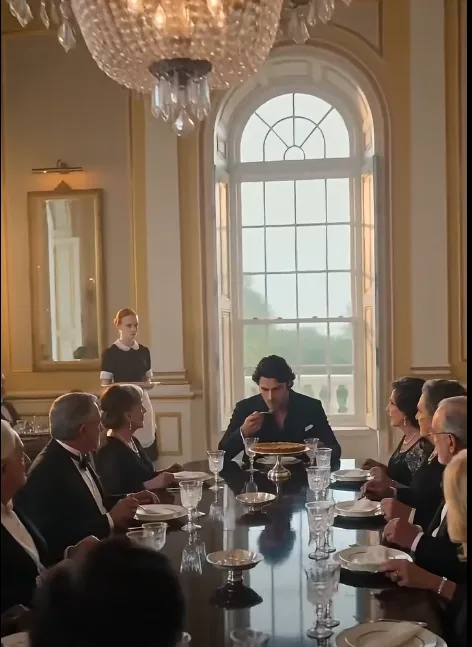
At a winter dinner in New Orleans, feared family boss Carmine Orsini tastes a pecan pie made by the quiet maid everyone else ignores—and immediately realizes she knows far more about baking than she should. His curiosity turns into suspicion when he discovers that “Nell Brisco” is not her real name, and that three years earlier, the woman behind that name lost her family bakery in a fire officially ruled accidental. But one detail refuses to fit: the investigator who signed off on the case vanished, and money appeared in his wife’s account days before he disappeared. As Carmine pulls at the buried thread, he realizes Nell has been hiding not only from the past, but from someone who may still be watching the house.
The dining room had emptied by half past ten, but Carmine Orsini remained at the long walnut table, staring at a clean dessert plate.
One fork lay across the porcelain.
A few crumbs of pecan crust clung to the edge.
That was all.
Yet Carmine had spent twenty minutes thinking about a piece of pie.
Outside, rain whispered against the tall windows of the New Orleans house, turning the garden lights into blurred halos. The old mansion had survived hurricanes, family feuds, police raids, political favors, and three generations of Orsini secrets. Carmine had inherited all of it at thirty-three, including the instinct to distrust anything that seemed harmless.
Especially anything that made him forget to be suspicious.
He lifted his eyes toward the doorway.
Nell stood there with a tray balanced against one hip.
She had been working in the house for almost a year. Carmine knew that because he knew the schedules of everyone who entered his property. He knew which cook bought groceries on Thursdays, which gardener smoked behind the carriage house, which security guard had a gambling problem.
But until tonight, he could not have described Nell's voice.
He had barely noticed her.
That was precisely what made him notice her now.
“Nell.”
She stopped.
“Yes, sir?”
“Who made the pie?”
Her fingers tightened slightly around the tray.
“I did.”
Carmine looked down at the plate again.
“You made it?”
“Yes.”
“You're a maid.”
A pause.
“I know.”
The answer was so calm that one corner of his mouth almost moved.
“I didn't mean that as an insult.”
“I didn't take it as one.”
Rain tapped softly against the glass.
Carmine leaned back.
“Where did you learn to bake?”
“My mother.”
“Your mother owned a bakery?”
Nell's expression changed.
Barely.
A fraction of a second.
Most people would have missed it.
Carmine did not.
“No,” she said.
He let the silence stretch.
She lowered her eyes to the tray.
“Is there anything else, sir?”
“Yes.”
Her gaze returned to him.
“Why did you lie?”
The room seemed to shrink.
Nell's face went pale, but she did not step backward.
“I didn't.”
“You did.”
“I told you my mother taught me.”
“You told me she wasn't a baker. That's different.”
For the first time, fear appeared in her eyes.
Not fear of Carmine.
Fear of being recognized.
That distinction mattered.
He had spent years learning the difference between a person afraid of punishment and a person afraid of the truth.
Nell was afraid of the truth.
“Go upstairs,” Carmine said.
She blinked.
“Sir?”
“Go.”
She turned and left.
Carmine waited until the door closed.
Then he picked up his phone.
“Find out everything about Nell Brisco.”
His security chief, Marco, answered immediately.
“Everything?”
“Everything.”
“And if there isn't much?”
Carmine looked again at the crumbs on the plate.
“There will be.”
By morning, there was a folder on his desk.
It was thin.
Too thin.
Nell Brisco, twenty-seven. No criminal record. No outstanding debts. No known relatives in New Orleans. Previous employment consisted of housekeeping positions, restaurant work, and six months at a hotel on Canal Street.
Her current identity appeared perfectly ordinary.
Perfectly clean.
Carmine turned the first page.
Then the second.
Then stopped.
A photograph had been clipped to the back.
A young woman stood outside a bakery beneath a striped awning.
She was smiling.
Same eyes.
Same narrow chin.
Same small scar near her eyebrow.
But her name beneath the photograph wasn't Nell Brisco.
It was Eleanor Fontaine.
Carmine read the report twice.
Three years earlier, Fontaine Bakery had burned down shortly after midnight.
The owner, Emmett Fontaine, had survived but suffered severe smoke inhalation and neurological damage. He had been unable to return to work and eventually moved into long-term care.
His daughter, Eleanor, had disappeared from New Orleans soon afterward.
The official cause of the fire had been listed as accidental.
Carmine stared at the photograph.
Then he looked toward the rain-dark windows.
“Nell,” he murmured.
He wondered why someone who had escaped a tragedy would walk willingly into a house like his.
The answer came that afternoon.
He found her in the kitchen.
She was standing beside the counter, sorting silverware while Mrs. Alvarez, the head housekeeper, complained about a broken cabinet hinge.
Nell looked up when Carmine entered.
Their eyes met.
She knew.
Of course she knew.
“You found me,” she said quietly.
Mrs. Alvarez glanced between them.
Carmine nodded toward the doorway.
“Give us a minute.”
When the kitchen emptied, Nell placed the silverware down.
“You should have told me,” Carmine said.
“You wouldn't have hired me.”
“That isn't true.”
“It is.”
“Why?”
She folded her hands together.
“My father was sick. I needed money.”
“That doesn't explain the name.”
“No.”
“Then explain it.”
Nell swallowed.
“My real name disappeared with everything else.”
Carmine said nothing.
She looked toward the window over the sink.
“My father owned Fontaine Bakery. My mother died when I was sixteen. After that, it was just the two of us. The bakery was our whole life.”
Her voice remained steady, but her hands did not.
“Three years ago, it burned.”
“I know.”
“You know the official report.”
“I know more than that.”
She looked at him.
Carmine placed the folder on the counter.
Nell didn't touch it.
“The fire started in the kitchen,” he said. “The report says the rear exit couldn't be opened because the frame had swollen from heat.”
Nell's face changed.
“It wasn't swollen.”
Carmine waited.
“I tried it.”
Her voice had dropped to almost a whisper.
“It wouldn't move.”
“Why?”
“I don't know.”
“Did your father?”
She shook her head.
“He kept saying someone had locked it.”
Carmine watched her carefully.
“Did you believe him?”
“I do now.”
Silence settled between them.
“Why didn't you tell the police?”
“I did.”
“And?”
“They said I was confused. I was twenty-four. My father was unconscious in the hospital. The bakery was gone. Everyone wanted the simplest explanation.”
She finally opened the folder.
Her eyes moved across the pages.
Then stopped.
“The investigator.”
“What about him?”
“He came to the bakery the week before the fire.”
Carmine's gaze sharpened.
“Why?”
“I don't know. He said he was checking an insurance complaint.”
“Did you know his name?”
She nodded.
“Daniel Mercer.”
Carmine already knew.
“Mercer disappeared six months after the fire.”
Nell looked up sharply.
“You knew?”
“I know now.”
She stared at him.
Carmine slid another document across the counter.