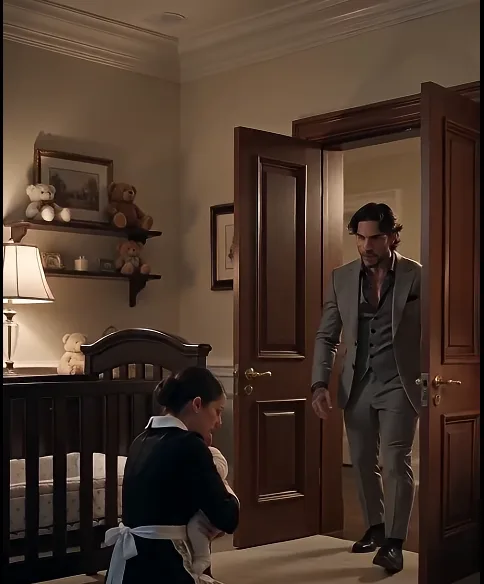
At 2:04 a.m., Alessio Romano held a loaded pistol to the nanny’s head while she fought to save his choking four-month-old son. She had only seconds to choose between obeying a man feared across Chicago and risking the life of the child in her arms. When the baby finally cried, a single blue bead found on the nursery floor transformed the emergency into something far more sinister: someone inside Alessio’s house had deliberately turned his son’s nursery into a crime scene. And somewhere behind the polished walls, one hidden camera was waiting to reveal which trusted member of the Romano household had betrayed them all.
Rain rattled the nursery windows at 2:04 in the morning, hard enough to make the old glass tremble in its frames.
I remember the exact time because I had been staring at the clock for what felt like an hour, though only six minutes had passed since Leo stopped breathing.
Six minutes was an eternity when you were holding a baby whose lips had turned blue.
Four months old.
Nine pounds of fragile life beneath my hands.
His name was Leo Romano.
And his father was pointing a gun at my head.
“Get away from him.”
Alessio Romano stood three feet from me, soaked from the rain, his white shirt open at the throat and the sleeves rolled above his forearms. His hair was damp and disordered, nothing like the immaculate man I had seen at dinner every evening for the past three months.
I could smell wet cedar on his skin.
Gun oil.
And the faint trace of Scotch.
The pistol in his right hand was steady.
His hand wasn't.
I didn't look at the gun again.
I couldn't afford to.
My left hand supported Leo's jaw. My right held a narrow pair of blunt forceps. The penlight between my teeth illuminated the inside of his mouth.
There.
Something blue.
Small.
Hard.
Wedged deep enough that my fingers couldn't reach it.
“Shoot me,” I whispered, “and he dies.”
Alessio's eyes hardened.
“You have no idea who you're talking to.”
“I know exactly who I'm talking to.”
I shifted the forceps a fraction.
“A father whose son can't breathe.”
The barrel touched my temple.
Leo's body had stopped fighting.
That frightened me more than the choking.
“Five seconds,” I said.
Alessio's jaw tightened.
“Four.”
I angled the forceps.
“Three.”
The blue object moved.
“Two.”
My heart hammered so violently that I could hear it.
“One.”
I closed the tips.
Pulled.
The object came free with a tiny metallic click and landed on the Persian rug.
A blue enamel bead.
For half a second, the room became silent.
Then Leo made a sound.
Not a cry.
A desperate little gasp.
I turned him onto his side and rubbed firmly between his shoulder blades.
“Come on, sweetheart.”
Nothing.
I tried again.
“Come on.”
His chest moved.
A ragged breath escaped.
Then another.
And suddenly the nursery exploded with the furious, beautiful sound of a baby crying.
I closed my eyes.
My knees nearly gave out.
Leo's face slowly regained its color against my shoulder.
I held him tighter, feeling his tiny heartbeat against my collarbone.
“You're okay,” I whispered. “You're okay. I've got you.”
Across the room, Alessio still held the gun.
He stared at his son.
Then at me.
Then at the bead.
Only after several seconds did he lower the weapon.
He placed it on the changing table with exaggerated care.
I noticed that.
Men who lived around violence learned to respect the weight of dangerous things.
Alessio came toward me.
“Give him to me.”
“No.”
His eyebrows lifted.
I heard my own voice and realized how reckless the answer sounded.
“He needs to stay upright,” I said. “His airway may swell. He needs emergency evaluation.”
“I have a doctor.”
“Then call him.”
“No police.”
“Call an ambulance.”
“No public hospital.”
I stared at him.
Rain streamed down the windows behind his shoulders.
“He was without oxygen,” I said quietly. “If protecting your secrets matters more than protecting your son's brain, take him yourself.”
Something changed in his face.
For the first time since he entered the room, the terrifying man disappeared.
There was only a father.
He reached for his phone.
“Dominic.”
Someone answered immediately.
“Boss?”
“Call Lake Forest emergency services. Pediatric airway obstruction. Open the gate. Send Dr. Rossi behind them.”
A pause.
“An ambulance?”
“Now.”
He ended the call.
I looked at the bead.
Something about it bothered me.
The pacifier clip sat on the dresser.
Pale wood.
Silver clasp.
Blue enamel decorations.
At first glance, the beads looked identical.
But they weren't.
I found an unused breast-milk storage bag, turned it inside out over my hand, and carefully picked up the bead without touching it.
Alessio watched.
“What are you doing?”
“Preserving evidence.”
His eyes narrowed.
“Evidence of what?”
I held the bag up.
“I don't know yet.”
He walked to the dresser and picked up the pacifier clip.
“Then where did that come from?”
I pointed toward Leo's crib.
“I checked the nursery at 1:58.”
“You were alone?”
“Yes.”
“Why?”
“Because Leo had finally fallen asleep.”
“And?”
“And there was nothing loose in the crib.”
I looked at the bead.
“This wasn't there.”
Alessio's gaze moved to the crib.
Then to the camera mounted above the nursery door.
A small green light blinked beneath the lens.
I stared at it.
The light blinked again.
A cold sensation moved down my back.
“Lock the room.”
Alessio looked at me.
“Why?”
“Because someone may have put that bead in his mouth.”
He didn't move.
I continued.
“Don't let anyone touch anything.”
His expression hardened.
“This is my house.”
“And that's your son's potential murder scene.”
The silence that followed was different from the silence before.
It wasn't fear.
It was recognition.
Someone had crossed a line.
Alessio walked to the door and locked it.
The brass mechanism clicked.
That was the first time Alessio Romano obeyed me.
It would not be the last.
The ambulance arrived twelve minutes later.
By then, Leo had been examined by Dr. Rossi and the paramedics. His breathing remained strained, but stable. The doctor insisted on taking him to the hospital.
Alessio went with his son.
I stayed behind.
I told myself it was because someone needed to protect the nursery.
The truth was simpler.
I was afraid.
Not of Alessio.
Not anymore.
I was afraid of what the evidence might say.
Because I had spent three months inside the Romano house.
I knew every employee.
Every security guard.
Every housekeeper.
Every member of Alessio's extended family who wandered through the place as though they owned pieces of it.
And one of them had been close enough to enter Leo's nursery while I was only twenty feet away.
At 3:17 a.m., Alessio returned.
He entered alone.
His face looked carved from stone.
“How is he?”
“Stable.”
The breath left me.
I hadn't realized I'd been holding it.
Alessio noticed.
“He's going to be okay.”
I nodded.
Neither of us said anything for a moment.
Then he asked, “Why did you know what to do?”
I looked at him.
“What?”
“With Leo.”
I folded my arms.
“I was a pediatric nurse before I became a nanny.”