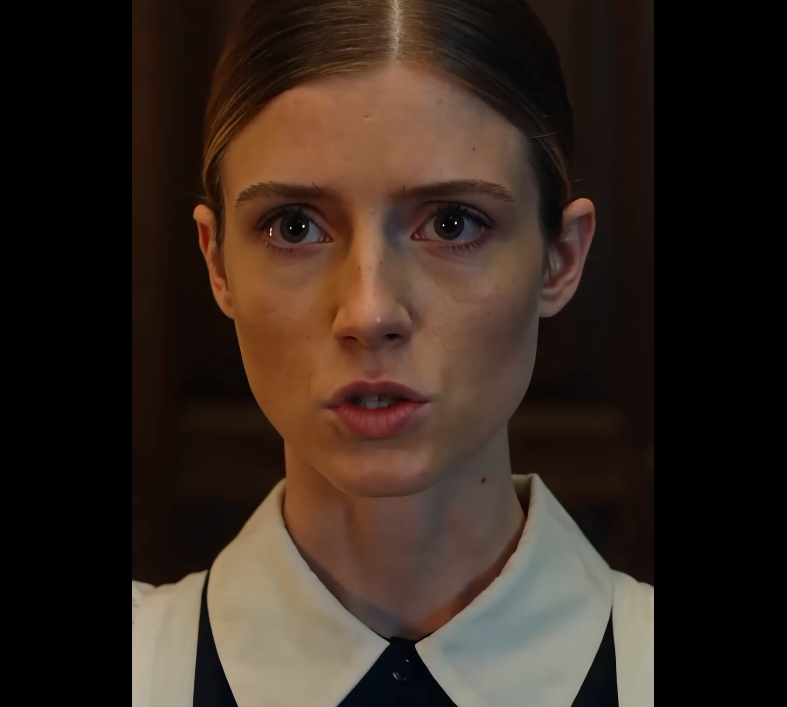
Thomas looked away.
Richard slammed his palm against the table.
“Did you know my daughter was alive?”
Thomas said nothing.
“DID YOU KNOW?”
At last, Thomas whispered, “Yes.”
Richard stared at him as if he were looking at a stranger.
Thomas began to explain that he had feared the baby would change Richard’s priorities, divide the family’s assets, and weaken his influence over the company. He claimed he had acted to preserve the business and had believed Margaret would keep the child safe.
None of it changed what he had done.
“You let me bury an empty future,” Richard said, tears shining in his eyes. “You watched me visit a grave, year after year, believing my little girl was beneath it.”
Thomas reached toward him.
“Richard—”
“Don’t.”
The word was quiet, but it ended the conversation.
Richard contacted his attorneys and the authorities. The old records, Margaret’s letters, and the hospital administrator’s testimony would be examined properly.
Thomas would have to answer for his actions.
But no court could return the years he had stolen.
And no punishment could bring Elizabeth back.
That evening, Emily found Richard sitting alone in the garden.
He was holding the first letter she had shown him.
“I keep thinking about her,” he said when Emily approached. “I keep wondering what she went through after she left the hospital. Whether she cried when she had to give you away. Whether she thought I had stopped loving her.”
Emily sat beside him.
“Mama told me she cried every birthday.”
Richard pressed the letter to his chest.
“She was alive, and I wasn’t there.”
Emily took a shaky breath.
“She told me something else. She said my real father wasn’t a bad man. She said he was a good man who had been made to believe the worst thing in the world.”
Richard covered his face.
“I should have fought harder.”
“You did fight,” Emily whispered. “You just didn’t know who you were fighting for.”
He looked at her, and the tears finally came.
“I missed your first steps. Your first words. Your first day of school. I wasn’t there when you were frightened or when you needed someone to tell you everything would be all right.”
Emily began to cry too.
“I needed you.”
Richard bowed his head.
“I know.”
For a long moment, neither of them spoke.
Then Emily reached into her pocket and took out a tiny, faded photograph.
It showed a little girl sitting on an old wooden bench, smiling with two missing front teeth. Beside her sat Margaret, her arms wrapped protectively around the child.
On the back, in Margaret’s handwriting, were the words:
For my little girl. You were never unwanted. You were loved by more people than you will ever know.
Emily placed the photograph in Richard’s hand.
“She wasn’t my birth mother,” Emily whispered. “But she was my mother in every way that mattered.”
Richard looked at the picture.
“Then she was a wonderful woman.”
“She was.”
He carefully returned the photograph to Emily.
“And I owe her everything.”
Emily leaned against his shoulder.
For the first time in twenty years, Richard did not feel alone in his grief.
He felt it beside someone who understood what it meant to lose a mother, to grow up with unanswered questions, and to carry love for a family she had never known.
The following morning, Richard made a decision.
He would not ask Emily to abandon the life she had built. He would not demand that she call him Father, move into his mansion, or forgive him before she was ready.
Instead, he asked her a simple question.
“Would you have breakfast with me tomorrow?”
Emily smiled through her tears.
“Only if you promise not to shout at the maid.”
Richard laughed.
It was the first real laugh that had filled the mansion in twenty years.
“I promise.”
Then Emily hesitated.
“There’s one more thing, sir.”
Richard looked at her.
“Mama’s birthday is next week. I always visited her grave alone.”
Her voice broke.
“I don’t want to go alone this year.”
Richard reached for her hand.
“Neither of us will.”
A week later, Richard and Emily stood before Margaret’s grave beneath a clear blue sky.
Richard had brought white roses. Emily had brought the little photograph of herself and the woman who had raised her.
For a while, Richard simply stood there, struggling to find words.
Then he knelt beside the headstone.
“Margaret,” he whispered, “thank you for keeping my daughter alive. Thank you for feeding her, protecting her, and loving her when I couldn’t.”
His voice cracked.
“I cannot give you back the years you spent without help. But I promise you this: she will never have to wonder whether she belongs again.”
Emily knelt beside him.
She placed the photograph against the headstone and brushed a fallen leaf from the stone’s surface.
“Mama,” she whispered, “I found him.”
She looked at Richard and took his hand.
“And I think you would have liked him.”
Richard broke down.
Emily wrapped her arms around him, and the billionaire who had once believed that money could solve every problem cried like a man who had finally understood how little money could do.
Later that afternoon, they returned to the mansion.
Emily stopped in the hallway before Elizabeth’s portrait.
For twenty years, Richard had walked past it without allowing himself to speak to the woman he had lost.
This time, he stood beside his daughter.
“She would have loved you,” he said.
Emily studied the portrait.
“Do you think she knew we’d find each other?”
Richard considered the question.
“I think she hoped we would.”
Emily took his hand.
“Then let’s make sure she wasn’t hoping for nothing.”
That evening, Richard opened the curtains in Elizabeth’s old bedroom for the first time in twenty years. Sunlight poured across the furniture, illuminating the photographs and the little wooden box that had held the truth.
He placed Emily’s childhood photograph beside Elizabeth’s portrait.
Two generations of love, separated by a terrible lie, finally stood together.
And for the first time since his wife had died, Richard felt that his home was no longer a museum of everything he had lost.
It was a place where something beautiful could begin.
As they sat down to dinner, Emily noticed an empty chair at the table.
“Who used to sit there?” she asked.
Richard glanced at it.
“Your mother.”
Emily was quiet for a moment.
“Then maybe we should leave it empty tonight.”
Richard nodded.
They ate together, telling stories about Elizabeth and Margaret, laughing through tears and discovering the little things that connected their lives.
Before going to bed, Emily returned to the dining room.
She placed a single white rose beside Elizabeth’s photograph.
Then she whispered, “I made it home, Mama.”
From the doorway, Richard heard her.
He did not interrupt.
He simply stood there, with tears in his eyes, listening to the words his wife had waited twenty years for their daughter to say.
And somewhere between the photograph, the rose, and the quiet warmth of a home that was no longer empty, Richard finally understood the truth Elizabeth had tried to leave behind.
A child does not need a perfect family. A child needs someone who refuses to stop loving them.
Emily had been loved by a woman who gave up everything to protect her.
Richard had been loved by a woman who had trusted him to find their daughter.
And although neither of them could recover the years they had lost, they could choose what happened to the years that remained.
For the first time in two decades, Richard went to sleep without visiting Elizabeth’s grave in his dreams.
Because the little girl he had mourned was alive.
She was home.
And when Emily called him Dad for the first time the following morning, he closed his eyes and held her hand as if the world had finally given him back the one thing he had never stopped searching for.
Not his fortune.
Not his power.
Not even his past.
His daughter.