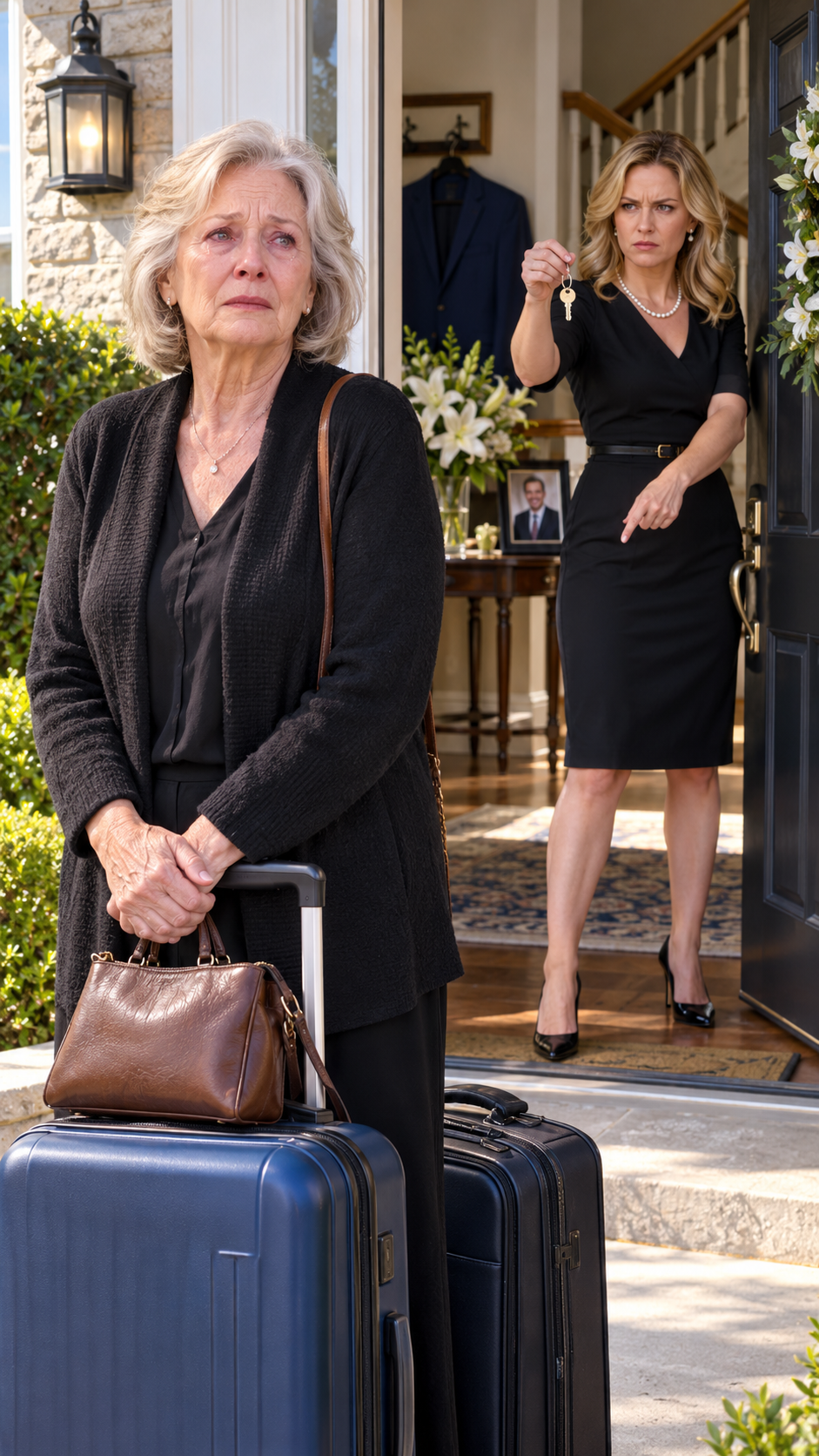
Almost a year passed before I saw Victoria again.
Not in person.
In a photograph attached to a legal document David left on the kitchen counter.
I didn’t read it.
I didn’t need to.
By then, her chapter in our house was over.
The divorce had taken months.
David rarely discussed it.
When he did, he kept the details away from Lily.
That seemed right.
Whatever Victoria had done, Lily did not need to spend childhood carrying adult bitterness.
The rings remained in the safe.
The photographs returned to the shelves.
Emily’s silver hairbrush was gone forever, but David found another one in an old travel case.
Lily placed it on her dresser.
The porcelain box had been repaired.
A thin gold line now traced the crack.
Lily loved it more that way.
“It looks like lightning,” she said.
I thought it looked like survival.
The house changed too.
Not physically.
The furniture stayed mostly the same.
The walls were still cream.
The staircase still curved beneath the chandelier.
The kitchen still seemed too large whenever only one person was inside.
But rooms remember the way people behave in them.
For months after Victoria left, I would still tense when I heard footsteps behind me.
Lily sometimes lowered her voice without realizing it.
David sometimes looked toward the front door when arriving home, as though expecting conflict.
Then slowly, those habits faded.
One Friday evening, David came home early.
I was in the kitchen making soup.
Lily was doing homework.
David walked in carrying a small wooden box.
“What’s that?” Lily asked.
“A surprise.”
“For me?”
“Eventually.”
She narrowed her eyes.
“Eventually surprises are boring.”
I laughed.
David set the box on the table.
“Come here.”
Lily abandoned her homework.
Inside the wooden box was Emily’s ring case.
The same dark blue velvet.
The same two diamond rings.
Lily looked at her father.
“I thought they stayed in the safe.”
“They did.”
“Then why are they here?”
“Because I want to tell you something.”
I turned toward the stove.
David looked at me.
“Sarah, stay.”
I hesitated.
“This is family.”
He gave me a small smile.
“Yes.”
The word stopped me.
I remained beside the counter.
David sat across from Lily.
“These belonged to your mother.”
“I know.”
“She wore this one when we got married.”
He touched the wedding ring.
“And this one?”
“I gave her this after you were born.”
“Why?”
“Because I was very happy.”
Lily smiled.
“Because of me?”
“Mostly.”
“Mostly?”
“Well, your mother did some work too.”
Lily laughed.
I shook my head.
David lifted the anniversary ring.
“Your mom cried when I gave her this.”
“Happy cry?”
“Very happy cry.”
Lily touched the ring.
“Why are you showing me now?”
David’s expression grew serious.
“Because I put these away after she died.”
“I know.”
“I told myself I was protecting them.”
Lily listened.
“But really, I was avoiding them because they reminded me of something painful.”
“Mommy?”
“Yes.”
He paused.
“And because I avoided that pain, I also avoided things I should have paid attention to.”
Lily looked down.
David reached for her hand.
“I need you to know something. What happened with Victoria was not because you did anything wrong.”
“I know.”
“Do you?”
She nodded.
Then hesitated.
“Mostly.”
David squeezed her hand.
“If an adult ever makes you afraid to tell me something, tell me anyway.”
“What if they say you’ll be mad?”
“Tell me.”
“What if they say you won’t believe me?”
“Tell me.”
“What if I did something bad too?”
“Tell me.”
Lily considered that.
Then looked at me.
“What if Sarah says not to tell?”
I raised my eyebrows.
David smiled.
“Tell me.”
“Hey.”
Lily giggled.
The sound filled the kitchen.
I realized how much I had missed hearing her laugh without checking who might hear.
David closed the ring box.
“These will be yours one day.”
“When?”
“When you’re old enough.”
“How old?”
“Older than six.”
“I’m seven.”
“Still older.”
“Ten?”
“No.”
“Eleven?”
“No.”
“Twenty?”
“Maybe.”
“That’s forever.”
David smiled.
“It comes faster than you think.”
Lily returned to her homework, dramatically disappointed by adulthood being so far away.
David carried the box toward the basement.
I stirred the soup.
When he returned, he stood beside me.
“Thank you.”
I sighed.
“We’ve discussed this.”
“I know.”
“You don’t have to keep thanking me.”
“I’m not thanking you for Victoria.”
I looked at him.
“What then?”
“For staying.”
I lowered the spoon.
“David…”
“After Emily died.”
His voice softened.
“I disappeared.”
“You were grieving.”
“That explains it. It doesn’t erase it.”
“No.”
“You kept this place together.”
“I had help.”
“Still.”
He looked at Lily.
“You kept her connected to her mother without making her live in the past.”
I swallowed.
“I tried.”
“And when I was too blind to see what was happening, you stood in front of her.”
I looked away.
“I was holding a stick in your living room. It wasn’t exactly graceful.”
David laughed.
“No.”
I laughed too.
Then he became serious.
“I’ve thought about that day a lot.”
“So have I.”
“I walked into this house and saw you holding that thing.”
I nodded.
“For about two seconds, I thought you had lost your mind.”
“I probably looked like I had.”
“Then Lily ran to me.”
His smile disappeared.
“She said, ‘Daddy, please help us.’”
I remembered.
So did he.
“That word,” David said.
“Us.”
He nodded.
“I knew something was wrong.”
“You still checked the safe.”
“I needed proof.”
“I understand.”
“I wish I hadn’t.”
That surprised me.
“Why?”
“Because my daughter’s fear should have been enough for me to stop everything and listen.”
I thought carefully before answering.
“David, adults need facts.”
“Parents need instincts.”
“Both can be true.”
He considered that.
Then nodded.
“Maybe.”
We stood quietly.
Across the kitchen, Lily erased something furiously.
“This math is stupid.”
David raised an eyebrow.
“Language.”
“Math language?”
“All language.”
She groaned.
I smiled.
Normal problems.
What a gift they were.
That summer, David took fewer trips.
We spent a week at the lake house the family had not visited since Emily became ill.
The first night there, Lily asked if her mother had slept in the same room.
David said yes.
Lily asked if that made him sad.
He said yes.
Then he stayed in the room anyway.
That was how healing happened.
Not by removing every reminder of pain.
By learning you could stand beside the reminder without being destroyed by it.
One evening, Lily and I sat on the dock.
She dangled her feet above the water.
“Sarah?”
“Yes?”
“When I grow up, are you still going to work for us?”
I laughed.
“Depends how fast you grow.”
“I’m serious.”
“So am I. I might be very old.”
“You’re already old.”
I stared at her.
She burst out laughing.
“You are terrible.”
“No, I’m seven.”
“Apparently those are the same thing.”
She leaned against my arm.
Then her voice became quiet.
“I remember that day.”
I knew which one she meant.
“Sometimes I do too.”
“I thought Victoria was going to make you leave.”
“So did I.”
“I thought if you left, no one would believe me.”
My chest tightened.
I wrapped my arm around her.
“I’m sorry you ever felt that way.”
“She said Daddy would send me away when he had a new baby.”
I went still.
That was something Lily had never told me.
I chose my words carefully.
“She lied.”
“I know now.”
“Your father would never send you away.”
“I know.”
She looked over the lake.
“I hated her.”
Children say things adults soften.
I didn’t correct her.
“You were hurt.”
“I still hate her sometimes.”
“That feeling may change.”
“What if it doesn’t?”
“Then you still get to decide what kind of person you become.”
She looked at me.
“What does that mean?”
“It means someone can hurt you without getting to choose what you become afterward.”
She thought about that.
“Can I become a veterinarian?”
I smiled.
“Yes.”
“Even though she was mean?”
“Especially because those two things have nothing to do with each other.”
She nodded seriously.
Then asked, “Can veterinarians have diamonds?”
I laughed so loudly a bird lifted from the reeds.
“Absolutely.”
“Good.”
She leaned against me again.
The sun lowered over the lake.
I thought of Emily.
Not as she had been at the end.
Not thin.
Not weak.
Not sitting beside a dark window asking me to make a promise.
I remembered her in the kitchen years earlier, pouring coffee for a nervous woman who needed a job.
I remembered her laughing when Lily put cereal in her hair.
I remembered her dancing barefoot after dinner.
I remembered the person, not the illness.
And finally I understood what she had truly left behind.
Not the rings.
Not the photographs.
Not the silver hairbrush.
She had left love inside people.
In David.
In Lily.
Even in me.
Victoria had tried to erase a dead woman by removing her things.
She had mistaken memory for objects.
That was why she could never succeed.
Emily was not hidden inside a safe.
She was in Lily’s laugh.
She was in the way David still lowered his voice when he spoke about kindness.
She was in a promise I had carried for years.
And she was in the moment I had stood between her daughter and someone who made that child afraid.
Months later, on the anniversary of Emily’s death, Lily placed flowers beside her mother’s grave.
David stood on one side of her.
I stood on the other.
Lily read the stone quietly.
Then she touched the carved letters of her mother’s name.
“Daddy?”
“Yes?”
“Do you think Mommy knows we’re okay?”
David looked at me.
I looked at Lily.
Then he answered.
“I think if she can see us, she knows.”
Lily smiled.
She took my hand.
Then her father’s.
We stood that way for a while.
No speeches.
No dramatic promises.
No need.
On the drive home, Lily fell asleep in the back seat.
David drove.
I watched trees pass outside the window.
When we reached the house, sunlight struck the front windows.
For an instant, the glass flashed almost as brightly as Emily’s rings.
I remembered the basement safe.
The empty velvet box.
Victoria’s terrified face.
The walking stick in my hands.
The moment I had decided I would rather lose my livelihood than leave a frightened child unprotected.
I had spent years thinking my promise to Emily meant I needed to protect Lily from terrible things.
I know better now.
No one can promise a child a life without terrible things.
We can only promise that when those things come, someone will notice.
Someone will listen.
Someone will believe them.
Someone will stand beside them.
And, if necessary, someone will stand in front of them.
David parked the car.
Lily stirred.
Her eyes opened.
“We home?”
“Yes,” I said.
She looked through the window at the house.
Her house.
Her father’s house.
The place where her mother had lived.
The place Victoria once told her she no longer belonged.
Lily smiled sleepily.
“Good.”
She opened the car door and ran toward the porch.
I watched her go.
No hesitation.
No fear.
She didn’t pause to wonder who might be waiting inside.
She didn’t lower her voice.
She didn’t ask permission to exist in her own home.
She simply ran through the door.
And that, more than the rings being returned, more than Victoria being thrown out, more than every apology and every legal paper that followed, was the ending I had wanted.
Not revenge.
Not punishment.
Safety.
A child feeling safe enough to run into her own home.
I followed Lily inside.
And for the first time in a very long while, I knew I had kept my promise.