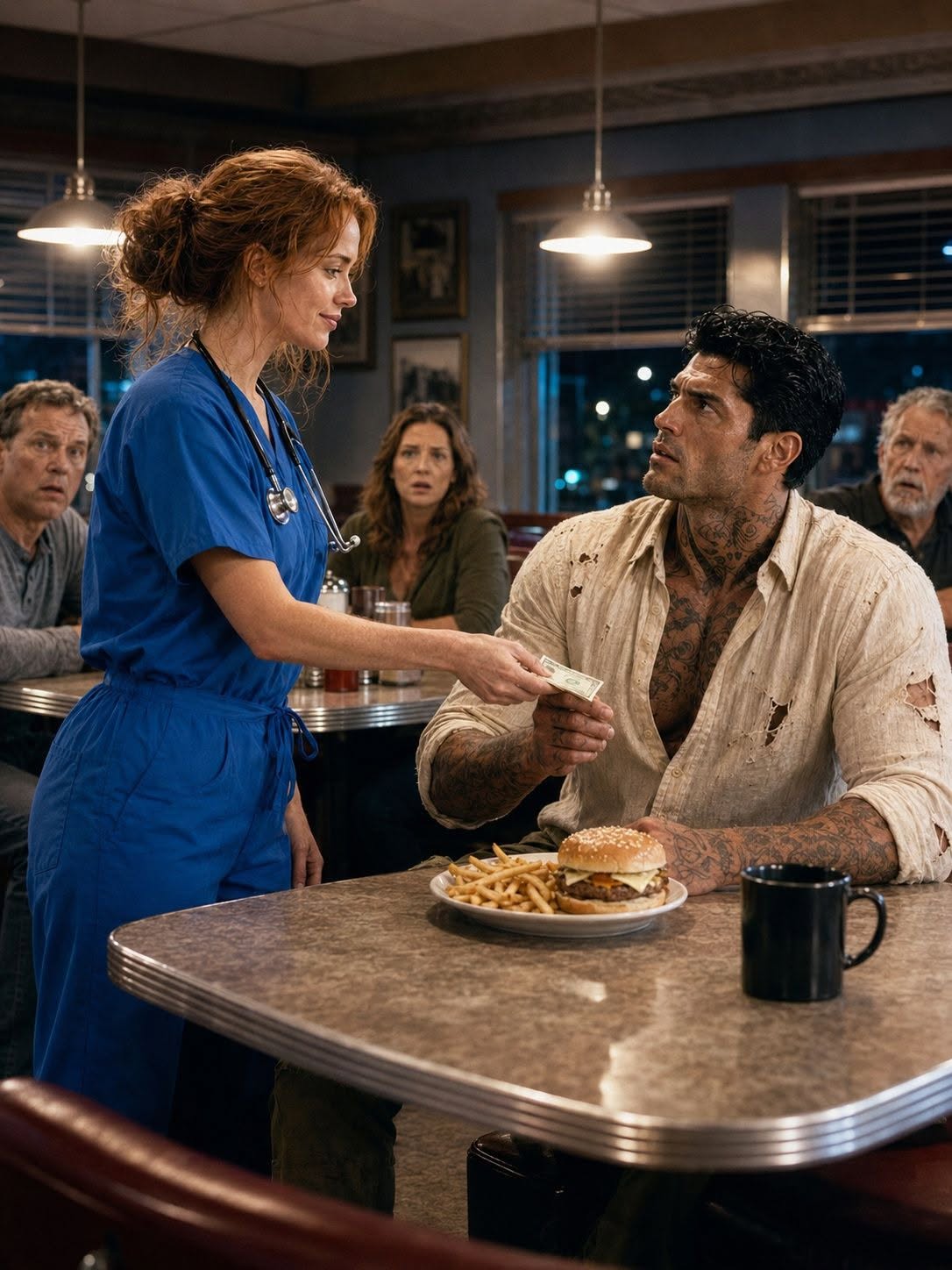
The man’s wallet was gone.
I paid his nineteen-dollar bill anyway.
By sunrise, he knew my address before I knew his real name.
At 2:38 on a February morning, Baltimore looked like a city somebody had forgotten to bring inside.
Cold rain slid down the windows of Rose’s Diner. Wind pushed dirty water along the curb in silver ribbons. Across the street, a flickering pharmacy sign painted the wet pavement green, then black, then green again.
Inside, the diner smelled like burnt coffee, fryer grease, wet wool, and industrial lemon cleaner.
I had just finished twelve hours at Mercy County Medical Center.
My feet hurt.
My shoulders hurt.
My head hurt in that hollow way it did after too much fluorescent light and too little food.
There was dried hand sanitizer in the crack of my right knuckle, and the elastic in my scrub pants had started twisting sometime around midnight.
I wanted two things.
Coffee.
And twenty quiet minutes before driving home to my nine-year-old brother, Noah.
Instead, I got the stranger.
He sat three stools down from me.
Tall.
Broad-shouldered.
Dark hair slicked back from the rain, with faint silver beginning near his temples.
There was a shallow cut over one eyebrow.
Mud stained the knee of his expensive-looking trousers.
His cream-colored shirt was torn at one sleeve and open at the collar, revealing black-and-gray tattoos climbing from his chest toward his throat.
At first glance, he looked homeless.
At second glance, he looked like a man who had lost a fight.
At third glance, if I’d been more awake, I might have realized men like him did not usually lose.
The problem started when Len, the night manager, brought him the check.
“Nineteen dollars even.”
The stranger reached inside his coat.
Stopped.
Checked another pocket.
Then another.
His expression changed almost imperceptibly.
“My wallet is missing.”
Len laughed without humor.
“Of course it is.”
The stranger took out a phone.
“Give me a moment.”
He tried once.
Declined.
Again.
Declined.
A third time.
The screen flashed something I couldn’t read.
Len folded his arms.
“You ate. You pay.”
“I am attempting to.”
“Three declines.”
“My accounts have been frozen pending fraud verification.”
“Sure they have.”
The stranger’s eyes lifted.
They were dark.
Not angry.
Not embarrassed.
Just still.
“I said I am attempting to resolve it.”
“Got ID?”
“No.”
“Credit card?”
“In the wallet.”
“Cash?”
The man looked at his empty hand.
“No.”
Len reached beneath the counter and picked up the diner phone.
“Then I’m calling the police.”
That was when I stood.
I still don’t know why.
Maybe because I had spent twelve hours watching people come through the emergency department on the worst day of their lives.
Maybe because I had watched a homeless veteran cry when security threw away his soaked backpack.
Maybe because a seventeen-year-old mother had apologized to me that morning for not having insurance while her baby struggled to breathe.
Or maybe I was just too tired to watch somebody get humiliated over beef stew and pie.
“Put it on mine.”
Len stared at me.
“What?”
“His check.”
“Dela, sit down.”
I pulled the cash from my scrub pocket.
Nineteen dollars.
Exactly.
I knew because I had counted it during my 11:00 p.m. break.
Twelve dollars had been for groceries.
Seven was supposed to go toward Noah’s rescue inhaler.
His prescription had increased again, and insurance had decided the new brand required authorization.
Apparently children’s lungs were subject to paperwork.
I placed the money on the counter.
The stranger looked at it.
Then at me.
“You don’t have to do that.”
“I know.”
Len took the cash.
“Nineteen even.”
Every dollar I had until Friday disappeared into the register.
I picked up my coat.
The stranger said, “Why?”
I looked at him.
“I didn’t do it for you.”
Something shifted in his face.
“Then who did you do it for?”
“Me.”
He waited.
I sighed.
“Because I don’t want to be the kind of person who watches somebody get humiliated over nineteen dollars and decides her coffee is more important.”
Len shook his head.
“Soft heart, empty wallet.”
“Thanks for the financial advice.”
I slid my arms into my coat.
The stranger was still watching me.
Not in the way men sometimes watched nurses after midnight.
There was no flirting in it.
He was studying.
My worn sneakers.
The cracked skin on my hands.
The cheap coat.
Then my badge.
DELA MARSH, RN.
MERCY COUNTY MEDICAL CENTER.
I pulled my coat closed.
Too late.
“What is your name?” he asked.
“You already read it.”
“Dela Marsh.”
“That’s what the plastic says.”
“You are a nurse.”
“I’m dressed like one.”
For the first time, the corner of his mouth moved.
Almost a smile.
“Mercy County.”
“You’re very observant.”
“So are you.”
I glanced toward the teenage busboy standing near the kitchen.
He had been stacking the same pile of napkins for five minutes.
“No,” I said. “I’m tired.”
The stranger followed my gaze.
The busboy immediately disappeared through the swinging kitchen door.
Something cold moved through my stomach.
I looked back at the stranger.
“Cancel your cards.”
“They already have been.”
“Good.”
I headed for the exit.
Behind me, he said, “Ms. Marsh.”
I turned.
His face had changed.
Only slightly.
But the humiliation was gone.
What remained was something controlled and dangerous.
“Thank you.”
I nodded once.
Then I left.
My Honda started on the second try.
That counted as a good night.
I pulled out of Rose’s parking lot and stopped at a red light.
That was when I saw him leave.
A black sedan rolled up to the curb.
Long.
Glossy.
Dark enough that the windows looked like polished stone.
A man in a black suit got out from the passenger side and immediately opened the rear door.
Not a rideshare.
Not a taxi.
Not a homeless man’s transportation.
The stranger paused on the sidewalk.
Another suited man emerged from the diner alley.
He leaned close and said something.
The stranger looked toward my Honda.
Directly at me.
The light turned green.
The car behind me honked.
I drove.
At 3:14 a.m., I parked outside our apartment building in Highlandtown.
Third floor.
No elevator.
One bedroom.
One foldout couch.
The radiator clanged whenever it felt emotionally neglected.
My mother had died four years earlier.
Noah was technically my half brother, but the distinction mattered only on legal forms.
He was mine.
That was enough.
Mrs. Alvarez from downstairs had stayed with him while I worked.
When I entered, she was asleep in the armchair with a television cooking show playing quietly.
Noah was curled beneath a blanket on the couch.
I touched his forehead.
Normal temperature.
Good.
His inhaler sat on the coffee table.
Almost empty.
Not good.
Mrs. Alvarez woke.
“You’re late.”
“Diner.”
“You eat?”
“Coffee.”
“That means no.”
She pushed herself up.
“I left arroz in your fridge.”
“I love you.”
“I know.”
She put on her coat.
Then she looked at me.
“You look worried.”
“I’m tired.”
“That is not the same thing.”
“I helped somebody at Rose’s.”