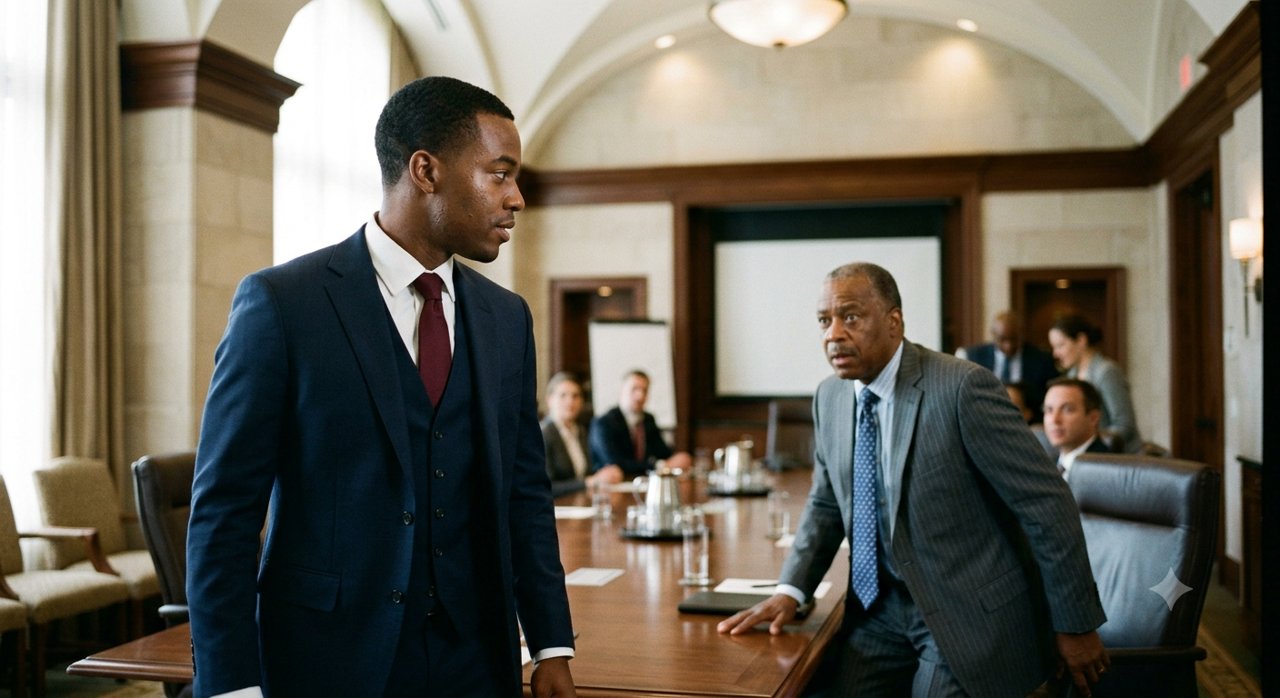
The moment the mafia boss's wife called me "an illiterate servant," the entire Manhattan restaurant went silent—but not because people felt sorry for me.
They went silent because I reached into my apron, pulled out a fountain pen, and prepared to expose something about her husband's empire that no one in that room was supposed to understand.
Maison Étoile on East Sixty-First Street was the kind of place where even cruelty came dressed in elegance.
Crystal glasses glowed beneath amber lights, velvet booths swallowed private conversations, and people worth millions whispered insults because they had never needed to shout to make someone feel small.
That night, however, Victoria Russo shouted.
"You are nothing but an illiterate servant," she snapped, her crimson designer gown gleaming beneath the chandelier.
"Do not speak to me again until you learn proper English."
Every nearby table froze.
A sommelier stopped pouring Bordeaux.
A man in a cashmere coat lowered his phone, and several diners turned openly toward me while I stood beside Victoria's booth holding a water carafe.
But I didn't cry.
I didn't apologize.
My name is Casey Miller, and at twenty-six, I had spent years learning how to survive people who assumed a black apron meant an empty mind.
Slowly, I set the water carafe on the table.
Then I reached into my apron.
Victoria's mouth curved into a satisfied smile, probably expecting me to pull out an order pad and quietly accept another humiliation.
Instead, I pulled out my fountain pen.
Across from her sat her husband, Dominic Russo.
People outside certain circles called him a restaurant investor, shipping executive, and real-estate developer.
People who understood Chicago and New York's darker business networks called him something else.
A mafia boss.
Dominic didn't speak.
He simply lifted his glass of thirty-year scotch and watched me with the calm expression of a man accustomed to seeing everyone else become nervous first.
That was his mistake.
Because by day, I wasn't a waitress.
I was a doctoral candidate at Columbia University specializing in international treaties, legal history, and linguistic ambiguity.
I spoke French and German fluently, moved comfortably between Italian and English, and spent my research examining how a single mistranslated word could alter contracts, governments, fortunes—and sometimes criminal empires.
By night, I carried plates.
Not because I was uneducated.
Because education didn't pay my mother's medical bills.
My mother, Mary, lived back in Ohio with stage-four renal failure.
Insurance covered enough to keep hope alive but never enough to stop the bills from multiplying, so every spare dollar I earned disappeared into treatments, medication, and another month of keeping her alive.
That was why I tolerated people like Victoria.
I had learned to smile when customers snapped their fingers at me.
I learned to swallow insults, clear plates, and become invisible whenever wealthy people wanted the room to belong entirely to them.
Endurance had become a skill.
But earlier that evening, while serving Dominic's table, I had overheard something.
Two Italian phrases.
One German legal term.
And the name of an old postwar agreement I had spent nearly three years studying.
At first, I thought I had misheard.
Then Dominic slid a document across the table.
I caught one sentence before Victoria covered it with her purse.
And suddenly, I knew exactly why that document could destroy everything Dominic Russo had built.
Victoria leaned back and gave me another contemptuous smile.
"Is there a problem?"
I uncapped my pen.
Dominic's expression changed for the first time.
Then I leaned over the document and circled one word.
"Actually," I said quietly, "there is."
---
What did Casey see in that document — and what happens when Dominic realizes she understood every word?
Comment **"NEXT"** if you want Part 2.