The address was a dry-cleaning business on West Forty-Seventh Street.
The kind of storefront that had been there for decades without anyone noticing it too closely.
I arrived at seven fifty-eight and stood outside long enough to confirm I hadn't been followed, then pushed through the door.
A woman behind the counter looked up.
"Drop-off or pick-up?"
"Pick-up," I said.
"Miller."
She nodded toward a door at the back.
The room behind it was not large.
A folding table, four chairs, a laptop, two paper coffee cups, and a corkboard covered in photographs.
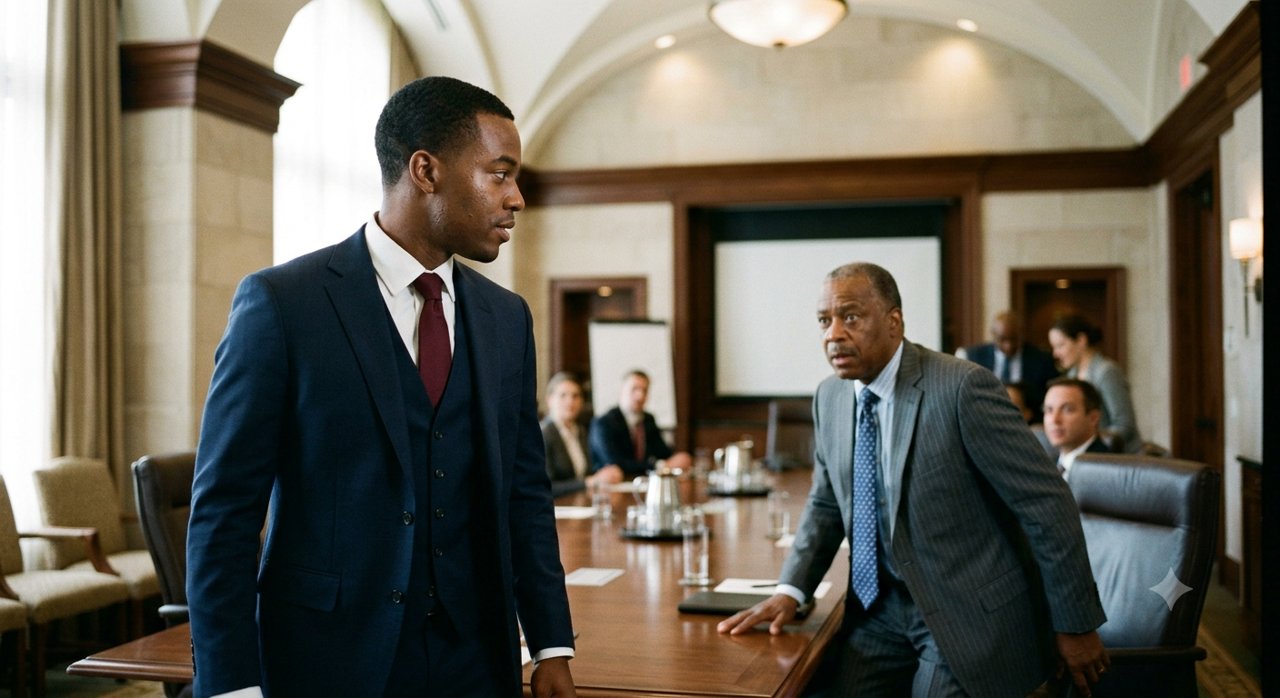
Agent Reeves was shorter than his voice had suggested — mid-forties, dark suit, the kind of face that was easy to forget in a crowd.
The woman beside him introduced herself as Agent Sandra Cho.
"Thank you for coming," Reeves said.
I sat down without being invited to.
"You said you've had surveillance on Russo for fourteen months.
What do you actually have?"
Reeves and Cho exchanged a look.
"Financial records," Cho said.
"Shell companies across six jurisdictions.
Wire transfers routed through a shipping subsidiary in Naples.
Enough to open a federal case, not enough to close one."
"Because the asset structure is the foundation," I said.
"And the asset structure rests on the Trieste Protocol interpretation."
"Correct." Reeves turned the laptop to face me.
On the screen was a scanned document — not the one from last night, but similar.
Older.
The letterhead was in Italian.
"This is the original 1947 agreement.
We've had three translators look at Article Nine.
All three gave us the same reading Russo's lawyers have been using for thirty years."
I leaned forward.
Read the relevant clause.
Sat back.
"They all made the same mistake," I said.
"Apparently."
"It's not an obvious mistake," I said.
"The word *Abtretung* appears in the German annex, not the Italian body text.
Most translators working from the Italian would never cross-reference the annex.
My dissertation specifically addresses that annex because it was added in the final forty-eight hours of negotiation and was never formally reconciled with the main document."
Cho set a folder on the table in front of me.
"We need a declaration.
Signed, sourced, citing your research.
Something a federal prosecutor can use to argue that Russo's entire asset structure is built on a fraudulent legal interpretation."
"Fraudulent implies intent," I said.
"We believe there was intent," Reeves said.
"Russo's lead attorney in 1994 — a man named Gerald Fitch — was a specialist in postwar European property law.
He would have known the correct reading.
We think he chose the wrong one deliberately."
"Where is Fitch now?"
Reeves looked at the table.
"He d*ed in 2019.
Cardiac event.
Officially."
The word *officially* sat in the room for a moment.
"So Russo has been operating on a legal fiction for thirty years," I said.
"And last night he realized a waitress had just spotted it."
"Yes."
"And the document I saw at the table last night — what was that?"
Cho opened the folder further.
"We believe it was a refinancing agreement.
Russo is attempting to move a significant portion of his assets into a new holding structure before the end of the fiscal year.
If he completes that transfer, the old Trieste-based claims become less central to the case.
The new structure would be much harder to challenge."
"How much time do we have?"
"The filing window closes in eleven days."
I looked at the corkboard.
Photographs of Dominic at various restaurants, airports, building entrances.
One photograph showed him shaking hands with a man I recognized — a city councilman whose name appeared occasionally in the Columbia law school newsletter as a donor.
"That's Alderman Ferretti," I said.
"Yes," Cho said.
"He's a person of interest."
"He donated forty thousand dollars to my university's legal research fund last spring."
Neither agent spoke.
"I want two things," I said.
"First — my mother's medical situation.
If I help you, I need to know she's protected.
Not just physically.
Financially.
The bills are — " I stopped.
Started again.
"She has stage-four renal failure.
The treatments are ongoing.
If something happens to me, or if this becomes public before it's resolved, she loses everything."
Reeves nodded slowly.
"We can arrange protective relocation and a medical cost arrangement through the witness assistance program.
It would need to be formalized, but yes."
"Second," I said.
"I want to be in the room when you confront him."
Cho looked at Reeves.
"That's not standard procedure," Reeves said.
"I know," I said.
"But I'm not a standard witness.
I'm the only person alive who can explain to a jury in plain English why that document means what it means.
You need me to understand this case from the inside, not just sign a declaration and disappear." I met his eyes.
"And frankly, after last night, I think I've earned the right to be in the room."
A long pause.
"We'll see," Reeves said.
It wasn't a yes.
But it wasn't a no.
I picked up one of the paper coffee cups.
It was cold.
I drank it anyway.
Outside on West Forty-Seventh Street, a black sedan had been parked across from the dry-cleaning shop since before I arrived.
As I left, it pulled away from the curb — not following me, just moving on, the way traffic moves in a city that never stops watching.
I didn't know then whose car it was.
I found out four days later, when it parked outside my apartment building at two in the morning, and Carlo Mancini stepped out.