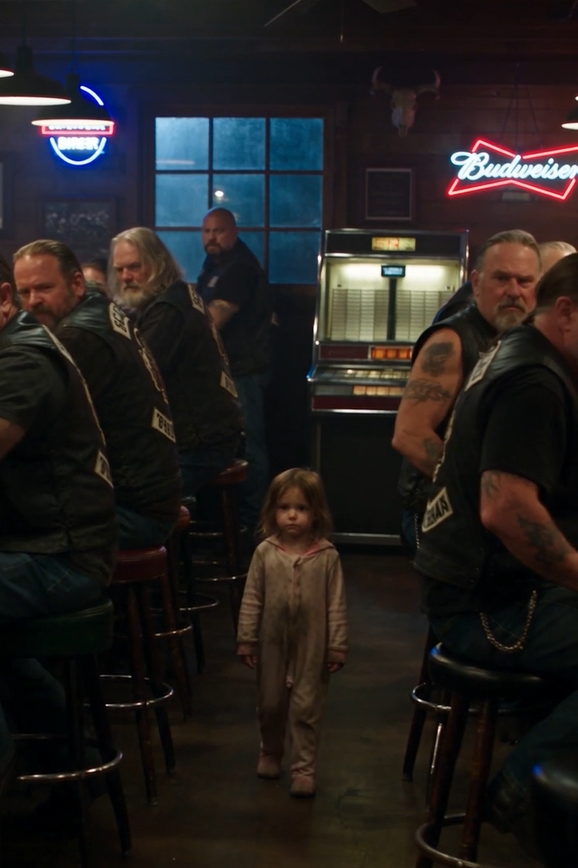
The music at the Iron Horse didn’t just fade; it died. One second, the jukebox was screaming ZZ Top, and the next, you could hear the ice melting in forty glasses. In twelve years of bartending, I’d seen blood, I’d seen tears, and I’d seen the worst parts of humanity—but I had never seen anything as terrifying as a four-year-old girl in stained pajamas standing in a room full of leather-clad bikers at midnight.
She climbed onto a barstool, her small hands gripping the sticky mahogany. She looked at me with eyes that had seen too much for a child who was only "four and three-quarters," and said, "My mommy needs help. She’s sleeping on the floor and there’s red stuff everywhere and she won’t wake up."
"What’s your name, honey?" I asked, my voice shaking in a way I didn't recognize.
"Lily."
"Okay, Lily. Do you know which way your house is?"
She pointed east, toward the old neighborhood where the streetlights had been shot out years ago. Rick, our club sergeant, was already on the phone with 911. Hank, our VP—a man who looked like he could wrestle a bear but spent his Sundays at tea parties with his granddaughters—crouched down next to her.
"Lily," Hank said softly. "Did something happen before Mommy went to sleep?"
Lily’s lip trembled. Her hands twisted in the fabric of her too-big pajama sleeves. "The man," she whispered. "The man with the loud voice. He was mad at the money. He hit the wall... then he hit Mommy. She fell down and the red stuff came out. He ran away, so I came to find a hero."
The air in the bar turned cold. Every man there—men who had been called outlaws and rebels—stood up as one. There was no discussion. There was no vote.
"We aren't waiting for the squad to find the house," Rick growled, snapping his phone shut. "They don't know the layout of the East Side like we do."
Hank picked Lily up, cradling her against his leather vest. "Lily, honey, can you show us which house has the blue door? Or maybe the one with the big tree?"
"The one with the star," she sobbed, burying her face in his neck. "Mommy put a paper star on the window for my birthday."
Within seconds, the roar of forty engines shattered the midnight silence. It wasn't a riot; it was a procession. We rode east, a wall of steel and chrome, with Lily tucked safely in the sidecar of Hank’s bike, wrapped in a denim jacket that swallowed her whole.
We found it six blocks away. A crumbling row house with a fading yellow paper star taped to the glass.
Hank didn't wait. He kicked the door in. The rest of us formed a perimeter, a human fence of leather and muscle that no one—not the man with the loud voice, not the shadows of the street—was getting through.
Inside, we found her. Lily’s mother was pale, lying in a pool of blood that looked like black ink under the dim kitchen light. She was barely breathing. Rick, who had been a combat medic in another life, dropped to his knees. "She’s got a pulse," he yelled over his shoulder. "But it’s thin. Get the paramedics in here now!"
The ambulance arrived three minutes later. As they loaded the stretcher, Lily wouldn't let go of Hank’s hand. She looked at the flashing lights, then back at the forty bikers standing guard in the middle of the street.
"Is Mommy going to wake up?" she asked.
Hank knelt down, wiped a smudge of dirt from her cheek, and took off his silver "Road Captain" pin, pressing it into her tiny palm. "Your mommy is a fighter, Lily. And you? You’re the bravest person I’ve ever met. We’re stayin' right here until we know she’s okay."
Three weeks later, the front door of the Iron Horse swung open. It wasn't midnight, and the bar wasn't full of smoke. A woman walked in, leaning heavily on a cane, her head bandaged but her eyes bright. Beside her, skipping with a pair of brand-new sparkly sneakers, was Lily.
The bar went silent again, but this time, it was the kind of silence you feel in a church.
Lily ran straight to the end of the bar where Hank was sitting. She didn't say a word; she just climbed into his lap and showed him her palm. Nestled there was the silver pin.
"Mommy's awake," she said proudly.
The mother looked at us—at the tattoos, the scars, and the rough faces of forty men who the world usually crossed the street to avoid. Her voice cracked as she spoke. "The police told me what happened. They said my daughter walked through the dark to find heroes. I didn't believe them until I saw the bikes outside."
I poured a glass of water for the lady and a Shirley Temple for the little girl who saved a life. For the first time in twelve years, the Iron Horse didn't feel like a biker bar. It felt like home.
.
.
Please follow us if you like this story 💕🙏💕