“What do you think?”
Valerie looked toward the hallway where her father’s engraved key holder sat near the door.
“I think the hardest cases are the ones where every available choice tells a different kind of truth.”
Mrs. Patterson nodded as if that made complete sense.
“Then pick the truth you can live with.”
Mitchell received notice of formal administrative charges Friday.
Failure to establish reasonable grounds for detention.
Failure to follow vehicle-verification procedure.
Inaccurate verbal characterization of a possible stolen vehicle.
Escalation without articulable safety basis.
Conduct inconsistent with department standards.
There was no charge for being rude.
No charge for arrogance.
No charge for humiliating someone.
Administrative systems preferred verbs they could prove.
Mitchell read the notice twice.
His union representative sat across from him.
“You’ve got options.”
Mitchell kept reading.
“We can argue judgment error,” the representative continued. “Training deficiency. Stress response. No physical injury. No arrest. Reeves interrupted before anything escalated.”
Mitchell looked up.
“Interrupted?”
“That’s how I’d frame it.”
“He didn’t interrupt.”
The representative frowned.
“What?”
Mitchell folded the pages.
“He stopped me.”
A silence.
“That distinction doesn’t help us.”
“I know.”
The representative leaned back.
“Derek, you need to decide whether you want to defend your job or confess to the newspaper.”
Mitchell stared at the wall.
He had spent the week furious at Valerie.
Then at Reeves.
Then at the crowd.
Then at whoever posted the video.
Each version of anger had lasted until he replayed the footage.
By Friday, something else had begun to intrude.
Memory.
Not of Valerie’s identification card.
Earlier.
The moment she lowered the window.
She had looked confused.
Nothing else.
No furtive movement.
No attempt to drive away.
No hostility.
He had supplied everything after that.
The suspiciousness.
The threat.
The possibility of theft.
He had built the entire encounter from an intuition he could not defend.
“What happens if I admit it?” he asked.
The representative studied him.
“You mean accept the findings?”
“I mean say why I stopped her.”
“You already said you were suspicious.”
“No.”
Mitchell looked down at the paper.
“I mean why.”
The representative’s expression changed.
“Derek, be careful.”
That warning followed him home.
Part IV — Reckoning
The first public hearing on Mitchell’s discipline was scheduled two weeks later.
By then, Valerie had returned to a normal docket, though normal had become relative.
People recognized her in grocery stores.
Strangers thanked her.
Others accused her online of ruining a police officer’s life.
Someone mailed a letter to chambers calling her a hero.
Someone else mailed one telling her to resign.
She read neither after the first paragraph.
The more interesting consequence occurred in court.
Attorneys became unusually cautious around police testimony.
Defense lawyers cited the viral video in unrelated cases.
Prosecutors objected.
Valerie sustained those objections when appropriate.
The law did not permit one officer’s conduct to become evidence against another merely because the public was angry.
That decision earned criticism from the same people who had praised her days earlier.
She found that almost reassuring.
Consistency was rarely popular for long.
One afternoon, after dismissing the last matter, Valerie remained at the bench while the courtroom emptied.
Reeves stood in the rear.
She had not seen him since Saturday.
He waited until everyone else left.
Then approached the rail.
“Judge Henderson.”
“Officer Reeves.”
He removed his cap.
“I wanted to apologize.”
Valerie considered him.
“For what?”
“For not stepping in sooner.”
“You arrived after the encounter began.”
“I mean before Saturday.”
She understood.
Reeves looked toward the empty counsel table.
“I knew he cut corners. Not like that. But enough.”
“Did you report it?”
“No.”
“Why?”
“I thought I was helping by partnering with him.”
Valerie stepped down from the bench.
“You probably were.”
Reeves looked surprised.
“That doesn’t mean it was enough.”
“No.”
He rubbed the edge of his cap with his thumb.
“I kept thinking if I corrected the plate checks, asked the questions, slowed him down, then nobody got hurt and I didn’t have to be the guy who turned on a partner.”
Valerie stopped several feet away.
“Did you think reporting him would be disloyal?”
“Yes.”
“And now?”
Reeves gave a small, bitter smile.
“Now I think I was loyal to the wrong thing.”
Valerie said nothing.
He continued.
“They’re asking why I kept notes.”
“Why did you?”
“Because I didn’t trust my memory.”
That answer landed with her.
It was the same reason she had pulled over after the parking lot and written everything down.
Reeves looked at her.
“I’m testifying at the hearing.”
“I assumed you would.”
“He knows.”
“I’m sure.”
“I don’t know what that does to him.”
“That isn’t your responsibility.”
Reeves glanced toward the bench.
“Easy for a judge to say.”
Valerie almost corrected him.
Instead she said, “No. It isn’t.”
He looked back.
“It’s easy for a judge to say because assigning responsibility is part of the job. Carrying it is harder.”
Reeves nodded slowly.
Before leaving, he paused at the door.
“For what it’s worth, I ran the plate because something felt wrong.”
“With the car?”
“With him.”
Then he left.
Mitchell’s disciplinary hearing took place in a municipal administrative room with no jury and no raised bench.
Valerie did not attend.
She was not a party.
But her recorded statement was admitted.
The shopping-center videos were admitted.
Reeves testified.
The hearing officer asked him to describe the moment he arrived.
“Officer Mitchell told me it was a possible stolen vehicle.”
“Did he indicate that dispatch had confirmed a theft report?”
“No.”
“Did he indicate that the plate had been checked?”
“No.”
“What did you do?”
“I looked at the plate and asked whether dispatch had confirmed.”
“Why?”
“Because that should have happened already.”
Mitchell sat beside his representative, looking straight ahead.
Reeves continued.
“When Judge Henderson asked to retrieve identification, Officer Mitchell moved toward her.”
“What did you understand him to be doing?”
“I believed he intended to take physical control of her wrist.”
“Was that necessary?”
“No.”
“How do you know?”
“She was standing still. Hands visible. Compliant.”
Mitchell’s representative rose.
“Officer Reeves, you and Officer Mitchell had disagreements before this incident, correct?”
“Yes.”
“You kept private notes about his conduct.”
“Yes.”
“Without reporting those concerns formally.”
“Yes.”
“So you were building a file against your partner.”
Reeves’ expression tightened.
“No.”
“What would you call it?”
“A record of things I was afraid I’d eventually have to explain.”
The room went quiet.
Mitchell looked at him for the first time.
Reeves met his gaze.
Neither man looked away.
The most damaging evidence was not the video.
It was Mitchell’s own body-camera audio.
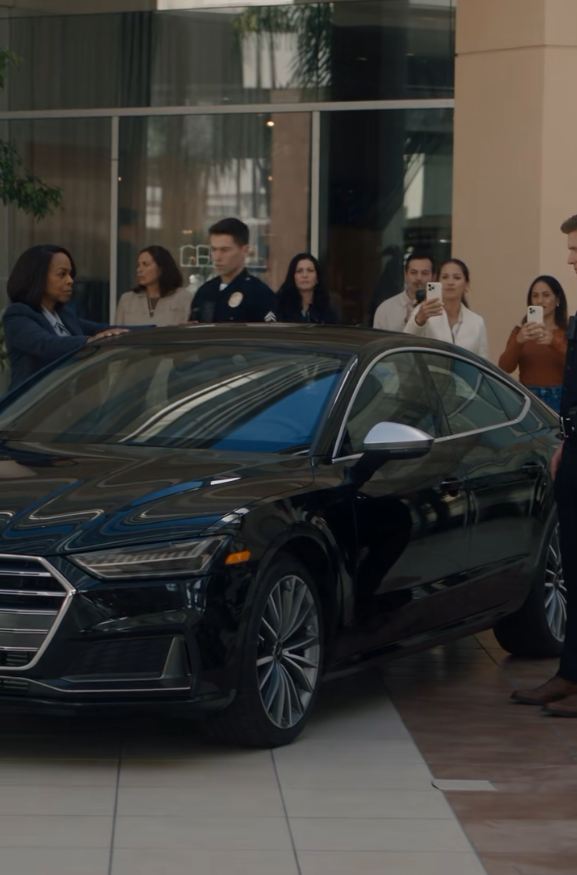
The image showed little more than Valerie’s shoulder and the side of the Mercedes.
The sound was clear.
Her repeated request that he verify the registration.
His refusal.
Her question about suspicious behavior.
His failure to answer.
Then, after Reeves arrived, a moment the shopping-center videos had not captured.
Reeves quietly asking, “What’d she do?”
Mitchell’s answer:
“She doesn’t fit the car.”
Four words.
Mitchell closed his eyes when they played.