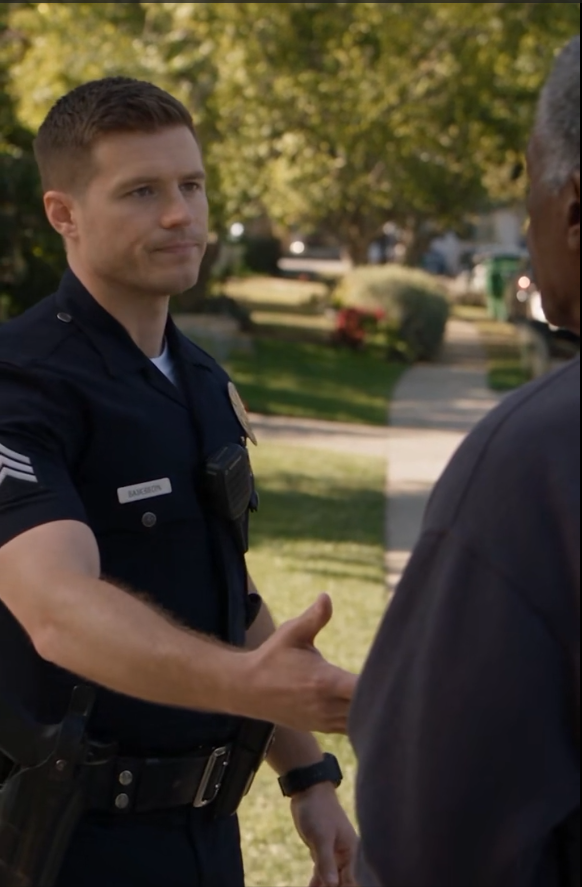
He said nothing.
“Or unemployed Arthur Pendleton.”
His jaw tightened.
“Director, I didn’t know who you were.”
“I know.”
“I mean—”
“I know you didn’t.”
He stared at me.
“That is the point.”
The supervisor shifted.
“Sir, Officer Rollins believed he had reasonable suspicion—”
“Then he can articulate it.”
Rollins looked at the supervisor.
The supervisor stopped.
I kept my eyes on Rollins.
“Officer, walk me through it.”
He straightened.
For a moment, training took over.
“At approximately 0718 hours, my partner and I observed an individual standing near a residential mailbox in an area that has experienced package thefts.”
“Observed doing what?”
“Standing near the mailbox.”
“Touching packages?”
“No.”
“Opening the mailbox?”
“I believe—”
“Did you see me open it?”
He paused.
“No.”
“Carrying property?”
“You had a newspaper.”
“The newspaper delivered to that address.”
“That was not verified at the time.”
“What specific conduct suggested theft?”
He shifted.
“Your presence.”
“In a residential neighborhood.”
“On private property.”
“Which I told you was mine.”
“That was unverified.”
“What did you do to verify it before handcuffing me?”
His mouth tightened.
“You didn’t have physical identification.”
“That wasn’t my question.”
Miller looked down at the table.
The supervisor’s face had become rigid.
I asked again.
“What did you do to verify my claim before handcuffing me?”
Rollins answered, “Nothing.”
The room stayed quiet.
I nodded.
“Why?”
“I believed immediate detention was appropriate.”
“Why?”
“To control the situation.”
“What situation?”
He looked at me.
I waited.
His answer mattered more than any apology.
Finally he said, “You were challenging my instructions.”
There it was.
Not theft.
Not property.
Authority.
“You told me to step away from the mailbox,” I said.
“Yes.”
“I did.”
“You kept questioning me.”
“Questioning you is not a crime.”
“I didn’t say it was.”
“You cited it as justification for control.”
He looked toward the supervisor.
I said, “Look at me.”
His eyes returned.
I did not raise my voice.
“You told your partner I didn’t look like the owner.”
Rollins went still.
Miller’s head lifted.
The supervisor looked at him.
Rollins said, “That’s being taken out of context.”
“Then provide the context.”
“I meant your clothing.”
I looked down at my sweatshirt.
“You believed the owner of a six-million-dollar house would dress differently to retrieve a Sunday newspaper?”
He said nothing.
“Different shoes?”
Nothing.
“Different skin?”
The supervisor inhaled.
Rollins’s face hardened.
“I never said that.”
“No. You said I didn’t look like the owner.”
“I meant presentation.”
“What presentation?”
“Director—”
“What presentation, Officer?”
He looked at me for several seconds.
Then away.
“I don’t know.”
That was the first honest thing he had said since we met.
I sat back.
Miller spoke.
“Sir.”
I turned.
He swallowed.
“I should have stopped it sooner.”
Rollins looked at him sharply.
Miller continued.
“I knew we could run the address. I said so. I knew he—” He caught himself. “I knew the detention was moving too fast.”
“Why didn’t you stop it?”
His answer came slowly.
“Because I didn’t want to undermine my partner in front of a subject.”
“Subject.”
He winced.
“Yes.”
“So you protected the authority of the stop.”
“Yes.”
“Over the accuracy of it.”
He looked at the table.
“Yes.”
That answer cost him something.
I respected that.
Not enough to excuse it.
Enough to hear it.
The supervisor finally sat down.
“Director, I need to make a notification to the chief.”
“Soon.”
“Sir, this is obviously—”
“Soon.”
He stopped.
I opened my credential case again, not to show it but to remove a small card containing contact numbers.
I slid it toward him.
“My counsel is on the way. Your department needs to preserve all body-camera footage, dispatch audio, CAD logs, cruiser video, station video, database queries, and internal communications related to this incident.”
“Yes, sir.”
“And I want Officer Rollins’s body camera preserved before anyone reviews it with him.”
Rollins’s head turned.
The supervisor nodded.
“Understood.”
Rollins said, “Am I being investigated?”
I looked at him.
“You should be.”
“For making a stop?”
“For whether your actions were lawful and whether they followed policy.”
He laughed once.
Not from amusement.
“So this is how it works?”
“How what works?”
“You hide who you are, let me make a mistake, and then destroy my career.”
The duty agent shifted slightly.
I raised one hand without looking at him.
No intervention.
Rollins continued.
“You could’ve told me in the driveway.”
“Yes.”
“You could’ve shown me credentials.”
“They were inside.”
“You could’ve said you were FBI.”
“Yes.”
“But you didn’t.”
“No.”
“So you set me up.”
I looked at him for a long time.
“No, Officer Rollins. You encountered a man in old clothes outside an expensive house and made a series of choices. I did not make them for you.”
His face flushed.
“You knew what would happen if I found out.”
“I suspected your behavior would change.”
“Exactly.”
“That should concern you more than it concerns me.”
He opened his mouth.
I continued.
“If the only thing that makes you slow down is discovering that the person in front of you has power, then your problem is not that I withheld my title.”
The room had become completely still.
“Your problem is what you permit yourself to do when you believe the person in front of you does not.”
No one spoke.
I stood.
“My counsel will coordinate with your department.”
The supervisor rose.
“Director, do you want Officer Rollins suspended immediately?”
I looked at him.
That was the first hard choice.
The easy answer was yes.
The emotionally satisfying answer was yes.
But power used carelessly in response to power used carelessly would teach the wrong lesson.
“I want your existing policy followed.”
The supervisor seemed surprised.
“If policy requires administrative leave pending investigation, do that. If it does not, do not invent a punishment because of my title.”
Rollins looked at me.
For the first time that morning, he seemed uncertain in a different way.
Not about who I was.
About what I would do.
I closed the credential case.
Then I looked at Miller.
“You drove past my house on the way here.”
“Yes, sir.”
“Did someone turn off the hose?”
His expression changed.
“I did.”
I nodded.
“Thank you.”
That was the only thank-you I offered that morning.
Part IV — The Record
By Monday, the story existed in three different forms.
The first was what had happened.
The second was what the records showed.
The third was what people needed it to become.
My job was to keep the first two from being swallowed by the third.
The department notified federal officials before noon Sunday. By evening, attorneys had spoken. By Monday morning, preservation notices were in place.
I did not issue a public statement.
I did not call the mayor.
I did not call anyone in Congress.
I did not want an institution learning the wrong lesson from my name.
At headquarters, my chief of staff stood across from my desk with an expression I had seen during hostage incidents and budget hearings but rarely at the same time.
“You were detained in handcuffs for nearly an hour.”