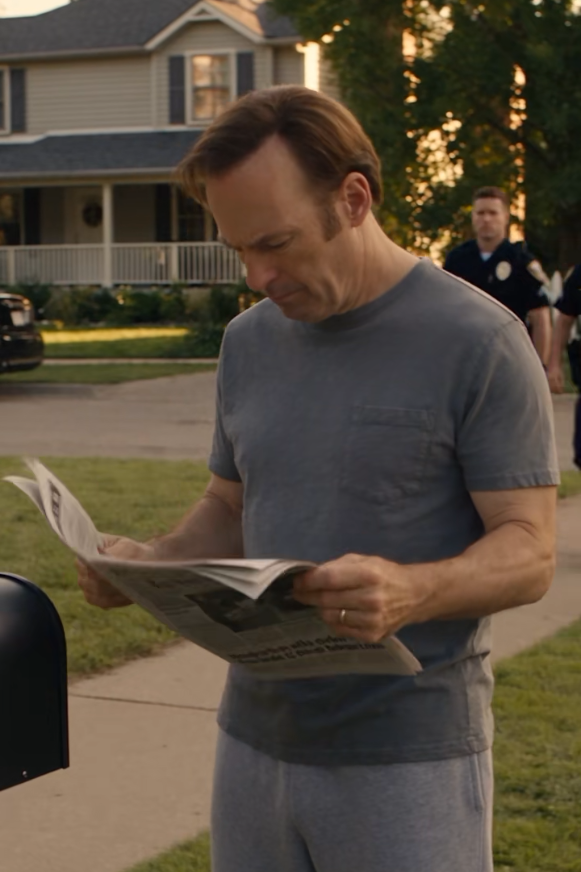
“What specifically?”
“You were at the mailbox.”
“My mailbox.”
“We didn't know that.”
“You refused every method I provided to verify it.”
“You didn't have identification.”
“Is failing to carry a driver's license while retrieving a newspaper from one's own property a crime?”
“No.”
“Did I provide a false name?”
“We didn't know.”
“You know now.”
He shifted.
I continued.
“Did you receive a call identifying me as the suspect in a theft?”
“No.”
“Did anyone report that I entered private property unlawfully?”
“No.”
“Did I attempt to flee?”
“No.”
“Threaten you?”
“No.”
“Refuse to give my name?”
“No.”
“Physically resist?”
His eyes moved toward Miller.
“No.”
“Then what transformed me from a homeowner without a wallet into a man in handcuffs?”
Rollins stood.
“I don't have to sit here and be interrogated by a suspect.”
Carter said, “Sit down.”
Rollins turned toward him.
“Lieutenant—”
“Sit.”
Something in Carter's tone finally broke through.
Rollins sat.
I studied him.
He was not stupid.
That mattered.
People often want wrongdoing to require ignorance, as though knowledge and judgment automatically travel together.
They do not.
Rollins knew procedure.
He knew enough law to construct language around what he had done.
He simply believed his instincts deserved more authority than facts.
I said, “Did you know the race of the homeowner when you approached?”
His eyes hardened.
“There it is.”
“What?”
“You're making this racial.”
“I asked a factual question.”
“I didn't know who owned the house.”
“Exactly.”
He looked at Carter.
“I'm done.”
I reached into the pocket of my sweatshirt.
Rollins reacted immediately.
“Hands where I can see them.”
Everyone froze.
I slowly removed nothing.
Because there was nothing in the pocket.
I had put my hand there deliberately.
Carter understood first.
Miller second.
Rollins last.
I placed my empty hand on the table.
“You still perceive me as a threat.”
Rollins's mouth tightened.
“Anyone reaching suddenly—”
“I moved at half walking speed while seated in a locked police interview room with three armed officers present.”
“You don't get to test me.”
“No. Citizens do that every day without knowing it.”
The words landed.
Rollins stared at me.
I leaned back.
“Now I'll answer your question.”
Carter looked toward me.
I saw concern there.
Not for me.
For what would happen next.
“My occupation is Director of the Federal Bureau of Investigation.”
Rollins did not react at first.
Not visibly.
His face simply lost expression.
Miller looked at me, then at Carter.
Carter gave a slight nod.
Rollins laughed once.
A short sound.
“You expect me to believe that?”
I turned to Carter.
“Lieutenant?”
Carter's voice was quiet.
“He is.”
Rollins stared at him.
Carter continued.
“Director Pendleton spoke at the regional task force conference last January. I've met him.”
Miller whispered something under his breath.
Rollins remained still.
Then he turned back toward me.
“You should have said something.”
There it was.
Not I'm sorry.
Not I was wrong.
You should have said something.
I let several seconds pass.
“I told you my name.”
“You know what I mean.”
“I told you where my identification was.”
“You could've told me your position.”
“I told you where I worked.”
“Not at the house.”
“No.”
“Why?”
I looked at him.
“Because I wanted to know how far you would go before the person in front of you became important enough to deserve procedure.”
His face reddened.
“This is entrapment.”
“No.”
“You set me up.”
“I walked to my mailbox.”
“You could have stopped this.”
“Yes.”
“And you didn't.”
“No.”
“Why?”
“Because the authority you exercised over me is the same authority you exercise over people who cannot stop it by naming a title.”
Rollins pushed his chair back.
Carter stood immediately.
“Stay seated.”
“This is insane.”
Miller said, “Derek.”
“No. He let us bring him here so he could make a point.”
I shook my head.
“I let you reveal one.”
Rollins looked toward the camera in the corner.
For the first time all morning, he seemed to remember that records existed.
Body cameras.
Dispatch.
Station video.
Database timestamps.
I watched calculation replace outrage.
Then something else appeared.
Fear.
Not panic.
Professional fear.
The kind that arrives when a person realizes an event has escaped the boundaries of explanation.
He looked at Carter.
“I want union representation.”
“That is your right,” Carter said.
“And I'm done answering questions.”
“Also your right.”
Rollins stood.
Carter opened the door.
Before Rollins stepped out, I said his name.
He turned.
“Officer Rollins.”
He waited.
“This is no longer about what happened to me.”
His jaw tightened.
“It was never about you.”
That sentence stayed with me.
Because I believed he meant it as an insult.
But later, I realized it was the closest he came to understanding the truth.
By 9:04 a.m., the county police chief was on the way.
By 9:11, my deputy director had called twice.
By 9:17, someone in the Bureau's executive security section had learned what happened despite my order that Carter keep the matter contained until I spoke with the local chief.
At 9:26, my phone—returned after Miller drove another officer to retrieve my wallet and federal credentials—showed fourteen missed calls.
I stood alone in Carter's office.
The cuffs had left purple marks around my wrists.
Carter offered ice.
I declined.
Then he offered coffee.
I accepted that.
He placed the paper cup on the desk.
“I owe you an apology.”
“You didn't arrest me.”
“He works under my command.”
“Then you owe me an investigation.”
He nodded.
“You'll get one.”
“I don't want a ceremonial one.”
“You won't.”
I studied him.
“Did you know about complaints?”
That changed something in his face.
A fraction.
Enough.
“Against Rollins?”
“Yes.”
Carter sat slowly.
“There have been... concerns.”
“Formal complaints?”
“Some.”
“How many?”
He didn't answer.
“Lieutenant.”
“Three in the last eighteen months.”
“For?”
“One discourtesy. One improper detention. One search complaint.”
“Disposition?”
“The discourtesy was sustained. The others were not.”
“Not sustained or unfounded?”
“Not sustained.”
Important distinction.
Unfounded meant evidence showed the allegation didn't happen.
Not sustained meant they couldn't prove it.
“Any demographic pattern?”
His eyes lifted.
“I don't know.”
“Find out.”
He nodded.
I sipped the coffee.
Bad coffee has been the most reliable constant in American law enforcement since at least 1974.
The familiarity steadied me.
Carter said, “Director, can I ask you something?”
“Yes.”
“Why didn't you identify yourself sooner?”
“Because I shouldn't have needed to.”
“I understand that.”
“No. You understand it now.”
He looked away.
I regretted the sharpness almost immediately.
Carter had recognized the problem and intervened.
He had also admitted there were earlier warning signs.
Both things could be true.
I sat across from him.
“My wife used to say institutions don't usually fail all at once. They teach themselves how.”
Carter looked at me.
“What does that mean?”
“It means people tolerate small things because correcting them is inconvenient. Then those small things become precedent. Then culture. Then somebody gets hurt and everyone asks when the system changed.”
He nodded slowly.
“She sounds smart.”
“She was.”
The past tense sat between us.
Carter did not ask.
I appreciated that.
There was a knock.
The door opened.
Police Chief Marian Holt entered without ceremony.
She was in uniform despite being called from home. Early sixties. Short gray hair. No entourage.