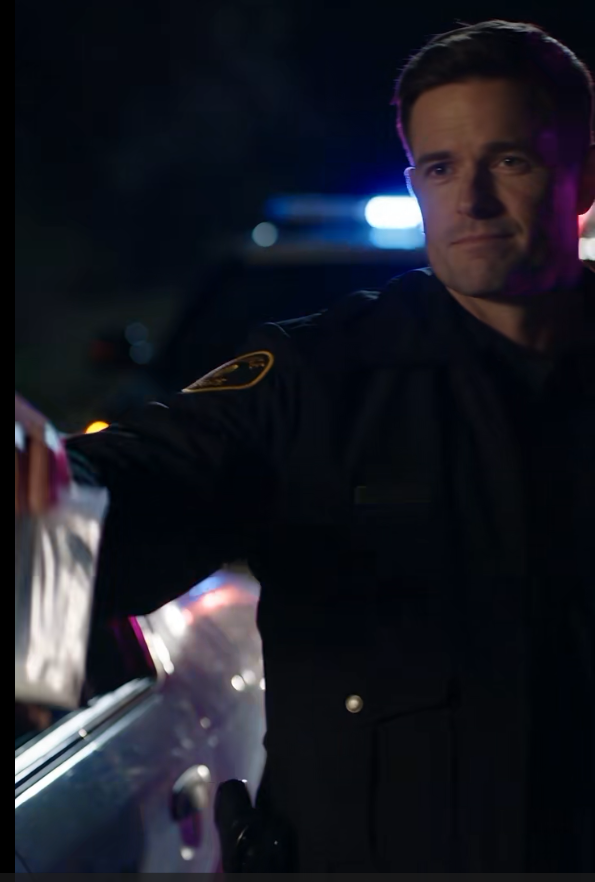
Franklin had.
But Foster had deliberately leaked Claire's movement to Franklin in order to expose him.
The roadside stop was not an accident.
Not entirely.
It was an unauthorized sting.
With Claire inside it.
Without her consent.
Without safeguards.
Without backup.
Without even telling Reeves.
Claire looked at the man who had spent years talking about accountability.
He had become the thing institutions often became when they feared losing control.
Certain that the mission justified secrecy.
Certain that oversight applied mostly to other people.
Foster said, "If Keller hadn't made such a sloppy move, Franklin would've exposed more of his network."
Claire stared at him.
"You still think the problem is that Keller was sloppy."
Foster's expression tightened.
"That's not what I said."
"It's what you meant."
"No."
"Then tell me what your mistake was."
He paused.
The room waited.
Finally:
"I underestimated the risk."
Claire shook her head.
"No."
Foster frowned.
"You denied me the right to decide whether I would take it."
That landed harder.
Reeves looked at Claire.
Ortiz did too.
Claire continued.
"You didn't underestimate danger. You understood danger and assigned it to someone else."
Foster looked away.
For the first time, he had no immediate response.
Claire pushed the final document toward him.
Her resignation letter.
Reeves turned sharply.
"Claire."
She did not look at him.
Foster stared at the paper.
"You can't be serious."
"I am."
"You leave now, you fracture the investigation."
"No."
"You're the principal investigator."
"The evidence survives me."
"You built the case."
"Then the case should be strong enough to stand without me."
Foster leaned forward.
"Think about what you're doing."
Claire looked at him.
"I have been."
"If you resign publicly, defense attorneys will use it against everything we've collected."
"Then I won't resign publicly."
Foster blinked.
Claire continued.
"I'll complete the evidentiary transfer. I'll give sworn testimony. I'll document exactly what happened. Then I'll leave."
Reeves said quietly, "Claire."
She looked at him now.
He understood.
She was not quitting the case.
She was refusing the institution.
Different thing.
Foster said, "And what happens to the commission?"
Claire looked at him.
"That's not my decision."
He stared.
She added, "Accountability doesn't stop being necessary when it reaches the people who created the accountability office."
Foster leaned back.
The fight went out of his posture.
Not because he agreed.
Because he knew the sentence would outlive his objections.
Ortiz stepped forward.
"Chairman Foster, I need to advise you that based on the statement we've received and the admissions you've made, this conversation is now part of an active criminal review."
Foster closed his eyes briefly.
When he opened them, he looked at Claire.
"Was this your plan?"
"No."
"Then what was?"
"To get home last night."
For the first time, Foster looked ashamed.
Not theatrically.
He simply looked down.
That was enough.
Part VI — Aftermath
The arrests began forty-eight hours later.
Franklin was charged first.
Conspiracy.
Official misconduct.
Evidence tampering.
Obstruction.
Further charges followed as forensic analysis linked him to multiple communications with officers named in Claire's file.
Keller eventually cooperated.
Not immediately.
His lawyer spent two days arguing the roadside incident could be interpreted as confusion.
Then Daniels' body-camera recording was synchronized with Claire's audio.
The sequence became impossible to explain away.
Keller walking to the cruiser.
Returning with the bag.
His posture.
His statements.
The hidden message.
The tool used on Claire's car.
The recovered phone.
The phrase use the usual if needed.
Keller accepted a cooperation agreement.
He named five officers.
Two supervisors.
One evidence-room technician.
He admitted the network had used planted or misattributed evidence in previous cases.
Sometimes to secure arrests.
Sometimes to pressure informants.
Sometimes simply because an officer believed a suspect was guilty and lacked legitimate proof.
That explanation disturbed Claire more than greed would have.
Greed was easy to understand.
Certainty was harder.
Men had convinced themselves that falsifying evidence was not corruption if the person deserved to be caught.
Then the habit expanded.
Once evidence could be invented for the "right" person, it could be invented for anyone.
One hundred twenty-three cases were flagged for review.
Thirty-one convictions were reopened in the first month.
Nine people were released pending further proceedings.
More followed.
Daniels remained on administrative leave during the investigation.
Claire saw him once three weeks later outside the courthouse.
He stood awkwardly near the steps, wearing civilian clothes.
"Ms. Moreau."
"Officer."
"Not right now."
Claire nodded.
"Daniels, then."
He looked relieved.
"I wanted to say something."
She waited.
He rubbed his palms together.
"I should've spoken sooner that night."
"You spoke."
"After."
Claire said nothing.
He looked toward the street.
"When he pulled that bag out, I knew something was wrong."
"But you weren't sure."
"I was sure."
That surprised her.
Daniels continued.
"I just didn't want to be sure."
Claire understood.
He looked at her.
"Does that make sense?"
"Yes."
"That's worse, isn't it?"
She considered.
"No."
He seemed confused.
"It's human."
"That doesn't make it okay."
"No."
He nodded.
Claire appreciated that he had not asked for absolution.
Daniels said, "They're letting me return."
"You going to?"
"I think so."
"Why?"
He thought about it.
"Because I know what it feels like now to watch something wrong happen and hope someone else handles it."
Claire looked at him.
"And?"
"I don't want to be that guy twice."
She gave a small nod.
"Then don't."
He almost smiled.
That was all.
Reeves became interim director of the commission after Foster resigned.
The resignation lasted four hours before state authorities announced a formal investigation.
Foster was not charged with ordering the false arrest.
There was no evidence he had done that.
But he was charged with misuse of state resources, unlawful surveillance authorization, obstruction-related offenses tied to unauthorized investigative activity, and failure to disclose material evidence.
His defense was predictable.
He had been trying to expose corruption.
He had believed unconventional methods were necessary.
He had never intended anyone to be harmed.
Claire believed all three statements were probably true.
They did not make him innocent.
That was one of the lessons the public often resisted.
Bad acts did not require cartoon villains.
Sometimes they required sincere people who gave themselves permission to cross one line because they were certain they would stop before the next.
The commission survived.
Barely.
Its charter was rewritten.
Independent audit controls added.
No covert integrity operation could be conducted without dual authorization and outside review.
Investigators had the right to be informed when they were placed in operational risk.
Reeves hated the language because he thought it was obvious.
Claire told him that obvious rules were often the ones people had already broken.
He did not argue.
She finished her evidentiary transfer on a Monday.
The same sealed file that Keller had tried to reach from the roadside lay open on a conference table.
Not dramatic.
Just paper.
Tabs.
Timelines.
Statements.
Charts.
Records.
Months of patient work.
Claire signed the final chain-of-custody certification.
Reeves stood across from her.
"You could stay."
"No."
"You know Foster's gone."
"I know."
"The commission isn't him."
"I know that too."
"Then why leave?"
Claire closed the file.
"Because I don't want to become the person who thinks a mission needs me badly enough to excuse anything."