Part I — The Gravel
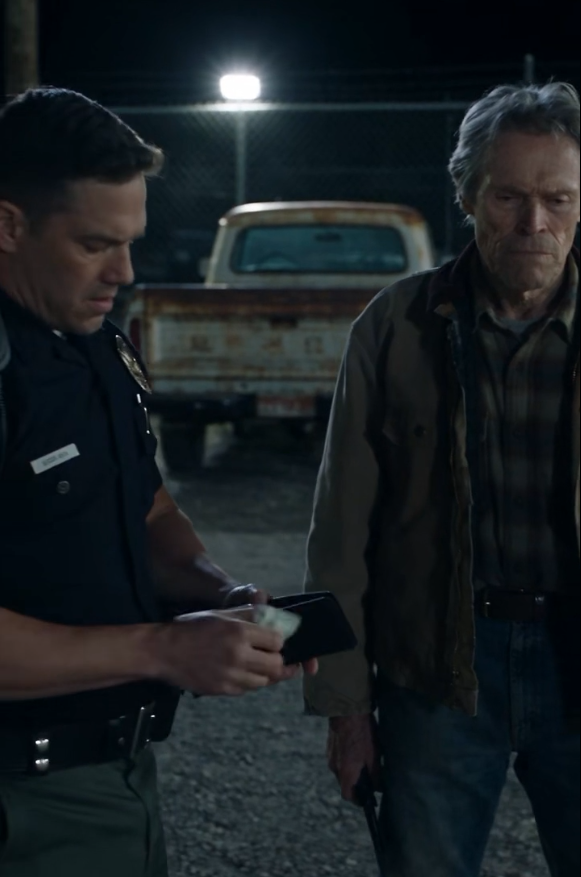
The yellow carbon release slip was still damp from the front-office counter when Officer Ryder tore it out of my hand.
He crushed it once in his fist, dropped it into the gravel beside my left boot, and reached directly into the breast pocket of my faded work jacket.
I went still.
At sixty-eight, stillness came easier to me than speed. My knees had been warning me about the weather since October, and that night the damp cold settled into every joint like it intended to stay until spring. But even if I had been twenty-eight instead of sixty-eight, I would not have jerked away from a uniformed officer with a badge on his chest and a duty belt at his waist.
Ryder pulled out my old leather billfold and flipped it open.
The wallet had belonged to me longer than either of the officers had probably been on the force. The corners were rubbed smooth, the stitching had separated near the fold, and a faint rectangle from an old photograph showed through the leather where I had kept the same picture for years before it faded beyond saving.
Ryder did not care about any of that.
He cared about the cash.
Five one-hundred-dollar bills.
The remainder of my monthly pension.
Heating oil and groceries through the end of November.
He counted them slowly enough for me to understand that the humiliation was part of the transaction.
"Five hundred more," he said.
He folded the money once and slid it into his trouser pocket.
Officer Miller stood several feet away, leaning against the passenger side of the cruiser. His arms were loose at his sides. His attention seemed fixed on the empty service road leading away from the impound yard.
"Gate fee," Ryder continued. "County surcharge. Whatever helps you sleep tonight, old man."
Behind the chain-link fence, my pickup waited under a humming halogen light.
Thirty years old.
Rust along the wheel wells.
A bent front fender from an argument with a concrete post two winters earlier.
The bed was loaded with my late brother's carpentry tools beneath a stained canvas tarp: two hand planes, clamps, a battered level, a circular saw, and an oak toolbox he had built himself when he was nineteen.
The truck was worth less than some people's monthly rent.
The tools were not.
Fifteen minutes earlier, inside the impound office, I had paid the two-hundred-dollar municipal release charge and watched the clerk stamp the yellow form PAID. She had signed beneath it and slid the carbon copy across the counter to me.
There had been no gate fee.
No county surcharge.
No second payment.
I knew that because I had asked.
Twice.
The clerk had looked at the receipt, then at me.
"You're clear," she'd said. "That's everything."
Now Ryder's boot stood less than a foot from the paper proving it.
"That's all the cash I have until the first," I told him.
The wind came hard across the asphalt and slipped through my flannel shirt.
My voice stayed level.
Ryder smiled without warmth.
"Then you should be grateful we're giving you the keys at all."
He tossed the empty wallet at me.
It hit my collarbone, bounced off my jacket, and landed in the dirt beside the crumpled release slip.
Miller shifted against the cruiser.
For the first time, he looked directly at Ryder.
"Let's roll," he said. "Shift change at nine."
Ryder did not acknowledge him.
He was looking at me, waiting.
I understood what he wanted.
He wanted me to bend down.
He wanted the old man on his knees in the gravel collecting his own property after being relieved of five hundred dollars.
So I stayed upright.
My right hand moved slowly toward my coat pocket.
Ryder's eyes followed it.
I took out my flip phone.
The plastic shell was cracked near the hinge. The screen had a pale blue line running through the middle. My brother used to tell me I kept things until they became archaeological artifacts.
The phone was already connected.
It had been connected since I stepped out of the office vestibule.
I raised it to my ear.
"We have all the evidence," I said.
Ryder paused with one hand on the driver's door.
His jaw changed first.
Not much.
Just a brief tightening.
Then the smile came back.
"Who you talking to, Walter?" he asked. "The mayor?"
He opened the cruiser door.
Before his boot reached the floorboard, the speaker clipped to his shoulder erupted in a burst of feedback.
The noise cut through the lot sharp enough to make Miller straighten.
Ryder turned his head.
The radio hissed.
Then a voice came through it.
His voice.
Thin through the small speaker, but unmistakable.
"Five hundred more. Gate fee. County surcharge. Whatever helps you sleep tonight, old man."
The words bounced off the metal siding of the impound office.
Nobody moved.
The recording played again.
Then came the soft, dry sound of money being handled.
Miller pushed away from the cruiser.
"What the hell is that?"
Ryder grabbed his shoulder microphone.
"Dispatch?"
No answer.
The red transmission light was dark.
The recorded voice started again.
Ryder tore the mic free of his epaulet and stared at it as if the thing had turned against him.
Miller stepped closer.
"Ryder, what channel are you on?"
"I don't know."
"You switched?"
"No."
The confidence had drained from Ryder's face.
He looked at the cruiser radio, then toward the impound office windows.
Finally, he looked at me.
I kept the phone beside my ear.
The voice on the other end had not spoken for almost a minute.
Then a woman said quietly, "Mr. Hale, stay where you are."
Ryder heard the faint sound from the phone.
His attention shifted to it.
"Give me that."
He took one step toward me.
Miller moved between us.
Not dramatically.
He simply stepped sideways and raised one hand.
"Leave the phone."
Ryder stared at him.
"What?"
"I said leave it."
Something passed between them then.
Not surprise.
Recognition.
That was the first detail I noticed that did not fit.
Before I could make sense of it, headlights appeared at the far end of the access road.
Two vehicles.
No sirens.
They came quickly.
Ryder turned toward them.
Miller exhaled through his nose.
The first vehicle stopped behind the cruiser. The second angled across the exit.
Three people got out.
Two wore plain clothes beneath dark jackets. The third wore a uniform different from Ryder's and Miller's.
The woman on my phone said, "You can lower the phone now, Mr. Hale."
I did.
Ryder looked at Miller.
"You knew?"
Miller did not answer.
The plainclothes woman approached us.
She was in her forties, maybe, with dark hair pulled back and the compact movements of someone who disliked wasting time.
"Officer Ryder," she said, "keep your hands visible."
His mouth opened.
She did not raise her voice.
"Do not touch your radio. Do not touch your belt."
Ryder's hands stayed at his sides.
The second plainclothes investigator walked to Miller.
Miller handed over his service weapon without being asked twice.
Ryder saw that.
His face changed again.
"You knew," he repeated.