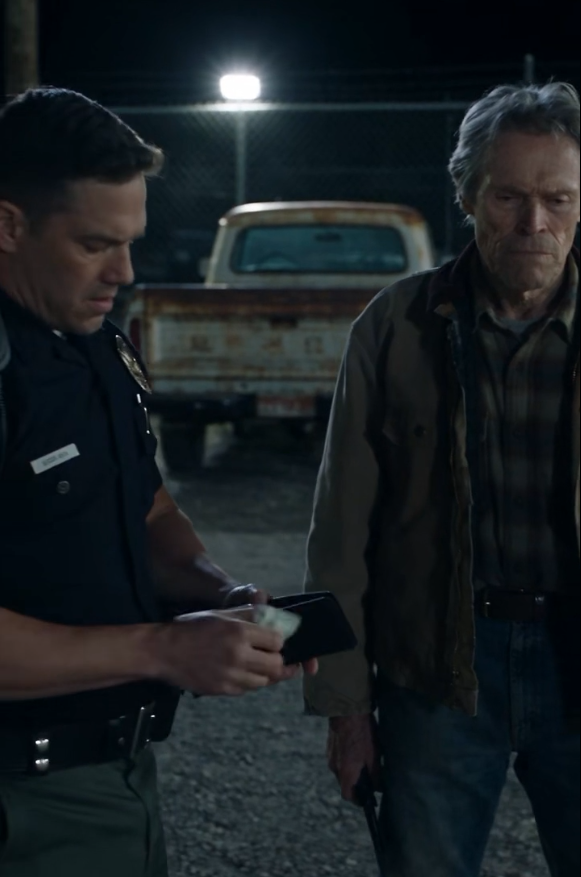
"I paid the impound fee."
"I know."
"You keep saying that."
"I do know, Mr. Hale."
"Knowing and unlocking the gate seem to be separate departments."
She let the comment sit.
That earned her more credit with me than an apology would have.
Finally she said, "Give me ten minutes."
It took twenty-seven.
At 10:16 p.m., the chain-link gate rolled open.
My pickup coughed twice before the engine turned over.
The investigator had arranged for the vehicle to be photographed and released without disturbing the tools in the bed.
My five hundred dollars remained in an evidence envelope.
Mercer gave me a property receipt for it.
"You'll get it back."
"When?"
"I can't promise."
"That's usually another way of saying not soon."
"It may be several days."
I folded the receipt.
She watched me put it in my wallet.
"Do you have heat tonight?"
"Yes."
"Enough?"
"I said yes."
It was technically true.
The furnace would run.
How long depended on the weather.
She wrote something on the back of her business card.
"If that changes, call me."
"I'm not asking the city to buy my heating oil."
"I'm not offering to buy your heating oil."
"What are you offering?"
"Information. So you don't have to guess where your money is."
I took the card.
That was a better answer.
As I reached the door, Mercer said my name.
"Mr. Hale."
I turned.
"You did the right thing."
I looked at her for a moment.
Then at the evidence receipt.
"Ask me again when I get my five hundred dollars."
I drove home with my brother's tools rattling softly under the tarp.
The house was dark except for the porch light.
I had lived there for thirty-nine years.
The kitchen linoleum had cracked in the same place twice. The bathroom door stuck during humid weather. The gutters needed cleaning, and every November I promised myself I would hire someone instead of climbing a ladder.
I put the thermostat at sixty-two.
Then I stood in the basement and tapped the side of the heating-oil tank with my knuckles.
Hollow higher up.
Dull lower down.
Not empty.
Not generous.
I went upstairs and made toast.
At 11:43, my phone rang.
I almost ignored it.
The display showed a number I did not know.
"Hello?"
There was silence.
Then breathing.
"Who is this?"
The line disconnected.
I stared at the phone.
Thirty seconds later it rang again.
Same number.
This time I answered and said nothing.
A male voice spoke.
"You should've taken your truck and gone home."
The line went dead.
I stood in my kitchen with the phone still against my ear.
The refrigerator motor clicked off.
The house became very quiet.
I called Mercer.
She answered on the second ring.
When I told her what had happened, the first thing she asked was whether the doors were locked.
"Yes."
"Did you recognize the voice?"
"No."
"Did the caller identify himself?"
"No."
"What exactly did he say?"
I repeated it.
Mercer went quiet for a moment.
Then she said, "Don't delete the call log."
"I wasn't planning to."
"I'm sending a patrol car past the house."
"No."
"Mr. Hale—"
"No uniformed car parked outside my house. My neighbors don't need a show."
"It won't park."
"I don't need protection."
"This isn't about pride."
"Good. Because I'm too old to have much left."
She almost laughed.
Almost.
"Keep your phone beside you," she said. "If anyone comes onto the property, call immediately."
"All right."
"And don't open the door."
"I made it sixty-eight years without that instruction."
"Humor me."
I hung up.
No one came.
But I did not sleep much.
At seven the next morning, someone knocked.
Three measured taps.
I looked through the curtain.
Officer Miller stood on my porch in civilian clothes.
Part III — The Man Who Watched
I opened the door but left the storm chain attached.
Miller wore jeans, a navy jacket, and a gray sweatshirt underneath. Without the uniform, he looked smaller.
Not physically.
Ordinary.
The badge had added geometry to him the night before—straight lines, polished metal, authority built into the silhouette.
Now he looked like a tired man who had not slept.
"What are you doing here?"
"I need five minutes."
"Investigator Mercer know you're here?"
"No."
"Then you need fewer than five."
His eyes lowered.
"Fair."
He looked toward the street.
No cars were passing.
"That call last night," he said. "It wasn't Ryder."
"How would you know?"
"Because they took our phones."
"Our?"
"Mine too."
"You have another?"
"No."
"Then maybe Ryder borrowed somebody else's."
Miller nodded.
"Maybe."
I started to close the door.
He put his hand up but did not touch it.
"Mr. Hale, wait."
I stopped.
"I didn't come to defend him."
"Good."
"I came because they're going to ask you about me."
"They already did."
His face tightened.
"What'd you tell them?"
"The truth."
"Which part?"
"All the parts I saw."
He looked past me into the house.
"Can I come in?"
"No."
He accepted that.
For a few seconds we stood with the storm door between us.
Finally he said, "I've been documenting him for four months."
I did not answer.
"Ryder."
"I know who you mean."
"I filed an internal complaint in July."
"Then why were you leaning on the cruiser while he took my money?"
His jaw worked once.
"Because every time I challenged him directly, he stopped."
"Sounds effective."
"For the person standing there, yes."
"That person was me."
"I know."
"You watched him take five hundred dollars out of my wallet."
"I know."
"You're saying that a lot too."
He looked down at the porch boards.
"When I first reported him, they asked for documentation. Times, dates, names. I had suspicions. No complainants willing to sign statements. No clean audio."
"So you waited for one."
"I didn't know it would be you."
"But when it was?"
He met my eyes.
"I knew the public integrity team was already monitoring his radio activity."
"Monitoring isn't the same as stopping."
"No."
"Was last night planned?"
"No. Not like that."
"Then explain it."
Miller rubbed a thumb over the edge of his jacket zipper.
"Ryder liked the impound detail because people showed up alone, late, angry, tired, and usually desperate to get their vehicle. He'd started calling the extra money a gate fee. Sometimes storage adjustment. Sometimes after-hours processing."
"How many times?"
"I don't know."
"Guess."
"I won't."
"Convenient."
His eyes hardened for the first time.
"You think I don't know what I did?"
"I don't know what you think."
"I watched too long."
There it was.
Not an excuse.
At least not yet.
He continued.
"I wrote down plate numbers when I could. Dates. Amounts if I heard them. I copied shift logs. A month ago I gave everything to public integrity."
"And last night?"
"They told me not to interfere unless someone was in danger."
I stared at him.
"They told you to watch officers steal cash from people?"
"They told me they needed evidence that would survive the investigation. Ryder had already accused two complainants of offering bribes. One backed out. The other changed his statement."
"So you needed an old man with a cheap truck."