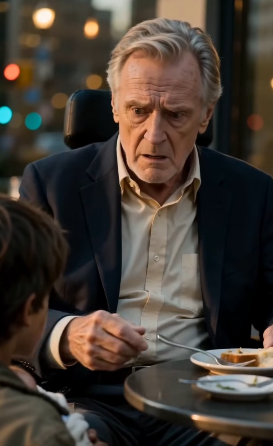
The old man was halfway through his meal when the boy dropped to his knees in front of him. He did it so suddenly that the chair across from the table scraped backward as a passing waiter stumbled to avoid him, and within seconds, half the sidewalk café had begun staring.
The boy looked no older than twelve. Dirt darkened the knees of his trousers, his shoes were splitting at the toes, and in his thin arms he carried a sleeping baby wrapped in a faded blanket while two smaller children hovered behind him like shadows.
Arthur Bellamy froze with his fork halfway to his mouth.
“What are you doing?”
The boy carefully raised the sleeping infant toward him. “This one can heal your legs.”
For one second, Arthur simply stared. Then he laughed so sharply that the youngest child behind the boy flinched and grabbed the sleeve of the girl beside him.
“You expect me to believe that?”
The boy remained on his knees. His eyes were wet, but there was something stubborn in them that made Arthur’s amusement begin to fade.
“Just let her touch you.”
Arthur lowered his fork.
The baby shifted inside the blanket, and one tiny hand slipped free. Arthur’s gaze dropped toward the wheelchair beside the table, then toward the legs that had not obeyed him properly in nearly seven years.
His fingers tightened.
“Wait.”
The boy rose just enough to bring the baby closer. His arms were trembling badly now, whether from fear, exhaustion, or the weight of the infant Arthur could not tell.
Arthur stared at the baby’s hand.
Then at the boy.
“You have five seconds to explain what kind of trick this is.”
The boy swallowed. “It isn’t a trick.”
A woman at the neighboring table whispered something to her husband. Someone farther down the café lifted a phone, and Arthur immediately noticed it.
He hated being watched.
Seven years earlier, Arthur Bellamy had been the kind of man whose arrival made people stand. He had built Bellamy Construction from two rented trucks into one of the largest private development companies in the state, bought restaurants without looking at prices, and once fired an executive for arriving eleven minutes late to a board meeting.
Then a highway accident had crushed part of his spine.
The surgeons saved his life but not the life he recognized.
Arthur could move his legs slightly. He could feel pressure. On good days, he could stand between parallel bars for several seconds. But walking independently had remained beyond him despite surgeries, specialists, experimental treatments, and enough money spent on rehabilitation to purchase the entire block where he now ate lunch.
The doctors had eventually stopped promising.
Arthur had not stopped being angry.
The boy standing before him knew none of this, but he could see the expensive wheelchair, the tailored coat, the silver watch, and the polished cane strapped uselessly along one side.
Arthur leaned back. “Who sent you?”
“Nobody.”
“You saw a rich cripple sitting alone and decided to perform a miracle?”
The girl behind the boy lowered her eyes.
Arthur noticed.
For the first time, shame pricked somewhere beneath his irritation.
The boy hugged the baby closer. “I didn’t call you that.”
“No. But that’s what you’re thinking.”
The boy shook his head. “I was thinking you looked sad.”
Arthur’s expression changed.
The café noise seemed to return all at once: dishes touching porcelain, buses sighing at the curb, shoes against pavement, the low conversation of strangers pretending not to listen.
Arthur looked away. “You’re wasting your time.”
The boy did not move.
Arthur picked up his fork again. “Go.”
The smallest child behind the boy whispered, “Eli.”
The boy glanced back.
She looked six, perhaps seven. Her cheeks were hollow, and she was rubbing her hands together against the cold.
“We should leave.”
Eli’s shoulders sagged.
That was when Arthur noticed the children were not watching his food politely.
They were staring at it because they were hungry.
His plate held roasted chicken, potatoes, bread, and vegetables he had barely touched.
Arthur set down the fork again.
“When did you last eat?”
Eli’s jaw tightened. “We’re not asking for food.”
“That wasn’t my question.”
The girl answered before her brother could stop her. “Yesterday.”
Eli turned sharply. “Maya.”
“What?” she whispered. “I’m hungry.”
Arthur looked at the smallest boy standing beside her, then at the baby in Eli’s arms.
Something uncomfortable moved through him.
He had spent years training himself not to feel pity, especially toward himself. Yet these children were standing three feet away in clothing too thin for the season while a plate worth more than their day’s meals cooled in front of him.
Arthur raised one hand toward the waiter.
“Bring four plates.”
Eli immediately shook his head. “No.”
Arthur frowned. “No?”
“We didn’t come to beg.”
“You dropped to your knees in front of my table.”
“For her.”
Eli looked down at the baby.
Arthur studied him carefully.
“What is she to you?”
“My sister.”
“And the others?”
“My brother and sister.”
“Where are your parents?”
Eli’s face closed.
Arthur knew the expression. He had seen it across negotiating tables whenever someone was protecting the only thing they still possessed.
“They’re gone,” Eli said.
Arthur waited, but the boy offered nothing more.
The waiter arrived hesitantly.
Arthur pointed toward an empty table. “Bring them whatever they want.”
Eli stepped backward. “We can’t pay you.”
“I didn’t ask you to.”
“We don’t take things for free.”
Arthur almost smiled. “Then consider it payment for entertaining me with the most ridiculous medical claim I’ve heard in seven years.”
Maya looked at the food.
Eli looked at Maya.
That ended the argument.
They moved to the neighboring table, though Eli kept the baby in his arms as he sat. Arthur watched the transformation when the food arrived. The children tried to eat slowly at first, almost ceremoniously, but hunger soon defeated manners.
The smallest boy stuffed half a bread roll into his mouth at once.
Maya whispered, “Slow down, Noah.”
Noah nodded while continuing to chew far too quickly.
Arthur looked away.
He suddenly felt like an intruder.
Eli ate last. He tore pieces of chicken apart with one hand while keeping the baby supported against his chest with the other.
Arthur watched him struggle for several minutes.
“Give her to me.”
Eli stopped chewing.
Arthur gestured impatiently. “You can barely use your fork.”
“No.”
“You wanted her to touch me five minutes ago.”
“That was different.”
“How?”
Eli looked at Arthur’s wheelchair. “I didn’t know if you were safe.”
Arthur stared at him.
Then, despite himself, he laughed.
This time there was no cruelty in it.
“You approached me.”
Eli glanced around the café. “There were people here.”
Arthur understood.
The boy had chosen a crowded place deliberately.
“Smart.”
Eli didn’t answer.
Arthur extended his arms. “Eat.”
After several seconds, Eli stood and crossed the narrow distance between their tables.
He lowered the baby slowly.
Arthur had held almost nothing more fragile than a wineglass in years.