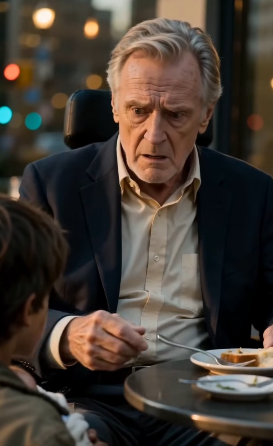
He returned the next morning.
Claire began visiting.
At first she stood behind the glass.
Then she entered.
Neither of them discussed the years they had lost.
They simply occupied the same room again.
Meanwhile, Eli and the children remained together under an emergency kinship arrangement while Claire’s team searched for relatives. Their father could not be located. A maternal aunt living two states away was eventually found, but she was undergoing treatment for cancer and could not care for four children.
The situation became complicated.
Arthur hated complicated situations.
He began attending meetings.
At the first one, a caseworker politely explained that money could not simply solve every problem.
Arthur leaned toward her.
“I have discovered that people usually say that shortly before explaining a problem money can help solve.”
Claire kicked his wheelchair lightly.
“Dad.”
“What?”
“Be nice.”
“I am being efficient.”
But the caseworker was right.
The children needed legal stability, emotional support, schooling, health care, documentation, and a long-term placement capable of keeping the siblings together.
So Arthur did something he had rarely done during his business career.
He listened.
Weeks turned into months.
Eli entered school again.
Maya began drawing constantly.
Noah gained six pounds.
Grace learned to pull herself upright using furniture, which delighted everyone except Arthur, who claimed she was showing off.
One afternoon, the children visited his rehabilitation session.
Arthur was inside the parallel bars.
Eli stopped in the doorway.
Arthur noticed him.
“You’re late.”
“We had school.”
“Poor excuse.”
Eli smiled.
Grace, now in Claire’s arms, began bouncing excitedly when she saw Arthur.
Claire lowered her to the padded floor.
The baby crawled toward him.
Arthur stared.
“No.”
Grace kept coming.
“Absolutely not.”
Lena laughed. “She doesn’t seem intimidated.”
“She has terrible judgment.”
Grace reached the outside of the bars and pulled herself upright.
Arthur gripped the rails.
His knees trembled.
He was practicing steps now.
They were small, assisted movements, nothing anyone sensible would call walking independently.
But they were steps.
Grace reached through the bars.
Her hand opened toward him.
The room became silent.
Arthur looked at Eli.
The boy was watching him with exactly the same expression he had worn at the café months before.
Hope.
Ridiculous, unreasonable hope.
Arthur moved his right foot.
Then his left.
His face tightened with pain.
Claire put one hand over her mouth.
Arthur took another step.
Grace squealed.
He nearly lost his balance.
Lena moved closer, but Arthur shook his head.
One more.
Then another.
By the time he reached the end of the bars, sweat covered his forehead.
Grace slapped both palms against the rail.
Arthur lowered himself into the chair.
Nobody spoke.
Arthur looked at Eli.
“Still think she healed me?”
Eli smiled.
“I told you.”
Arthur shook his head. “She did not heal my spine.”
“No.”
“She didn’t repair nerves.”
“I know.”
“She has no medical qualifications whatsoever.”
Eli laughed.
Arthur looked toward Grace.
Then toward Claire.
His voice softened.
“But she reminded me I was still alive, and apparently that was the part of me that needed treatment.”
Claire turned away because she was crying.
Arthur pretended not to notice.
Almost a year after the café encounter, the children moved into a renovated house owned by the Bellamy Family Foundation, where they lived with a licensed foster couple experienced in keeping sibling groups together. Arthur refused to call the arrangement charity.
He called it infrastructure.
Eli called it home.
The abandoned train station was later purchased by Bellamy Construction and converted into a transitional family center. When reporters asked why a seventy-three-year-old developer had suddenly become obsessed with emergency housing for families, Arthur refused to tell them the complete story.
He simply said he had been eating lunch one afternoon when someone interrupted him.
The better answer came months later.
Arthur returned to the same sidewalk café with Claire and the children.
He still used his wheelchair for longer distances.
He probably always would.
But when Eli arrived carrying Grace, Arthur locked the wheels.
Then he reached for his cane.
The café owner came outside.
Several staff members stopped to watch.
Arthur pushed himself upright.
His legs shook.
He steadied himself.
Grace, nearly two now, wriggled free from Eli and toddled toward him.
Arthur took one careful step.
Then another.
She reached him and wrapped both arms around one of his knees.
Arthur nearly fell.
Claire gasped.
Arthur grabbed the table and began laughing.
Eli rushed forward.
“I told you she could heal your legs.”
Arthur looked down at Grace, then at the boy who had once knelt on this same pavement because desperation had convinced him that the only valuable thing he possessed was a miracle.
Arthur placed one hand on Eli’s shoulder.
“No.”
Eli’s smile faded slightly.
Arthur looked around the table at Maya, Noah, Claire, and Grace.
Then he looked at the wheelchair behind him.
“She didn’t heal my legs, Eli. You children gave me a reason to use them again.”
Eli lowered his eyes.
Arthur squeezed his shoulder.
“And for the record, you never needed to offer anyone a miracle to deserve a meal.”
Eli’s face crumpled.
He tried to turn away.
Arthur pulled him closer.
For several seconds, the boy resisted out of instinct, pride, and years of having to be older than he was.
Then he stopped.
He leaned into Arthur’s chest and cried.
Not quietly.
Not carefully.
Like a child.
Arthur held him.
Around them, the café continued moving. Forks clinked against plates. Cars passed. Warm light glowed through the windows, and strangers talked without knowing that almost a year earlier, four hungry children had stood beside that same table believing they had nothing to offer except a baby’s touch.
Arthur knew better now.
Grace had never carried a miracle in her hands.
The miracle, if there was one, had been much less magical and far more difficult: a desperate boy had trusted a bitter stranger for five seconds, and the stranger had finally chosen not to look away.
From that choice came a meal.
From the meal came a conversation.
From the conversation came a safe room, then a home, then treatment, school, rehabilitation, reconciliation, and dozens of other ordinary acts that would never sound miraculous when listed separately.
Arthur glanced at his cane.
Then at Grace.
Perhaps that was why people misunderstood miracles.
They expected thunder, light, or impossible bodies suddenly made whole.
Sometimes a miracle was simply the moment someone who had given up decided to try again.
And sometimes it began because a hungry boy knelt beside a stranger and said the one thing desperate enough to make him listen.