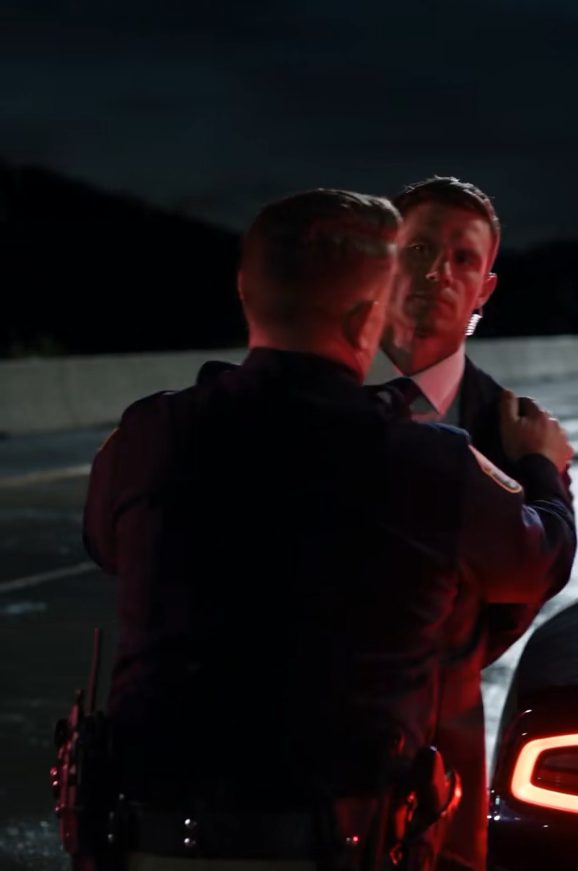
Mitchell’s eyes stayed on me.
“But questioning something and isolating yourself from every answer are not the same thing.”
No one interrupted.
“The moment he turned off his radio because he expected dispatch to disagree with him, the issue stopped being the plate. The moment he disabled the camera because he expected supervisors to judge his choices, the issue stopped being verification. He built a situation where only his conclusion could survive.”
The attorney returned to his table.
The panel chair asked me a final question.
“Agent, if you were in command of Officer Mitchell, what would concern you most?”
I thought about the highway.
The empty lanes.
The cold trunk under my chest.
His dead radio.
The headlights appearing over the hill.
Not the cuffs.
Not the arrogance.
Not even the fact that he had been wrong.
“The fact that he made disagreement impossible.”
The chair nodded.
“No further questions.”
I stepped down.
Outside the hearing room, I expected Harris.
Instead, Mitchell came out fifteen minutes later.
He stopped when he saw me.
Neither of us spoke at first.
His badge was no longer on the table.
It was in his hand.
He turned it over once.
“I’m done.”
I didn’t know whether he meant the hearing or the job.
“What happened?”
“Suspension upheld. Reinstatement possible after review, retraining, fitness evaluation.”
“So you’re not done.”
He gave a humorless smile.
“Maybe I am.”
I waited.
He looked at the badge.
“They gave me the option to resign.”
“What are you going to do?”
“Don’t know.”
That answer sounded more honest than anything he had said on the highway.
He put the badge in his pocket.
“I thought you’d bury me in there.”
“I told them what happened.”
“You also told them the plate system failed.”
“It did.”
“You didn’t have to.”
“Yes, I did.”
He shook his head.
“Your agency could’ve made me the whole problem.”
“You were enough of the problem.”
That almost made him laugh.
Almost.
Then he became serious.
“I keep thinking about something you said.”
“What?”
“That I made disagreement impossible.”
I leaned against the wall.
Mitchell stared through the glass doors at the parking lot.
“When I was a rookie, my field-training officer used to say hesitation gets people hurt.”
“Sometimes it does.”
“He hated indecision. Said once you had enough facts, make the decision and own it.”
“Reasonable advice.”
“Yeah.”
He rubbed his thumb along the edge of his pocket where the badge rested.
“I think somewhere along the way I changed ‘own the decision’ into ‘defend the decision.’”
I said nothing.
He didn’t need help reaching the rest.
“And then I changed ‘defend it’ into ‘don’t let anybody stop you.’”
A group of employees passed through the hallway.
Mitchell waited until they were gone.
“I really thought you were fake.”
“I know.”
“I thought when your people showed up, I’d be proven right.”
“That must have been an interesting ten seconds.”
This time he did laugh.
One short breath.
“Yeah.”
Then he looked at me.
“When those headlights came over the hill, I knew.”
“That I was federal?”
“No.”
He shook his head.
“That I had already decided what every answer meant before I asked the question.”
That was the first thing he had said that made me believe the incident might actually change him.
He started toward the exit.
I called after him.
“Mitchell.”
He stopped.
“If you go back, leave the radio on.”
He nodded.
“I will.”
Then he walked out.
Part VI — The Open Channel
Six months later, I was back on an interstate at night.
Different state.
Different protectee.
Different operation.
But highways under closure all begin to look alike.
Dark lanes.
Distant overpasses.
Reflective barricades.
The low wash of emergency lights against concrete.
I stood beside my sedan at an advance checkpoint while local dispatch completed the final unit acknowledgment.
“South sector, verify.”
A voice answered.
“South sector secure.”
“West access.”
“Secure.”
“Maintenance entry.”
“Secure.”
One by one.
Every officer.
Every unit.
Every location.
My terminal showed the vehicle verification in green.
No pending synchronization.
No delayed token.
No ambiguity.
The local patrolman assigned to my checkpoint stood fifty feet away beside his cruiser.
His radio was loud enough that I could hear dispatch through the open window.
Not because anyone had ordered him to turn it up.
Because an open channel had become part of the culture around these movements.
That was the practical aftermath.
The policy memo was six pages.
The lesson fit inside one sentence.
Do not remove the system that can prove you wrong.
Harris walked over carrying two coffees.
He handed me one.
I smelled it.
“Still terrible?”
“Government consistency.”
He stood beside me and looked down the empty highway.
“You hear about Mitchell?”
I glanced at him.
“No.”
“Went back.”
“To patrol?”
“After retraining.”
That surprised me.
“Same agency?”
“Yes.”
“How’s that going?”
“Apparently quiet.”
“Quiet is good.”
Harris took a sip.
“He teaches a block now.”
“On what?”
“Decision-making under uncertainty.”
I looked at him.
“You’re kidding.”
“I am not.”
“Who thought that was a good idea?”
“Probably somebody who understands irony.”
I stared out at the road.
Somewhere behind us, the primary package had begun moving toward the route.
Seven minutes away.
I touched my earpiece.
Clear signal.
Dispatch traffic steady.
Every piece connected.
Harris said, “He uses the incident.”
“The checkpoint?”
“Yes.”
“With our information?”
“Sanitized version.”
I tried to imagine Mitchell standing in front of a room full of young officers, explaining how confidence had put his knee into the thigh of a federal agent while an armored motorcade came over the horizon.
“What does he tell them?”
Harris looked at his coffee.
“I heard he starts by asking what they should do when they know dispatch is wrong.”
“And?”
“Everybody gives the obvious answers. Verify independently. Request a supervisor. Use another channel. Maintain observation.”
“Reasonable.”
“Then he asks how many of them would turn off the radio.”
I smiled despite myself.
“Nobody.”
“Exactly.”
A voice came through my earpiece.
“Echo One, Command. Primary is five minutes.”
I touched the transmit switch.
“Copy.”
Harris looked toward the checkpoint.
“You ready?”
I checked the road.
Barricades secured.
Local unit visible.
Cross traffic locked.
Vehicle verification green.
Communications open.
The things that mattered were rarely dramatic when they worked.
“Almost.”
I walked toward the local cruiser.
The patrolman straightened when he saw me.
“Everything good?” he asked.
“Radio check.”
He gave me an amused look.
“You can hear it from there.”
“I know.”
He lifted the microphone.
“Dispatch, Delta local. Radio check.”
“Delta local, loud and clear.”
He returned the mic to its mount.
“Satisfied?”
“Yes.”
“You federal guys really love radios.”
“More than I used to.”
He had no idea what that meant.
He didn’t need to.
I returned to the sedan.
Four minutes.
The highway ahead was black.
For a moment, memory put another patrol cruiser across the lane.
Another officer behind me.
Cold steel around my wrists.
A dangling earpiece.
A dead radio.
Then the image disappeared.
The present was quieter.
Better.
The primary package called three minutes.
I drove the final sweep.
At the crest of the hill, the road opened below me.
The checkpoint lights formed a clean line.
No unauthorized vehicles.
No movement inside the sterile zone.
Every local unit exactly where it had reported.
At Delta, I slowed.
The patrolman raised a hand from beside his cruiser.
Not to stop me.
Just acknowledgment.
I returned it.
Then I touched the switch beneath my tie.
“Command, Echo One.”
“Go, Echo.”
I looked through the windshield at an empty, secure highway and thought about how close we had come to treating the entire incident as one arrogant officer’s mistake.
That would have been easier.
We could have fired him, changed nothing, and congratulated ourselves for identifying the problem.
Instead, Mitchell had been held responsible for his choices.
We had been held responsible for ours.
The database changed.
Vehicle swaps changed.
Acknowledgment procedures changed.
Local briefings changed.
And Mitchell, if Harris was right, had changed too.
Not because twelve armored vehicles frightened him.
Because eventually he had understood why they had appeared.
He had cut himself off from every voice that might have corrected him.
I looked at the glowing communications panel.
Every channel alive.
Every unit reachable.
“Delta secure,” I said.
Command answered immediately.
“Copy, Echo One. Primary continues.”
Far behind me, headlights began appearing over the rise.
This time there was no confusion in their path.
No cruiser blocking the lane.
No officer standing alone with a conclusion he had made impossible to challenge.
I eased onto the shoulder and watched the formation approach.
Six months earlier, the sight of those headlights had meant rescue.
Now I understood it differently.
The strongest part of the system had never been the armor, the weapons, the federal credentials, or the authority attached to the motorcade.
It was the open channel.
The possibility that someone, somewhere, could still say:
You’re wrong.
And be heard.
The motorcade swept past.
I stayed beside the road until the final vehicle disappeared into the dark.
Then the local patrolman’s voice came through the shared frequency, calm and ordinary.
“Delta clear.”
I pressed my transmit switch.
“Copy.”
And this time, nobody had turned the radio off.