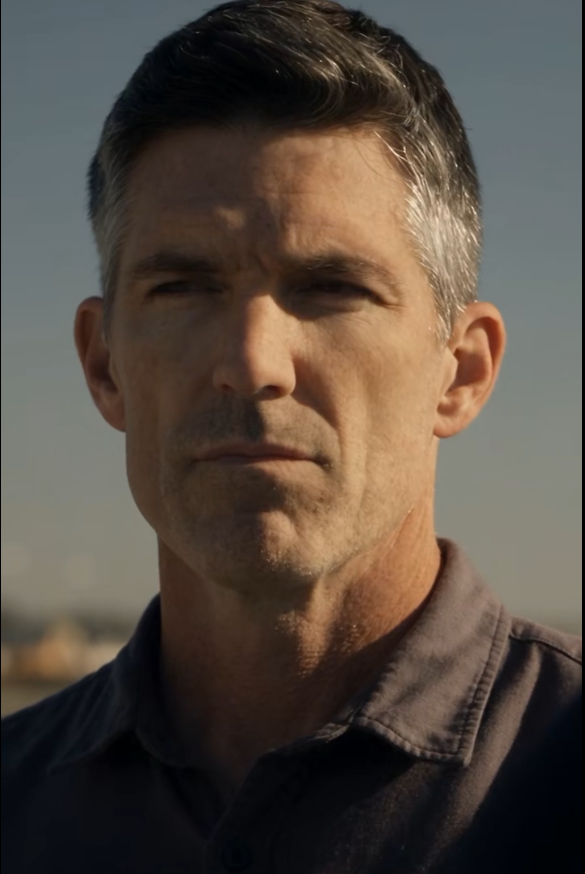
"Problem?"
"No."
"What are you looking at?"
"Nothing yet."
I pressed restore.
The cruiser came back to life.
The dispatch screen rebooted.
Console lights illuminated one after another.
Then the radio burst into sound.
"—Unit forty-four, status check. Unit forty-four, acknowledge."
Brady instinctively moved toward the vehicle.
The sergeant stopped him.
"I'll answer."
He picked up the microphone.
"Dispatch, supervisor on scene. Unit forty-four secure. Communications restored. Hold unit out of service pending technical review."
A dispatcher acknowledged.
Then another voice cut onto the channel.
"Supervisor, municipal network security is requesting the unit remain physically stationary. Diagnostic event has been flagged for audit."
The sergeant slowly lowered the microphone.
Brady looked at me.
"What did you flag?"
"I didn't."
"You did something."
"The system flags itself."
"Convenient."
"No."
I slipped the terminal into my pocket.
"It's inconvenient by design."
The sergeant rubbed his forehead.
"Anybody armed besides the two people who are supposed to be?"
Neither of us answered.
He looked at Brady.
"That was rhetorical."
Then he turned to me.
"You're coming to the precinct."
"Am I under arrest?"
"Not at this moment."
"Then I'll drive myself."
The sergeant considered it.
"Fine. You'll follow me."
Brady protested.
"Sergeant—"
"You are not driving Unit forty-four."
"What?"
"Municipal security just told me to freeze the vehicle."
"My gear's in there."
"It can stay there."
Brady looked at me again.
I saw the moment he understood that the dead radio had stopped being a private contest between us.
It had become a record.
And unlike people, records do not get intimidated by uniforms.
The sergeant pointed toward his vehicle.
"Brady, you're riding with me."
"Why?"
"Because I'm not leaving you standing on the shoulder."
Brady's face hardened.
The sergeant's voice dropped.
"And because right now I want both of you where I can see you."
That included me.
I appreciated the fairness more than I wanted to.
We drove to the precinct in a short line: the sergeant's cruiser first, my sedan behind, Unit 44 remaining on the shoulder beneath the late-afternoon sun.
My taillights worked perfectly the entire way.
Part III — The Snapshot
The precinct interview room had no windows and too much air conditioning.
I had been inside municipal buildings like it a hundred times while installing network equipment.
They always looked different when the door was closed behind you.
A metal table.
Four chairs.
Beige walls.
A camera mounted high in one corner.
I sat with my prosthetic leg stretched slightly forward beneath the table because the socket had begun rubbing badly.
My watch was still in Brady's pocket.
That bothered me more than it should have.
Not because of its monetary value.
There wasn't much.
The city had ordered hundreds of them over the years.
Mine mattered because twenty years had been compressed into a few engraved lines.
Twenty years of overnight migrations, failed vendor upgrades, emergency patches, hurricane drills, budget hearings, radio cutovers, and the invisible labor of making sure strangers could ask for help and be heard.
Then the accident.
Then the dining room.
Then the uncomfortable realization that a career can continue after the shape of your life changes, but not necessarily in the form you expected.
The door opened.
The sergeant entered with a plainclothes man carrying a city-issued laptop.
The man introduced himself only by department.
"Municipal network security."
I nodded.
He sat across from me.
"Your credential executed the isolation?"
"Yes."
"From your assigned terminal?"
"Yes."
"Any indication Unit forty-four's communications hardware was compromised?"
"No."
"Any technical justification for the command?"
"No."
He typed something.
The sergeant watched me.
"You're making this very easy for him."
"I'm trying to make it accurate."
The network-security officer looked up.
"Why did you use the override?"
"Officer Brady took my watch."
The man's expression stayed flat.
"And?"
"And I was angry."
"You understand that isn't an authorized use."
"Yes."
"You understood it at the time?"
I took a breath.
"Yes."
That answer cost more than the first one.
The security officer stopped typing.
"All right."
The sergeant leaned against the wall.
"Brady says he had reasonable suspicion the watch was stolen."
"Then he should have checked the engraving."
"He says he intended to."
"After putting it in his pocket?"
The sergeant didn't answer.
The door opened again.
A desk officer handed him a clear evidence bag.
Inside was my watch.
My eyes went to it immediately.
The sergeant noticed.
"Recovered from Officer Brady's uniform pocket."
The words were careful.
Not "returned."
Not "found."
Recovered.
He placed the bag on the table.
I could see the back of the watch through the plastic.
The engraving was visible.
My name.
Twenty years.
Municipal Emergency Systems Division.
The sergeant looked at the network-security officer.
"His story checks."
The security officer didn't react.
"I'm not investigating the watch."
"Maybe you should."
"I'm investigating the network event."
The distinction made sense.
I hated it.
Systems divide responsibility because division creates competence.
It also creates gaps people can hide inside.
The security officer rotated his laptop toward me.
"Tell me exactly which path you used."
I described the menu hierarchy.
He compared it against the log.
"You used voice lookup."
"Yes."
"Badge number translated to assigned vehicle."
"Correct."
"You received an active-unit warning."
"Yes."
"You confirmed."
"Yes."
He turned the computer back.
"That's not a good sequence for us."
"I know."
"You helped design it."
"Parts of it."
"So you know why."
"Yes."
He looked at me for a long moment.
"Then why make it so easy?"
I almost gave him a defensive answer.
Instead I said, "Because during a real intrusion, speed matters."
"And today?"
"Today speed was the problem."
Something shifted in his face.
Not forgiveness.
Professional recognition.
He understood what I meant.
The same features that make emergency systems effective can make misuse efficient.
Authority plus speed is useful right up until judgment fails.
The sergeant's phone buzzed.
He checked it.
Then looked at the security officer.
"They're ready for the unit image."
The man stood.
"I need your terminal."
I put a hand over my pocket.
"Under what authority?"
"Administrative security review. It's city property."
He was right.
I removed it and handed it over.
He powered it down.
"You'll get a receipt."
Brady hadn't given me one for the watch.
The contrast did not need explaining.
The sergeant slid the evidence bag toward me, then stopped before it reached my hand.
"Technically we need to document return."
"That's fine."
He filled out a property form.
He read the engraving.
Then he looked at me.
"Twenty years?"
"Yes."
"Doing what?"
"Emergency network architecture."
He glanced toward the door Brady was somewhere beyond.
"That explains some things."
"It doesn't excuse them."
He met my eyes.
"No."
I signed the receipt.
He opened the bag.
The watch felt strangely cold when he placed it in my palm.
There was a shallow scratch near the clasp.
I rubbed my thumb across it.
The sergeant saw.
"Was that there before?"
"I don't know."
That was a lie.
It hadn't been.
But I didn't want one more allegation.
I fastened the watch around my wrist.
The weight settled into its familiar place.
For a moment, that should have been enough.
It wasn't.
The security officer returned forty minutes later.