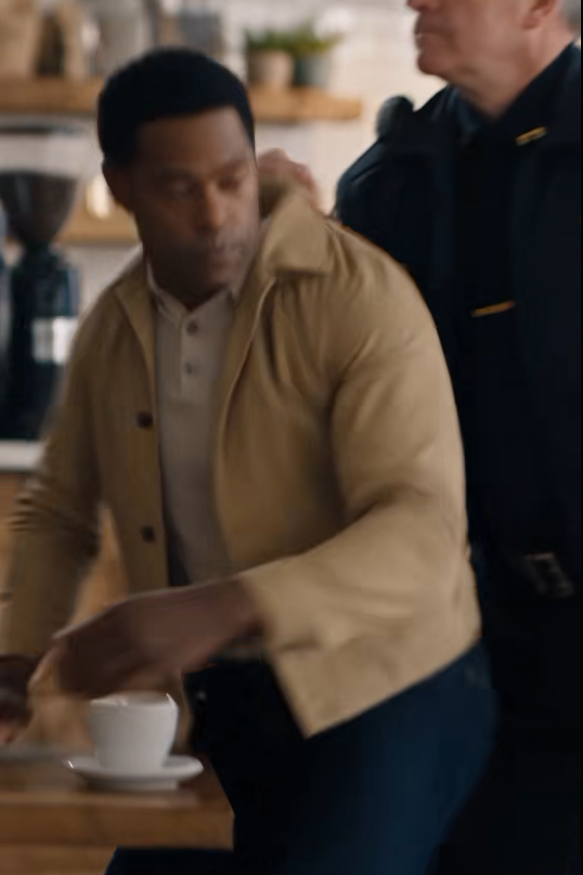
Part I — The Corner Table
The first thing Chief Gerald Thornton did after handcuffing me was announce three crimes I had not committed loudly enough for every person in the coffee shop to hear.
“Trespassing.”
The first cuff ratcheted shut around my right wrist.
“Failure to comply.”
The second locked around my left.
“Resisting arrest.”
He said the last one with satisfaction.
Not anger. Not fear.
Satisfaction.
My chest was pressed against the edge of a scarred wooden table, my newspaper had fallen open on the floor, and the black coffee I had been drinking less than thirty seconds earlier was spreading between broken pieces of ceramic near my shoes.
Around us, Common Grounds had gone quiet.
Not theatrically quiet. People did not freeze with cups suspended halfway to their mouths or stare in collective disbelief.
Real silence is less dramatic.
A spoon stopped tapping against a mug.
A chair shifted.
Someone near the window whispered, “Jesus.”
Then came the faint sound of milk steaming behind the counter.
Ray Coleman was still working.
That mattered.
Chief Thornton pulled my hands higher behind my back.
“You should have listened the first time.”
I turned my face just enough to see him.
He was fifty-six, thick through the shoulders, gray beginning at his temples, police uniform fitted tightly over a body that had once been athletic and had grown heavier without losing its sense of authority. A gold badge sat over his heart. Four rows of commendation bars decorated his shirt.
People who did not know him saw a police chief with twenty-eight years of service.
I saw a man whose name had appeared in forty-seven complaint files, seventeen internal emails, nine witness statements, six civil settlements, and a statistical pattern that had taken my office three years to understand.
I also saw Officer Brenda Sullivan standing six feet behind him, doing nothing.
That mattered too.
“Chief,” I said.
His grip tightened.
“I’m done talking to you.”
“Then listen.”
Thornton leaned closer.
“You don’t give instructions in my city.”
There it was.
Not this coffee shop.
Not this situation.
His city.
Behind the register, Nora Whitfield stood with one hand resting flat against the countertop.
She was sixty-one, silver-haired, narrow-faced, and normally incapable of hiding disapproval. That morning she looked almost blank.
Thornton glanced toward her.
“Ma’am, you want him removed?”
Nora met his eyes.
“No.”
A tiny pause.
Thornton’s jaw moved.
“What?”
“I said no.”
“I’m handling a disturbance.”
“There wasn’t one.”
Thornton looked at me, then back at her.
“This man was loitering and behaving suspiciously.”
“He bought coffee.”
“He’s been sitting here over an hour.”
“So have three other customers.”
Thornton’s voice cooled.
“Nora.”
She did not blink.
“He is not trespassing.”
For the first time since Thornton had approached my table, something changed in his expression.
Not doubt.
Calculation.
He had expected Nora’s silence. Maybe even her gratitude.
Instead she had contradicted him in front of witnesses.
He shifted his weight and pushed me more firmly against the table.
“You don’t know everything that happened.”
“I’ve been standing right here.”
Thornton ignored her.
“Officer Sullivan, clear the area.”
Brenda hesitated.
She was thirty-four, compact, disciplined, with dark hair pulled into a regulation bun. According to her file, she had served seven years in Ridgemont and had never received a sustained complaint.
That sounded impressive until you learned she had been present during six incidents that later generated allegations against other officers.
She had never been accused of initiating anything.
She had also never contradicted anyone.
“Chief,” she said quietly.
Thornton looked back at her.
“Clear the area.”
Brenda’s eyes flicked toward me.
Then Nora.
Then Ray.
Finally she turned to the customers.
“Please step back.”
Nobody moved much.
There was nowhere to go.
Common Grounds occupied the ground floor of a century-old brick building on Mason Street, narrow and deep, with a row of tables against the windows and mismatched couches near the rear. By nine-fifteen on a weekday morning, half the customers were regulars.
They had seen me before.
Most of them had seen Thornton before too.
That was one reason we chose the place.
Thornton pulled me upright.
My shoulder protested.
I was forty-four, not seventy-four, but months of sitting still had not improved an old rotator-cuff injury. Pain traveled down my arm.
I let it.
Three years earlier, one of the first Ridgemont complaints I reviewed had come from a fifty-eight-year-old Black mechanic named Samuel Bennett.
He had been standing outside his own shop after closing.
A patrol officer stopped him.
Asked why he was there.
Bennett explained.
The officer asked for identification.
Bennett asked whether he was being detained.
The officer put him against his own storefront window.
The official report said Bennett became “physically resistant.”
The body-camera recording began forty-one seconds after the physical contact.
Internal Affairs cleared the officer.
Insufficient evidence.
Bennett was not in Common Grounds that morning.
But I thought about him when Thornton lifted my wrists.
“Easy,” I said.
“You lost the right to easy.”
Ray set down the glass he had been wiping.
That was the signal.
To everyone else, it looked like a barista reacting to tension.
To me, it meant a secure alert had just gone to a four-person surveillance team positioned within three blocks.
It did not mean cavalry was coming.
That was important.
Nobody was supposed to burst through the doors and reveal who I was.
Our job was to document.
Not rescue.
Thornton began walking me toward the entrance.
“Chief.”
This time Nora’s voice stopped him.
He looked over his shoulder.
“You haven’t asked me whether I want charges filed.”
“I don’t need your permission.”
“For trespassing on my property?”
Thornton’s expression hardened.
“He refused a lawful order.”
“Your order to leave my business.”
“My order to comply with an investigation.”
“What investigation?”
He turned fully.
Nora’s hand was trembling now, but her voice remained level.
“What crime were you investigating?”
Thornton stared at her.
The room seemed smaller.
I could feel my pulse in the metal touching my wrists.
We had spent months discussing what Nora should do if Thornton confronted a customer while she was present.
The answer had always been simple.
Tell the truth.
Do not provoke.
Do not perform.
Do not exaggerate.
Just remove ambiguity wherever possible.
Nora had done exactly that.
Thornton stepped toward her.
“You want to be careful.”
Ray looked down.
I saw his thumb move beneath the counter.
Another signal.
Threat to cooperating witness.
Thornton must have realized how the sentence sounded because his tone changed.
“I’m saying you should be careful about interfering with police work.”
“I’m not interfering.”
“You are.”
“I told you he is welcome here.”
Thornton stared at her for another second, then gave a short laugh.
“Fine.”
He turned me toward the door.
“Then I’ll book him on obstruction and resisting.”
“You already said trespassing,” I said.
He jerked the cuffs.
“You want another charge?”
“No.”
“Then shut up.”
He pushed open the door.
Sunlight struck my face.
Outside, Ridgemont was beginning an ordinary Tuesday.
A delivery truck double-parked across the street.