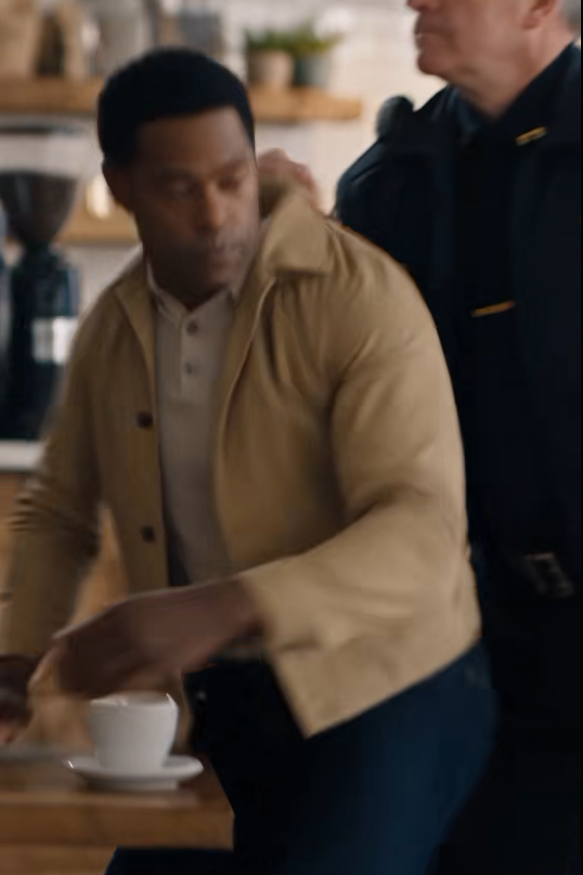
I stared at the wall.
She continued.
“Unless that’s stupid.”
“It isn’t.”
“Cool. Venmo me twenty dollars.”
“For what?”
“Consulting.”
I smiled for the first time that day.
The next morning I recommended the agreement—with amendments.
Public quarterly reporting.
Independent complaint intake.
Automatic preservation of civilian-witness interviews.
External review whenever command staff were subjects.
Protection for officers who contradicted supervisors in official reports.
And community participation in policy review.
The city accepted four of five immediately.
The fifth—automatic external review—took another week.
We refused to sign without it.
They agreed.
That was my choice.
Not the dramatic one.
The useful one.
Part VI — The Empty Chair
Eight months after the arrest, I returned to Common Grounds.
No cover.
No khaki jacket.
No newspaper.
I wore a charcoal suit because I had come from a morning hearing at the state capitol.
The bell above the door rang.
Nora looked up from behind the counter.
She stared at me.
Then said, “You look terrible in a tie.”
“Good morning to you too.”
Ray was gone.
Back at the bureau.
Brenda had transferred to another agency after completing discipline, retraining, and a cooperation agreement. She sent Nora a letter of apology.
Nora never told me what it said.
Dorsey had pleaded guilty to evidence tampering and obstruction.
Henley pleaded guilty to conspiracy.
Reed lost his job, his law license pending final disciplinary proceedings, and whatever reputation he thought he had been protecting.
Thornton’s criminal case was still moving through court.
Slowly.
As real cases do.
His attorneys challenged the notebook search.
They lost at the trial level.
An appeal remained possible.
Federal prosecutors had not announced whether separate civil-rights charges would be filed.
People sometimes found that unsatisfying.
They wanted the ending where every bad act received one matching punishment.
Life rarely organizes itself that neatly.
But Ridgemont had changed.
Not because one chief resigned.
Systems are not cured by removing one person any more than they are corrupted by only one.
The complaint unit now reported outside the chain of command.
Body-camera deletion alerts went automatically to the independent monitor.
Stop data were published monthly.
Disparities had not disappeared.
But officers now had to articulate reasons in fields that could not be left blank.
Supervisors had to review patterns.
Residents could file complaints outside police headquarters.
Those were procedural changes.
Boring changes.
The kind that do not trend online.
They mattered.
Nora poured coffee.
Black.
No room.
She placed the mug on the counter.
“You paying this time?”
“I always paid.”
“You broke the cup.”
“Thornton broke the cup.”
“You were attached to it.”
I handed her five dollars.
She slid it back.
“On the house.”
“That could compromise me.”
“You’re not undercover anymore.”
“Habit.”
She nodded toward my old table.
Someone was sitting there.
A young Black man in a college sweatshirt, laptop open, headphones around his neck.
I looked at him longer than I meant to.
Nora noticed.
“He’s studying.”
“I assumed.”
“Been here three hours.”
“Good coffee.”
“Terrible coffee.”
“That too.”
We stood in comfortable silence.
Then the door opened.
An officer walked in.
Young.
White.
I did not recognize him.
Ridgemont uniform.
He ordered a drink.
The student at my old table did not look up.
The officer waited at the counter.
No scanning the room.
No questions.
No demand to know how long anyone had been sitting anywhere.
Just coffee.
I knew better than to turn one uneventful moment into proof of transformation.
That would be the same mistake in reverse.
Patterns take time.
Accountability takes time.
Trust takes longer.
Nora handed me the cup.
“You sitting?”
I looked at the tables.
The only open one was near the back.
“No.”
“You came all this way.”
“I have another meeting.”
“With people who drink worse coffee?”
“Almost certainly.”
I turned toward the door.
“Aaron.”
I looked back.
Nora’s expression had changed.
“You know what bothered me most?”
“About what?”
“That morning.”
I waited.
“He looked at you like he already knew what you were.”
I said nothing.
She continued.
“Not your job. Not exactly. I mean he thought he knew what kind of person you were.”
I understood.
“He thought I was someone he could move.”
“Yes.”
“And he was partly right.”
Nora frowned.
“How?”
“He moved me.”
“Into handcuffs.”
“Into the case.”
She leaned against the counter.
“You were already in the case.”
“Not the same way.”
That was the part I had taken months to understand.
Before the arrest, Ridgemont had been files.
Numbers.
Witness statements.
Patterns.
Afterward, I had to confront something investigators rarely admit.
We like distance.
Distance feels objective.
It protects judgment.
But distance can become another form of comfort.
I had understood Samuel Bennett’s complaint intellectually.
Marcus Bell’s detention legally.
Nora’s fear professionally.
Then someone put my body against a table and told me I did not belong.
That did not make me more correct.
It made neutrality harder.
The work afterward was learning that empathy and objectivity were not opposites.
You could understand what something cost and still demand proof.
You could believe a witness and still test the statement.
You could be angry and still write the sentence the evidence supported instead of the sentence anger wanted.
That was professionalism.
Not the absence of feeling.
Control over what feeling was allowed to decide.
I picked up the coffee.
“Take care, Nora.”
“You coming back?”
“Probably.”
“Same table?”
I looked toward the window.
The student had removed his headphones and was rubbing his eyes over a textbook.
“No.”
“Why not?”
“It’s taken.”
Outside, Mason Street was busy.
Cars moved through the intersection.
A bus hissed at the curb.
Two teenagers walked past laughing.
Across the street, workers were replacing the old municipal surveillance camera with a newer model under the reform agreement.
I started toward my car.
Halfway there, someone called my name.
“Aaron.”
I turned.
Officer Sullivan stood near the corner.
Brenda.
Not in uniform.
Jeans, blue blouse, hair loose around her shoulders.
I had not seen her since the final debrief.
She approached slowly.
“I heard you were here.”
“From who?”
“Nora.”
“She’s terrible at operational security.”
Brenda almost smiled.
Then she looked at the sidewalk.
“I wanted to say something.”
“You already testified.”
“Not that.”
I waited.
She put her hands in her pockets.
“That morning, when Thornton grabbed you, I knew it was wrong.”
I said nothing.
“I knew before he touched you.”
Traffic moved behind her.
She looked directly at me.
“And I still stood there.”
“Yes.”
The word landed between us.
No comfort.
No punishment.
Just fact.
She nodded.
“I keep thinking I should explain why.”
“You already did.”
“Fear.”
“Yes.”
“It sounds weak.”
“It was weak.”
She absorbed that.
I continued.
“But weak isn’t the same as permanent.”
Her eyes lifted.
“I lied in booking.”
“Yes.”
“I corrected it.”
“Yes.”
“Too late.”
“Later than it should have been.”
She nodded again.
I could see she wanted absolution.
Maybe not consciously.
Most people do.
Investigators are sometimes mistaken for priests because we listen to confessions.
But our job is not forgiveness.
“I don’t know what I’m supposed to do with it,” she said.