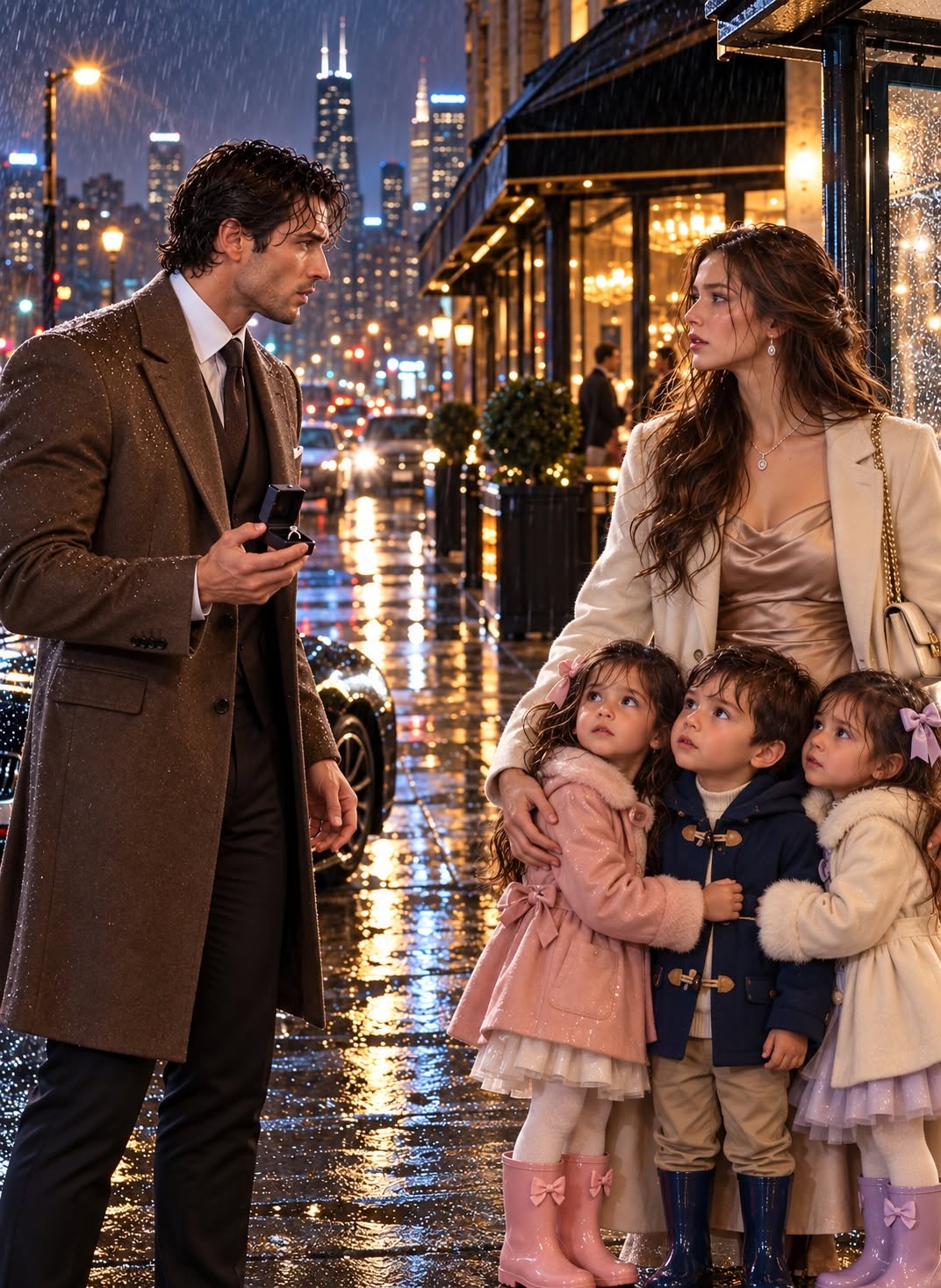
A few blocks away, at Le Bernardin, a candlelit table was reserved under my name. A bottle of vintage Krug champagne was chilling in an ice bucket. Amelia Brooks, my fiancée-in-waiting, was sitting there in her designer emerald dress, checking her diamond-encrusted watch every thirty seconds, wondering why the man who had promised her the world was currently standing frozen on a dismal street corner like a ghost looking at its own grave.
An hour ago, my life had a clear trajectory. Ryan Vance, rising partner at one of the city's most ruthless corporate law firms, a man who measured success in billable hours, corner offices, and high-society galas with a woman who fit seamlessly into the pristine picture I had painted for my future.
Now, the picture was shredded.
Grace.
My ex-wife.
She stood ten feet away, her thin black trench coat soaked through to the fabric, shivering not from the autumn chill, but from something far deeper, far more terrifying. And clutching at her legs were three small children in matching crimson raincoats.
When the little boy had turned to look at me, time had simply collapsed. Those eyes—that unmistakable gray-blue shade with the slight, stubborn tilt at the corner—were a mirror image of the face I shaved every single morning. They were the eyes of my late grandfather, the eyes my mother had traced with pride, the eyes that stared back at me from every photograph of my childhood.
"How old are they?" I had asked her.
And her voice, hoarse and breaking against the roar of the traffic, had whispered back: "Three."
Three.
The mathematical impossibility of it crashed against my temples like a tidal wave. Grace and I had signed the final divorce decree three years, two months, and fourteen days ago. She had packed her meager belongings into two battered suitcases while I was out of town on a merger negotiation in New York. She had left no forwarding address, blocked my number, and vanished into the sprawling anonymity of the Midwest like smoke through a screen.
My family—my mother, especially—had cheered when she left. “She was holding you back, Ryan,” my mother had told me over martinis at the yacht club. “A small-town librarian with no ambition, no pedigree, and no stomach for the life you’re building. You’re better off.”
And I had believed them. I had been too busy climbing corporate ladders, attending charity balls with Amelia, and burying myself in contracts to look back. I had convinced myself that Grace’s quiet demeanor was a lack of drive, that her tears were weakness, and that her desperate pleas for me to stay home were just emotional manipulation designed to anchor my soaring career.
I remembered the last month before she walked out.
The dark circles under her eyes. The way she would sit at the kitchen island long after midnight, staring at the glowing screen of her phone, waiting for me to text that I was delayed at the office again. The night she had clutched the lapel of my Armani suit, tears spilling silently down her cheeks, whispering, “Ryan, please. Just tonight. Stay here with me. I need you.”
And my cold, calculated response: “Grace, stop being melodramatic. I have a 7:00 AM flight to Frankfurt. Our life doesn't pay for itself.”
She hadn't argued back. She had just let go of my lapel, stepped back into the shadows of the hallway, and gone silent.
Now, looking at the three children huddled beneath her coat, the horrifying truth began to peel back its layers. She hadn't left because she fell out of love. She had left because she was pregnant, terrified, and utterly alone, carrying my children while I was too blind, too arrogant, and too selfish to notice the woman dying right in front of me.
The city bus had roared away into the grey mist, carrying Grace and my blood into the labyrinth of Chicago.
My phone had buzzed in my other pocket. Amelia’s text: Where are you? Everyone’s staring at me sitting alone. Answer your phone, Ryan.
I didn't answer. I pulled out the velvet box, popped the lid open, and stared at the two-carat diamond solitaire catching the dismal fluorescent glow of a streetlamp. It looked cheap. It looked hollow. It looked like a monument to a hollow man.
I shoved the box back into my coat, sprinted to my BMW parked in a tow-away zone, and punched the engine to life. I didn't care about the red lights. I didn't care about Amelia’s waiting table. I tailed that bus through the rain-slicked arteries of the city, my knuckles white against the steering wheel, driven by a desperate, pounding terror that I was about to lose everything twice.
Twenty minutes later, the bus pulled to a sluggish halt in front of a sprawling, limestone-faced complex on the near West Side.
I cut my headlights, killed the engine, and stared up through the rain-streaked windshield at the chiseled stone lettering above the grand double doors: St. Jude’s Pediatric Medical Center.