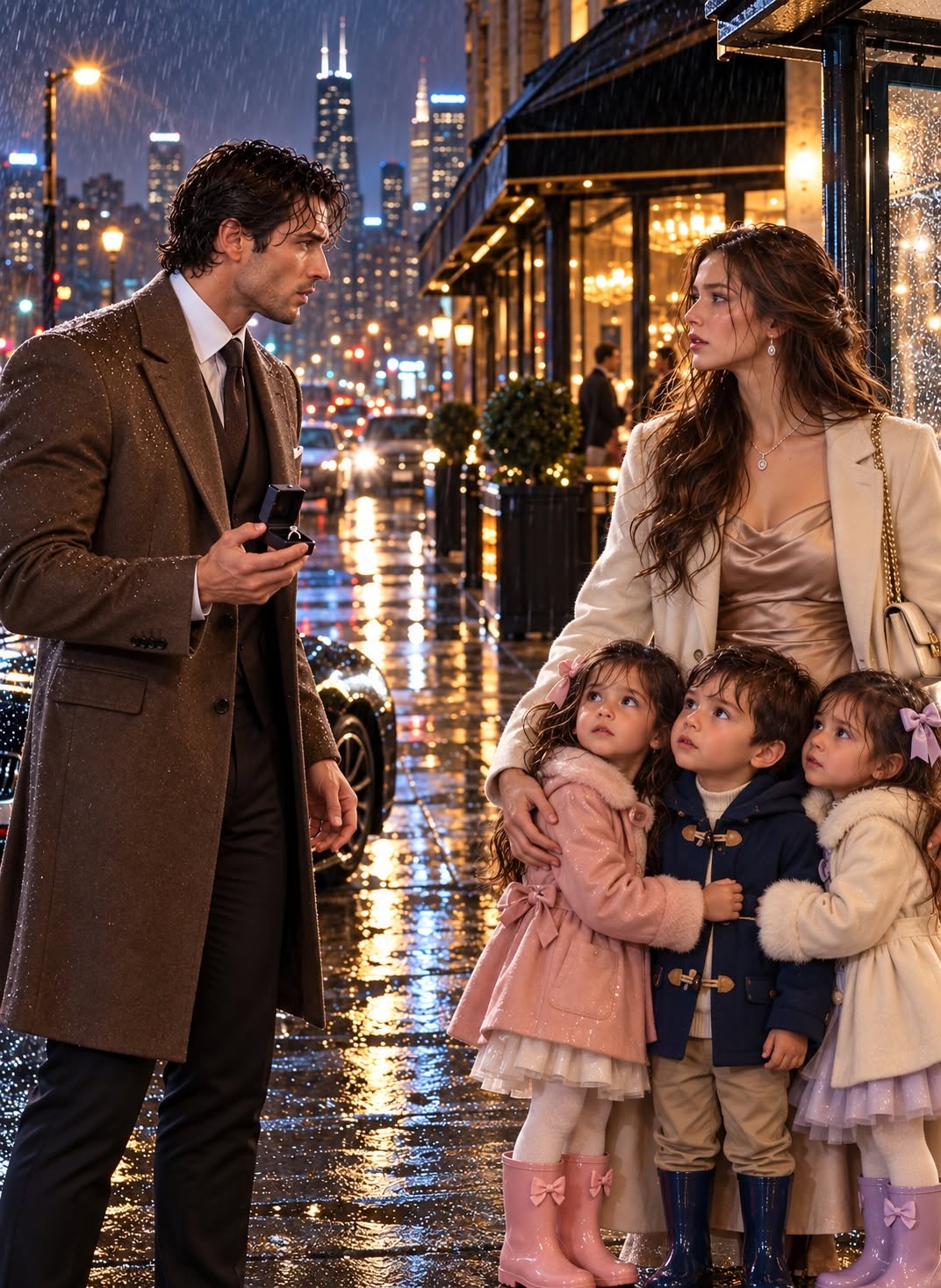
When Grace and the children disappeared into the inner sanctum of the pediatric wing, I planted myself on a hard plastic chair outside the consultation room door, ignoring the suspicious stares of the security guard pacing near the entrance.
My phone buzzed continuously in my pocket—first Amelia, then my mother, then my managing partner at the firm demanding to know where the hell I was during the most important corporate dinner of the quarter. I pulled the device out, powered it completely off, and dropped it into my coat pocket. Let the world burn. For the first time in my thirty-eight years, the fragile glass tower I had built around myself felt completely meaningless.
Two hours crawled by like centuries.
Finally, the frosted glass door swung open, and the pediatrician stepped out, holding a clipboard. He spotted me sitting rigidly in the plastic chair, let out a heavy, weary sigh, and walked over.
“Mr. Vance, right?” the doctor asked, his tone flat and professional.
“Yes,” I stood up immediately, towering over him by a few inches. “How is she? How are the kids? What’s going on?”
The doctor crossed his arms, eyeing me with undisguised clinical disdain. “Grace is exhausted. She’s running on fumes, pure adrenaline, and sheer maternal will. As for the children—twins, Lily and Maya, and their older brother Leo—they’re malnourished, chronically fatigued, and living in an environment of high environmental stress.”
My stomach dropped into a bottomless pit. “Stressed? Malnourished? Grace comes from a middle-class family—she has support, she has—”
“Grace has nothing,” the doctor interrupted sharply, his voice dropping an octave. “Except what she earns working night shifts at a 24-hour printing press and cleaning offices downtown while her sister watches the kids on weekends. Her family cut her off when she refused to beg you for financial support during the divorce. She didn't want your blood money, Mr. Vance. She wanted out of a cage.”
The words felt like acid burning down my throat.
“Is Leo sick?” I forced myself to ask, my voice trembling. “Why are they here at a pediatric medical center?”
The doctor’s expression softened just a fraction, though the disapproval remained etched into the lines around his eyes. “Leo has juvenile idiopathic arthritis. It’s a chronic, painful autoimmune condition that requires specialized pediatric rheumatology care, physical therapy, and expensive daily medication. That’s why Grace was at the bus stop in the pouring rain. She had to walk four blocks from the pharmacy because her car transmission blew out last Tuesday, and she couldn't afford the tow truck fee.”
I staggered back, my hand gripping the edge of the hallway wall to steady myself.
My son—my flesh and blood—was suffering from a chronic, painful disease, living in near-poverty, while I sat in a luxury penthouse overlooking Lake Michigan, wearing three-thousand-dollar suits, buying diamond rings for a woman who wouldn't have crossed the street to spit on me if I lost my bank account.
“Let me see her,” I demanded, stepping past the doctor toward the door.
“No,” a voice rasped from behind the partially open doorway.
I stopped.
Grace pushed the door open the rest of the way. She had changed out of her soaked coat into a faded grey sweater, her hair pulled back into a messy bun. She looked smaller than I remembered, yet somehow ten times stronger than any corporate titan I had ever cross-examined in a courtroom.
“Let him in, Dr. Hayes,” Grace said quietly, never breaking eye contact with me.
The pediatrician hesitated, then nodded and walked down the hall, leaving us alone in the sterile corridor.
I stepped slowly across the threshold into the small, clinical consultation room. The air smelled of rubbing alcohol and old paper. The three children were sitting quietly on a cot in the corner, coloring in books with red and blue crayons, entirely oblivious to the seismic fault line running through their parents' lives.
Grace closed the door softly behind me, leaning her back against the wood as if she needed the support to remain upright.
“You heard,” she stated. It wasn't a question.
“Why didn't you ask me for help, Grace?” I choked out, the anger and guilt warring violently inside my chest. “Damn it, those are my children! I am a wealthy man! You could have sued me for alimony, child support, medical coverage—anything! Why live like this in the shadows?”
Grace let out a bitter, humorless laugh that sounded like dry leaves scraping across concrete.
“Ask you?” she whispered, stepping away from the door and walking slowly toward me until we were standing only a foot apart. I could see the fine lines around her eyes, the exhaustion etched into every pore. “Do you remember the last conversation we had before I packed my bags, Ryan?”
I searched my memory frantically, desperately trying to pull up the past.
“You told me,” Grace continued, her voice dropping into a devastatingly calm register, “that I was a parasite draining your energy. You told me that if I couldn't handle the sacrifices required to be an executive’s wife, I was free to walk out the front door—just as long as I didn't expect you to finance my failure.”
The memory slammed into me like a freight train.
I remembered it now. It was our fifth wedding anniversary. She had cooked dinner; I had arrived three hours late, smelling of champagne and boardroom cigars, holding a generic gift card because I hadn't had time to shop. She had cried. And in my drunken, arrogant fury, I had spewed those exact, venomous words across the dining table.
“I was angry,” I whispered, the confession tasting like ash in my mouth. “I didn't mean—”
“You meant every single syllable,” Grace interrupted softly. “And that was the moment I realized something vital. If I stayed with you, I wouldn't just lose my soul—I would lose my children to your world. A world where human beings are just collateral damage in a race to the top. So I took nothing. I didn't take your money, I didn't take your name, and I didn't take your pity. I just walked away.”
She reached up, her hand trembling slightly as she touched the small gold band still hanging on a simple silver chain around her neck—our old wedding ring, worn down to a thin sliver of metal.
“And I survived, Ryan,” she said, her dark eyes locking onto mine with an unyielding, terrifying brilliance. “Without you, I survived. So don't you dare walk into my life now, smelling of expensive cologne and diamond rings, and act like you have a right to any of this.”