Emily died on a rainy Thursday in October, three weeks before her eighty-first birthday.
She passed away exactly where she wanted to: in the front bedroom of our small house, with the window cracked open so she could smell the damp earth, and with her hand resting inside mine. Sophie and Lily were there. They had arrived at four in the morning when her breathing grew ragged.
There were no dramatic last words. She opened her eyes once, looked at the ceiling, whispered the word "pancakes", and stopped breathing.
We did not hold a public memorial. We held a private service at the chapel near the cemetery where Caroline Mercer was buried. We laid Emily to rest on the opposite slope of the same hill, beneath an old sugar maple whose leaves had turned the color of burnt orange.
Sophie had chosen the plot.
"Is that weird?" young Caroline had asked her mother during the arrangements. "Putting Grandma Emily in the same cemetery as Grandma Caroline?"
"No," Sophie had replied. "They shared a child. They might as well share the hill."
Two weeks after the funeral, the house was devastatingly quiet.
I was seventy-three. For the first time in fifty years, I was living alone. I woke up at six out of habit, brewed a pot of coffee that was twice as large as I needed, and sat at the kitchen table watching the morning fog lift from the grass.
At eight-thirty, a key turned in the front lock.
Sophie walked in. She was wearing an oversized gray cardigan—one that had belonged to Emily—and carrying a brown paper bag.
"Morning, Dad," she said, hanging her coat by the door.
"You should be at work," I said.
"I took the morning off. Daniel is at the clinic covering my admin hours."
She unpacked the bag: a loaf of sourdough, a tub of creamy peanut butter, and a jar of strawberry preserves. She pulled two plates from the cabinet and set them on the table.
She didn't ask if I was hungry. She took a butter knife and began spreading the peanut butter across the bread with slow, methodical strokes.
I watched her hands. They were strong, capable hands. The hands of an occupational therapist who spent forty hours a week teaching children with cerebral palsy how to hold spoons and button their coats.
"Caroline called from school last night," Sophie said as she worked.
"How is she?"
"She finished her bioethics paper."
I leaned forward. "What did she write?"
Sophie smiled, though her eyes were tired. "She wrote about the difference between custody and parentage. She argued that the legal system failed our family not because it was corrupt, but because it tried to treat assisted reproduction like commercial shipping contracts."
"She got an A?"
"She got an A-minus," Sophie laughed softly. "The professor commented that her conclusions were 'emotionally partisan.'"
"Good for her," I said. "Partisanship is what keeps families alive."
Sophie set a plate in front of me. Two sandwiches, cut diagonally.
I looked down at the bread. "You cut them."
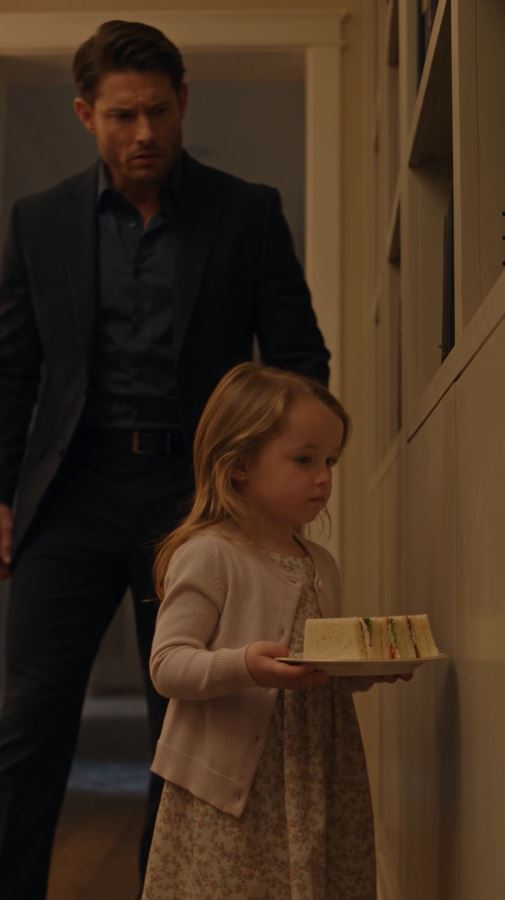
"Lily never cut them," Sophie said, sitting across from me and picking up her half. "Lily just shoved four whole squares through the crack in the baseboard. One of them was missing a corner because she took a bite on the way down the hall."
"I remember," I whispered.
We ate in silence. The peanut butter was thick, sticking to the roof of my mouth, exactly the way it had when I was forty years old and pacing the halls of a large house on Elm Street, wondering why my daughter was out of bed at midnight.
"Dad?" Sophie said after finishing her half.
"Yes?"
"Do you ever regret finding me?"
I set my sandwich down. I looked at her across the scarred oak tabletop.
"Never," I said. "Not for a single second of thirty-four years."
"Even with the trials? The money? The reporters? The way it changed Mom?"
"It didn't change Emily," I told her. "It revealed Emily. It showed me that the woman I married was larger than her own biological instincts. And it gave me you."
Sophie reached across the table and covered my liver-spotted hand with hers. Her skin was warm.
"Then we’re square," she said.
---