Five years after the birthday dinner that nearly destroyed my family, I turned seventy-five.
This time, nobody planned a surprise.
I made the guest list myself.
No executives invited because they were important.
No country-club acquaintances.
No people selected to impress anyone.
Only family and friends.
Daniel arrived first.
His hair had begun turning gray at the temples.
I enjoyed pointing that out.
Vanessa came behind him carrying flowers.
They were still married.
Not magically.
Not perfectly.
But honestly.
Counseling had lasted years.
There had been arguments.
Setbacks.
Days when Daniel doubted whether trust could return.
Days when Vanessa wondered whether she deserved another chance.
They kept working.
That was their choice.
I respected it.
Vanessa kissed my cheek.
“You smell wonderful.”
We both froze.
Then we laughed so hard Daniel demanded an explanation.
“No,” I said.
“Absolutely not,” Vanessa agreed.
Some jokes belong only to people who survived the thing that made them possible.
Margaret arrived.
So did Susan.
Several employees I had known for decades joined us.
A young woman named Rosa came with her husband and baby.
The emergency fund had helped Rosa when her premature daughter required months of treatment.
She hugged me.
“You saved us.”
“No,” I said. “A company full of people helped you.”
That distinction mattered.
Whitmore Precision no longer belonged emotionally to one family.
Maybe it never had.
Companies like ours were built by machinists, accountants, truck drivers, engineers, receptionists, cleaners, managers, and thousands of hands Thomas and I would never know.
That understanding became the final change I made.
On my seventy-fifth birthday, I announced that a portion of the Whitmore family shares would gradually transfer into an employee ownership trust.
Daniel already knew.
Vanessa did too.
Margaret had helped design it.
Everyone else stared.
One longtime machinist began crying.
“So the employees own part of it?” he asked.
“They will.”
Daniel raised his glass.
“To Dad.”
I shook my head.
He stopped.
I lifted mine.
“To everyone who built it.”
Glasses rose around the table.
Thomas would have liked that.
After dinner, Daniel disappeared into the kitchen.
He returned carrying a cake.
One candle.
“Very funny.”
“Fire code,” he said.
Everyone sang.
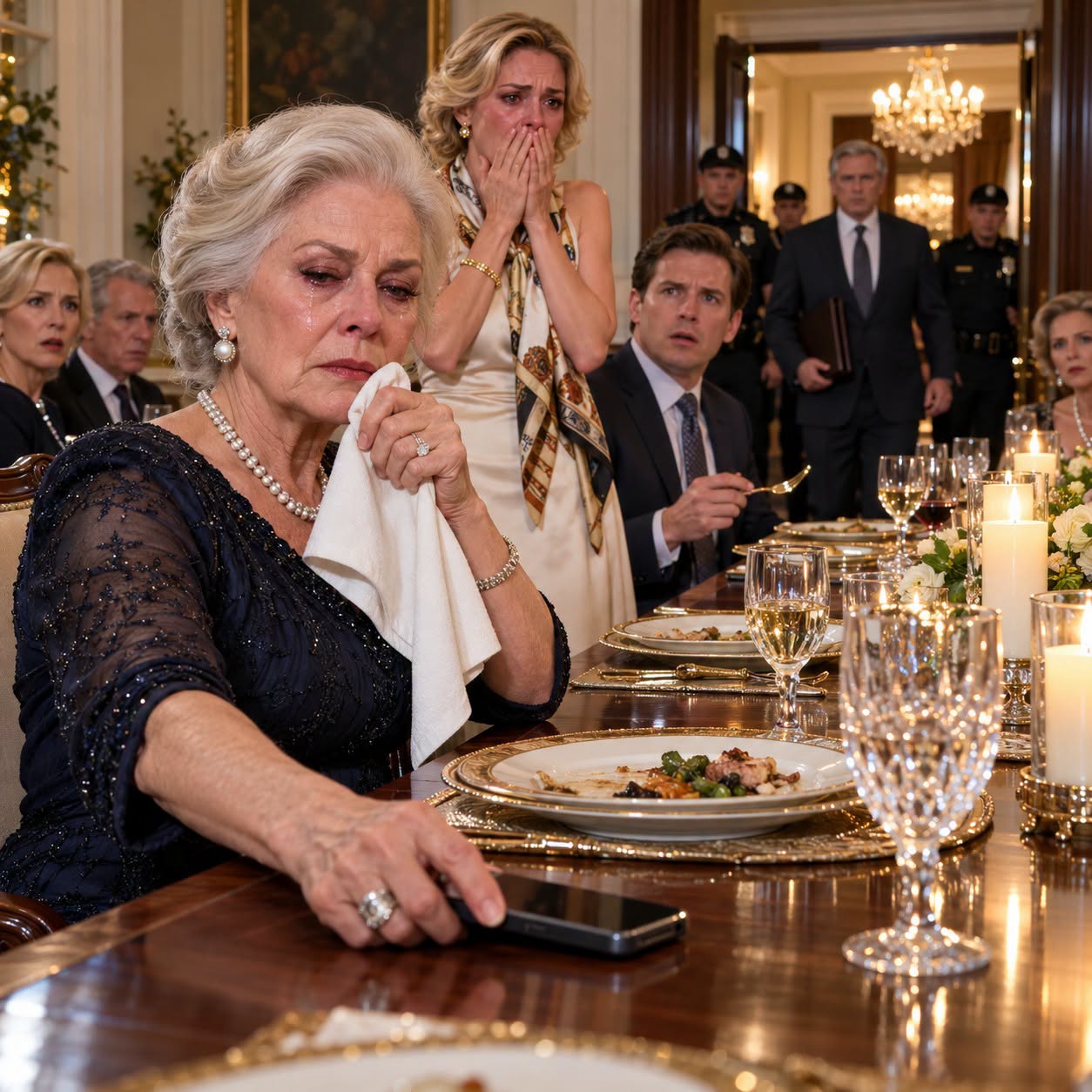
I looked around the walnut table.
Once, this room had been the scene of my humiliation.
Vanessa had sat there and called me filthy.
My son had doubted me.
My husband's closest friend had been stealing from us.
A forged signature waited inside an envelope.
And a black phone contained the truth.
For years, I thought the lesson of that night was that I had defeated them.
It wasn't.
Arthur lost his freedom because of his choices.
Richard lost his career.
Vanessa nearly lost her marriage.
Daniel lost his certainty.
I lost my innocence about people I trusted.
Nobody won that night.
What mattered was what happened afterward.
Daniel learned that honoring his father did not mean becoming him.
Vanessa learned that money could never create the security she had spent her life chasing.
I learned that independence wasn't something younger people granted older people.
It was something I had the right to define for myself.
And our family learned something more difficult.
Forgiveness without accountability is surrender.
Accountability without compassion can become revenge.
Healing requires both truth and time.
After everyone left, I remained at the table.
Vanessa had forgotten her phone beside her plate.
I picked it up.
For a moment, the sight of a black phone against polished walnut carried me back five years.
“Your stink is ruining my appetite.”
I could still hear her voice.
I could still see Daniel's frozen fork.
My own hand reaching toward my phone.
The recording.
The silence.
The fear.
Then I looked around the room as it existed now.
Family photographs covered the sideboard.
One showed Daniel and Vanessa outside their smaller house.
Another showed me standing in Rome with gelato in one hand.
There was a photograph from Scotland.
One from Whitmore's forty-fifth anniversary.
And in the center was Thomas.
Laughing.
Always laughing.
I touched the frame.
“You were right about one thing,” I whispered.
Silence answered.
“You married a stubborn woman.”
I could almost hear him correcting me.
Smart woman.
I smiled.
Then the front door opened.
Daniel hurried inside.
“Vanessa forgot her phone.”
“I have it.”
He entered the dining room and stopped.
“You okay?”
“Perfectly.”
He looked at the table.
“You know, we should have this refinished.”
“No.”
“Mom, it's covered in scratches.”
“I know.”
“There are stains.”
“I know.”
“That mark has been there forever.”
“I know.”
He laughed.
“Then why keep it like this?”
I ran my fingertips over the wood.
Thomas had built this table when we had almost nothing.
Daniel scratched it with a toy truck when he was five.
A hot casserole left a pale circle when he graduated high school.
Thomas spilled red wine on it during our thirtieth anniversary.
My phone scratched it slightly on my seventieth birthday when I pushed it into the center and pressed play.
Every imperfection belonged to a story.
“Because,” I said, “if you erase every mark, eventually you erase the life that made them.”
Daniel became quiet.
Then he nodded.
“Dad would've liked that.”
“Your father would've said refinishing it cost too much.”
Daniel laughed.
He kissed my forehead.
“Happy birthday, Mom.”
“Thank you.”
He picked up Vanessa's phone and walked toward the door.
“Daniel?”
He turned.
“I love you.”
His expression softened.
“I love you too.”
After he left, I switched off the chandelier.
Only the candles remained.
Their reflections moved across the old walnut surface.
Five years earlier, I had sat at the far end of that same table while people looked at me with pity.
They thought I was fragile.
Vanessa thought humiliation would make me easier to control.
Arthur thought age had made me irrelevant.
Even Daniel had briefly wondered whether I could still trust my own mind.
They had all mistaken quiet for weakness.
That mistake nearly cost them everything.
But the strangest part was this:
I no longer needed them to know they had been wrong.
I knew who I was.
That was enough.
I carried my plate toward the kitchen, then stopped beneath the doorway and looked back one last time.
There was Thomas's chair.
Daniel had sat in it tonight.
I didn't mind anymore.
There were the scratches.
The candles.
The flowers Vanessa brought.
The ordinary evidence of people living imperfect lives together.
Tomorrow morning, I would wake up seventy-five years old.
I would make coffee.
I would walk through my garden.
Next month, Margaret and I were traveling to Greece.
In the spring, I planned to take a photography class.
Daniel thought that was hilarious because I still occasionally covered the camera lens with my finger.
I intended to prove him wrong.
There were places I hadn't seen.
Books I hadn't read.
People I hadn't met.
There were birthdays ahead of me that would contain laughter instead of accusations.
And someday, perhaps, someone else would sit at this table and run a hand across the scratches.
Maybe they would wonder who made them.
Maybe Daniel would tell them.
Maybe Vanessa would.
Perhaps a grandchild would hear about the night Grandma Evelyn placed a phone on the table and exposed a conspiracy before dessert.
Knowing Daniel, the story would become more dramatic every year.
I smiled at the thought.
Then I remembered something Thomas had told me during the first difficult year of our marriage.
We had been broke, exhausted, and frightened.
I asked him what would happen if everything went wrong.
He took my hand and said:
“Then we find out what we're made of.”
It had taken me almost fifty years to understand the answer.
We are not made from the things we own.
Not houses.
Not companies.
Not trusts.
Not expensive scarves.
We are made from what we choose when losing those things becomes possible.
Arthur chose greed.
Richard chose cowardice.
Vanessa chose badly, then eventually chose responsibility.
Daniel chose to question the man he had become.
And I chose not to disappear simply because other people had decided my useful years were behind me.
I turned off the final candle.
The room went dark.
But it didn't feel empty.
Not anymore.
I walked upstairs without looking back.
The old table remained below, carrying every scratch we had given it.
I wouldn't erase a single one.
Because at seventy-five, I finally understood something worth more than everything Thomas and I had ever owned:
A good life isn't one that remains unscarred.
It's one where the scars stop being wounds and become proof that you survived long enough to make another memory.
And tomorrow, I intended to make plenty more.
THE END