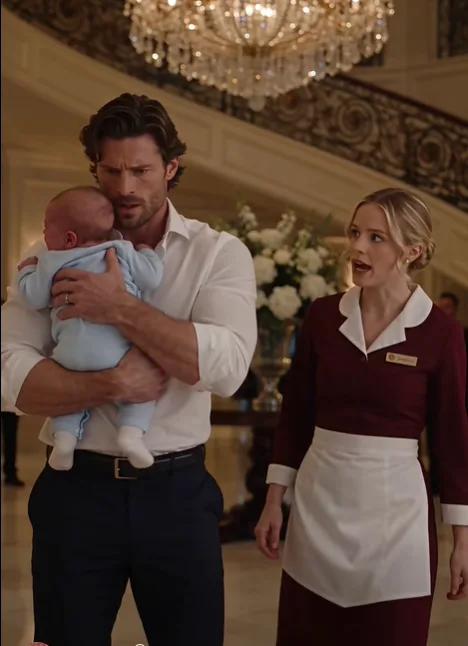
"And I won't let you turn me into another person who works here because they think they owe the family something."
He looked down at the papers.
"Fair enough."
She moved toward the door.
"Adrian?"
He looked up.
"Yes?"
"You don't have to earn the right to be someone's brother."
His expression changed.
For a moment, he looked like the boy in the old photograph, standing between two women who had tried to protect him from a world they did not know how to control.
Then he smiled.
"Neither do you."
Elena left him in the library.
Outside, the evening air smelled of damp grass and new leaves. The garden lights had come on, casting soft pools of gold across the paths. Somewhere in the nursery, Noah was laughing at something Sofia was doing with a wooden rattle.
Elena stood on the terrace and listened.
For the first time since she had entered the mansion, the sound did not make her feel like an intruder.
It made her feel at home.
A year later, the old Cole mansion opened its doors to the public.
The renovation had taken months. The east wing, once used for storage, became a temporary residence for families in crisis. The library housed a small legal resource center, and the former ballroom was converted into a gathering space where community organizations could meet without paying rent.
The foundation was restructured under independent oversight, and its first grants went to the families whose funds had been misappropriated. A portion of the recovered money established a scholarship program for students pursuing careers in law, social work, and public service.
Elena enrolled in evening classes.
She still worked at the mansion part-time, but she no longer wore a uniform. She coordinated the family archive project, helped Rebecca organize the historical records, and spent her mornings studying before Noah woke.
Sofia moved into a small apartment nearby. She and Elena learned to be sisters again, slowly, through ordinary things. They argued about groceries. They shared meals. They visited their mother's grave together and brought flowers on the anniversary of her death.
Sometimes they spoke about the years they had lost.
Sometimes they did not.
Both kinds of silence became easier to bear.
Julian remained close to Catherine, helping her with the things she could no longer manage alone. He had begun working with the foundation's legal team, determined to ensure that no one else would be separated from their family by a secret disguised as protection.
He and Adrian did not become brothers overnight.
They had too many memories that belonged to different lives, too many unanswered questions, too much anger to dissolve in a single conversation.
But they began meeting every Sunday.
At first, they discussed business. Then they talked about their childhoods, comparing memories that had once seemed impossible to reconcile. Adrian remembered the smell of the rose garden after rain. Julian remembered Catherine singing in the kitchen. One remembered a birthday cake; the other remembered a letter that had never arrived.
Their lives had been divided by a lie, but the memories themselves belonged to both of them.
Over time, they began to build new ones.
Margaret visited the community center every week. She did not expect anyone to praise her for it. She spent hours sorting books, helping prepare meals, and listening to families who needed someone to sit beside them without asking for anything in return.
She never asked Elena to forgive her again.
Instead, she tried to become someone Elena could trust.
It was slow work.
But it was honest work.
Vanessa moved to another city. She sent Noah a birthday card and a small book of illustrated animals. Elena gave the card to Sofia, who placed it in a drawer until she was ready to decide what it meant.
Noah grew quickly, filling the mansion with the sort of joyful noise that made the old rooms seem less like a museum and more like a home.
He learned to crawl across the library rug, to pull himself up against the furniture, and to reach for Elena whenever she entered the nursery.
The first time he said her name, she cried.
The second time, she laughed.
By then, the necklace had been cleaned and repaired. The tiny key remained hidden inside the pendant, but Elena no longer wore it every day. Sometimes she kept it in the pocket of her coat. Sometimes she placed it beside the restored photograph of Isabel and Catherine.
It had opened a locked room.
It had led her to a truth that had altered every part of her life.
But it no longer felt like a burden.
It felt like a reminder.
On the anniversary of the mansion's reopening, Elena stood in the old rose garden with Noah on her hip. The air was warm, and the flowers had begun to bloom. Beyond the hedges, people moved through the open doors, carrying boxes of donated books and trays of food.
Adrian approached with two cups of coffee.
"You're supposed to be inside," he said.
"So are you."
"I'm the owner."
"Not for much longer, if you keep giving away rooms."
He smiled.
"Then I suppose I'd better enjoy the title while I have it."
He handed her a cup.
For a moment, they stood together in the garden, listening to the voices drifting through the house.
"Do you ever think about that first day?" Adrian asked.
"When I started working here?"
"When you came upstairs and took Noah from me."
Elena looked at the baby.
"Sometimes."
"I thought you had some kind of magic."
"I had experience with crying babies."
"I had experience with everything except being a father."
She glanced at him.
"You learned."
"Eventually."
He looked toward the house.
"I used to think that the truth was something you found at the end of a long search. Like a document in a locked drawer. Once you found it, everything would make sense."
"And now?"
"Now I think the truth is what you decide to do after you find it."
Elena smiled.
"That sounds like something my mother would have said."
"I think I would have liked her."
"You would have."
He looked at her.
"I'm sorry you lost her before you could ask all the questions you needed to ask."
Elena lowered her eyes to the pendant in her hand.
"I'll always wish I had more time with her."
"Of course."
"But I don't think she left me with nothing."
She touched the tiny engraved symbol.
"She left me with a way to find the truth. And she left me with the choice of what to do with it."
Adrian nodded.
For a while, they stood without speaking.
Then Noah reached toward the necklace, his fingers curling around the pendant.
Elena laughed softly and gently freed it from his grasp.
"Not this time, little man."
He protested, then settled against her shoulder.
Adrian watched them with a quiet smile.
The house behind them was no longer silent. Voices filled the halls. Doors stood open. Sunlight fell across the polished floors, and the portraits that had once seemed to watch the family with judgment now looked like witnesses to a story that had finally been told.
Elena thought of Isabel, of the woman who had worked in this house and left it with her reputation damaged but her conscience intact. She thought of Catherine, who had spent decades believing that silence was the only way to keep her children alive. She thought of Margaret, who had confused fear with duty, and of Julian, who had spent half his life searching for a mother who had never stopped waiting for him.
And she thought of herself.
For years, she had believed that her life was defined by the things she had lost. A mother. A sister. A home that felt secure. The chance to ask the questions that mattered before it was too late.
Now she understood that loss could shape a person without owning them.
She could carry her mother's memory without carrying her fear.
She could love her family without accepting every choice they had made.
She could forgive without pretending that nothing had happened.
And she could build a life that belonged to her.
Noah rested his head against her shoulder, his breathing soft and even.
Elena kissed his hair.
Behind her, the mansion's front doors opened wider as another group of visitors arrived. Somewhere inside, Sofia called her name. Adrian turned toward the sound, then looked back at Elena.
"Coming?"
She glanced once more at the rose garden.
The house had kept its secrets for twenty-five years. It had watched people come and go, witnessed promises made in fear, and hidden the evidence of a family that had mistaken silence for safety.
But houses did not decide what their histories meant.
People did.
Elena adjusted Noah in her arms and walked toward the open doors.
"Yes," she said. "I'm coming home."
And for the first time, the words belonged entirely to her.