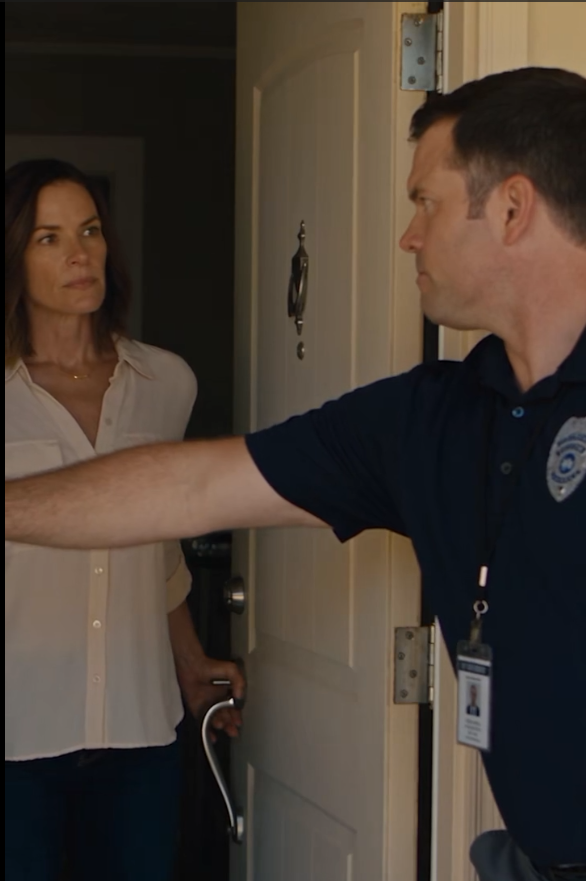
“Then why was your hand on her door?”
That was the question.
The one Derek had an answer for when he thought it was only me standing in front of him.
Now he had none.
Part II — Three Weeks Earlier
The dispute had started with three photographs.
That was the part that bothered me most later.
Not because the photographs mattered.
Because of how ordinary they were.
The first showed the back corner of my patio.
The second showed a narrow strip of gravel beside it.
The third showed a small privacy screen I had installed near the seating area.
I opened the email on a Tuesday night while standing at the kitchen counter waiting for water to boil.
NOTICE OF POSSIBLE EXTERIOR MODIFICATION VIOLATION.
That was the subject line.
I had lived in Cedar Ridge for almost seven years. I knew the association had rules. Some were annoying, some were sensible, and most were easy enough to live with.
The privacy screen had replaced an older wooden panel that had warped after years of rain.
Same dimensions.
Same location.
Slightly different material.
I had not expected it to become an issue.
I replied the next morning.
I explained what had been replaced and attached the receipt.
Two days later, Sentinel Community Security responded on behalf of the association.
They requested exterior access for verification.
Fine.
I gave them two time windows.
Derek arrived the following Monday with Marcus.
That first meeting was almost forgettable.
Almost.
Derek introduced himself, showed me his Sentinel identification, and asked me to open the side gate.
I did.
He photographed the screen.
Measured its width.
Looked at the gravel.
Asked when it had been installed.
I answered.
Marcus entered information on his tablet.
Then Derek walked toward the back windows.
“What are you looking for?” I asked.
“Just documenting the relation to the structure.”
He bent slightly to look through the glass.
I stepped between him and the window.
“You can document the exterior without looking into my house.”
He straightened.
“I’m not looking into your house.”
“You were.”
He gave me the same small smile I would see again on the porch.
Not friendly.
Not exactly mocking.
More like the expression of someone who had decided the conversation was too minor to matter.
“We sometimes need to verify whether modifications continue through an interior wall.”
“This doesn’t.”
“We may need to confirm.”
“You can confirm from here.”
Derek looked past me toward the patio door.
“Would you mind letting us take a quick look inside?”
“Yes.”
He paused.
“Yes, you would mind?”
“Yes.”
“All right.”
He said it easily.
Too easily, I realized later.
Marcus didn’t look up from his tablet.
The inspection continued.
Five minutes later they left.
I assumed that was the end of it.
That evening, however, a new email arrived.
Additional verification may be required to determine whether the reported exterior modification affects structural or attached interior conditions.
I read the sentence twice.
Then I replied.
The privacy screen is freestanding and does not connect to the house. You inspected it today. You do not have permission to enter my home.
The next morning, I received a message saying the file remained open.
Two days after that came another notice.
This one asked for photographs from inside the patio door showing the wall adjacent to the screen.
I did not send them.
Instead, I took pictures of the outside wall and sent those.
The response came from Derek.
Interior photographs are preferable.
I wrote back:
They are not necessary to determine whether the exterior privacy screen is attached to the structure. Your own exterior photographs should show that it is not.
For a day, there was silence.
Then the association sent me a warning that failure to complete inspection requirements could result in additional compliance action.
That was when the issue stopped feeling like a stupid argument over a patio.
I called the association office.
A woman answered.
I explained that Sentinel had already inspected the modification.
She reviewed the file.
“I see exterior inspection completed,” she said.
“Then why are they requesting interior access?”
There was a pause.
“I don’t see anything here requiring entry into the residence.”
I straightened in my chair.
“You don’t?”
“No. It says additional verification pending.”
“Who put that in?”
“Sentinel.”
I wrote down the time of the call.
“Does the association authorize private security inspectors to enter homes without homeowner permission?”
“No.”
Her answer came immediately.
“Can you send that to me?”
Another pause.
“I can send you the inspection policy.”
“Please do.”
The policy arrived an hour later.
I read it twice.
Exterior compliance inspections could be conducted from common areas, association property, or homeowner property where access had been granted.
Interior access required homeowner consent except where separately authorized by law.
That seemed clear.
I forwarded the policy to Sentinel.
Derek answered less than thirty minutes later.
The policy does not restrict Sentinel from requesting access necessary for complete verification.
Requesting.
That word mattered.
I replied with one sentence.
You may request it. I decline.
I thought that would end the conversation.
Instead, the tone changed.
The next notice no longer asked.
It said Sentinel would return for “interior verification.”
I called the association again.
This time I asked to speak with whoever supervised the Sentinel contract.
I was told someone would review the issue and get back to me.
No one did that day.
That night, I sat at the dining room table with my laptop open and every email arranged by date.
My daughter came downstairs around ten.
She was old enough to recognize when I was annoyed and young enough to find it interesting.
“You’re still doing the patio thing?”
“The patio thing has become the email thing.”
She looked at the screen.
“Can’t you just let them look?”
I leaned back.
“I could.”
“Then why don’t you?”
I thought about that.
It would have been easier.
Open the door.
Let Derek stand in my living room for thirty seconds.
Point toward the back wall.
End the argument.
But something about the way he had looked through the window bothered me.
Something about how a request had slowly become a requirement.
“If someone asks for something they’re allowed to ask for,” I said, “you can say yes or no.”
She waited.
“If they keep pretending you were never allowed to say no, that’s different.”
She nodded as if she understood, though I wasn’t sure she did.
Then she pointed at my screen.
“Your water is boiling.”
The next morning, I received the message that made me call the Sheriff’s Department.
Interior verification remains required. We will attend this morning and obtain access as permitted under association authority.
Obtain access.
Not request.
Not seek consent.
Obtain.
I read it at 7:19.
At 7:26 I called the association.
No answer.
At 7:31 I called Sentinel.
A receptionist told me Derek was already in the field.
At 7:38 I called the Sheriff’s Department’s non-emergency line.
I felt ridiculous at first.
I explained the dispute.
I explained the email.
I explained that no one had entered yet and I wasn’t claiming a crime had occurred.