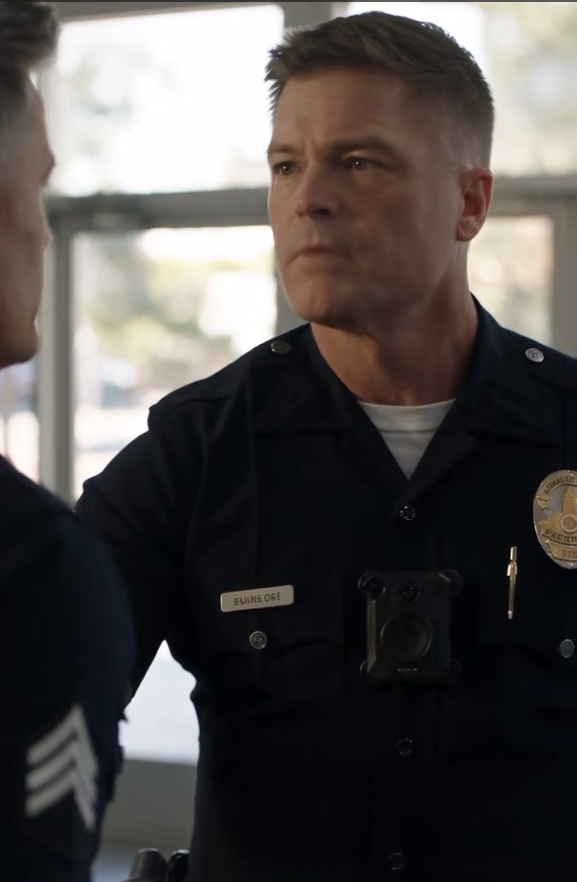
A few expressions shifted.
“I suppose Sergeant Caldwell handled that for me.”
There was a brief ripple of uncertain laughter.
Marcus let it pass.
“What happened downstairs will be reviewed according to policy. I’m not going to discuss an active personnel matter with you.”
The room settled.
“But I am going to discuss something else.”
He looked toward the back.
Not at the younger officer specifically.
At the group around him.
“This morning, one officer suggested that my identity be verified. He was ignored. Then he suggested that someone call upstairs. He was ignored again.”
Now the younger officer looked down.
Marcus continued.
“He was junior to the supervisor making the decision.”
No one moved.
“That matters.”
He paused.
“If you see something that does not make sense, I expect you to say so. Professionally. Clearly. Respectfully. If your supervisor is making a mistake, you do not become disloyal by pointing toward procedure.”
He let the words rest.
“And if you are the supervisor, your rank does not make you correct.”
That landed harder.
Marcus saw it.
A lieutenant near the wall folded his arms.
An older patrol officer gave the smallest nod.
Marcus went on.
“I don’t want a station where junior officers are afraid to ask reasonable questions. I also don’t want a station where every disagreement becomes insubordination. We are adults. We can learn the difference.”
He stepped away from the podium.
“That’s all.”
Someone near the front looked surprised.
Marcus smiled faintly.
“You were promised a speech?”
A little more laughter this time.
Real laughter.
“Sorry to disappoint you.”
The room loosened.
For the first time that day, Marcus felt the station breathe normally.
Afterward, the younger officer waited near the door.
He seemed to be debating whether to approach.
Marcus saved him the trouble.
“Officer.”
The young man stepped forward.
“Yes, Chief.”
“Walk with me.”
They went into the hallway.
Marcus kept his pace unhurried.
“You thought Caldwell was making a mistake.”
The officer chose his words carefully.
“I thought verification would be faster.”
Marcus glanced at him.
“That’s a diplomatic answer.”
The officer looked straight ahead.
“I’m trying to keep my first conversation with the new chief from becoming memorable for the wrong reason.”
Marcus almost smiled.
“Too late.”
The young officer looked alarmed.
Marcus said, “You spoke up twice. I remember.”
“Oh.”
They walked several more steps.
“Why didn’t you speak a third time?”
The question caught him.
He took a few seconds.
“Because he told me he had it.”
“That stopped you?”
The officer hesitated.
“Yes, sir.”
Marcus nodded.
“Fair answer.”
The young officer glanced toward him.
Marcus stopped beside a window.
“You weren’t required to keep pushing once the scene was under control. I’m not asking why you failed.”
The officer waited.
“I’m asking what you believed would happen if you pushed again.”
A longer pause.
“I thought he’d write me up.”
Marcus looked at him.
“For what?”
“Insubordination. Maybe disrespect.”
“Has he done that before?”
The officer immediately became careful.
Not evasive.
Careful.
Marcus noticed the distinction.
“I don’t know what I’m supposed to say.”
“The truth.”
“Yes, sir.”
“And if you don’t know, say you don’t know.”
The officer looked toward the floor.
“He’s strict.”
“That wasn’t the question.”
“No, sir.”
Marcus waited.
Finally the officer said, “He has corrected people for challenging him in front of others.”
“Corrected how?”
“Written counseling sometimes. Shift assignments sometimes.”
Marcus’s expression did not change.
The officer added quickly, “I’m not saying he breaks policy.”
“I didn’t ask you to.”
“No, sir.”
“Did you believe his reaction to you this morning was unusual?”
The officer thought.
“No.”
That answer mattered.
Marcus kept walking.
The young officer followed.
“Thank you.”
“Am I in trouble?”
Marcus stopped.
“For what?”
“I don’t know.”
“Then no.”
The officer looked relieved.
Marcus added, “But if Professional Standards asks what happened, answer them the way you answered me.”
“I will.”
Marcus left him there and headed toward Helen’s office.
She was standing behind her desk when he entered.
“You found something.”
He closed the door.
“The young officer expected retaliation for disagreeing with Caldwell in public.”
Helen’s face tightened.
“Specific retaliation?”
“Counseling. Shift assignments.”
“Policy violations?”
“Not necessarily.”
Helen sat down.
“That can be harder.”
“I know.”
There were clean forms of bad leadership.
They never looked dramatic enough on paper.
A supervisor could destroy trust without ever crossing the line that made an easy disciplinary case.
Assignments.
Tone.
Public embarrassment.
Private warnings.
Selective scrutiny.
The power to make someone’s workday unpleasant was enormous in a paramilitary organization.
Most of it left no bruise.
Marcus sat across from Helen.
“How long has Caldwell been a sergeant?”
“Seven years.”
“Same station?”
“Five here.”
“Complaints?”
Helen pulled up a file.
“Formal complaints, a handful. Mostly demeanor. None sustained beyond counseling.”
“Use of force?”
“No significant record.”
“Integrity?”
“Nothing.”
“Performance?”
“Above average.”
Marcus leaned back.
That complicated things.
It would have been easier if Caldwell had been incompetent.
He was not.
Easier if he had a disciplinary history.
He did not.
Helen looked at him.
“You wanted to know whether he was the problem or the first sign of the problem.”
“Yes.”
“You’re thinking culture.”
“I’m thinking incentives.”
She waited.
Marcus said, “If he has been rewarded for aggressive certainty for seven years, today didn’t come from nowhere.”
Helen closed the file.
“You want to review his supervision record.”
“I want to review what gets praised here.”
Her eyes narrowed slightly.
“Explain.”
Marcus gestured toward the computer.
“Evaluations. Commendations. Promotion language. Counseling patterns. What gets somebody called decisive? What gets somebody called weak?”
Helen watched him.
“You think that’s in the paperwork.”
“Not all of it.”
“Where else?”
Marcus looked through the glass wall toward the floor below.
“In who speaks when the boss is wrong.”
Part IV — The Weight of Being Right
The administrative review took three days.
Marcus did not rush it.
That irritated several people.
A union representative called the process “unnecessarily prolonged.”
One senior officer privately told Helen that Marcus risked looking indecisive.
Helen repeated the comment to him over coffee.
Marcus said, “Good.”
She raised an eyebrow.
“Good?”
“If they think due process is indecision, we found another problem.”
Helen gave him a tired smile.
“You are going to be difficult.”
“I’ve been told.”
The body-camera footage was clear.
The lobby video clearer.
Witness accounts aligned.
Caldwell had no factual defense and did not try to create one.
That surprised Marcus.
The sergeant admitted he had ignored alternatives.
Admitted he had interpreted calm disagreement as provocation.
Admitted he had chosen detention before verification.
What Caldwell resisted was the suggestion that the behavior represented a pattern.
“I made one bad call,” he said during his second administrative interview.
Marcus was not conducting it.
Professional Standards was.
But afterward, Marcus reviewed the transcript.
One bad call.
The phrase stayed with him.
Because it might be true.
But Marcus had never trusted incidents in isolation.
He requested Caldwell’s last five years of performance evaluations.
The documents showed what Helen had promised.