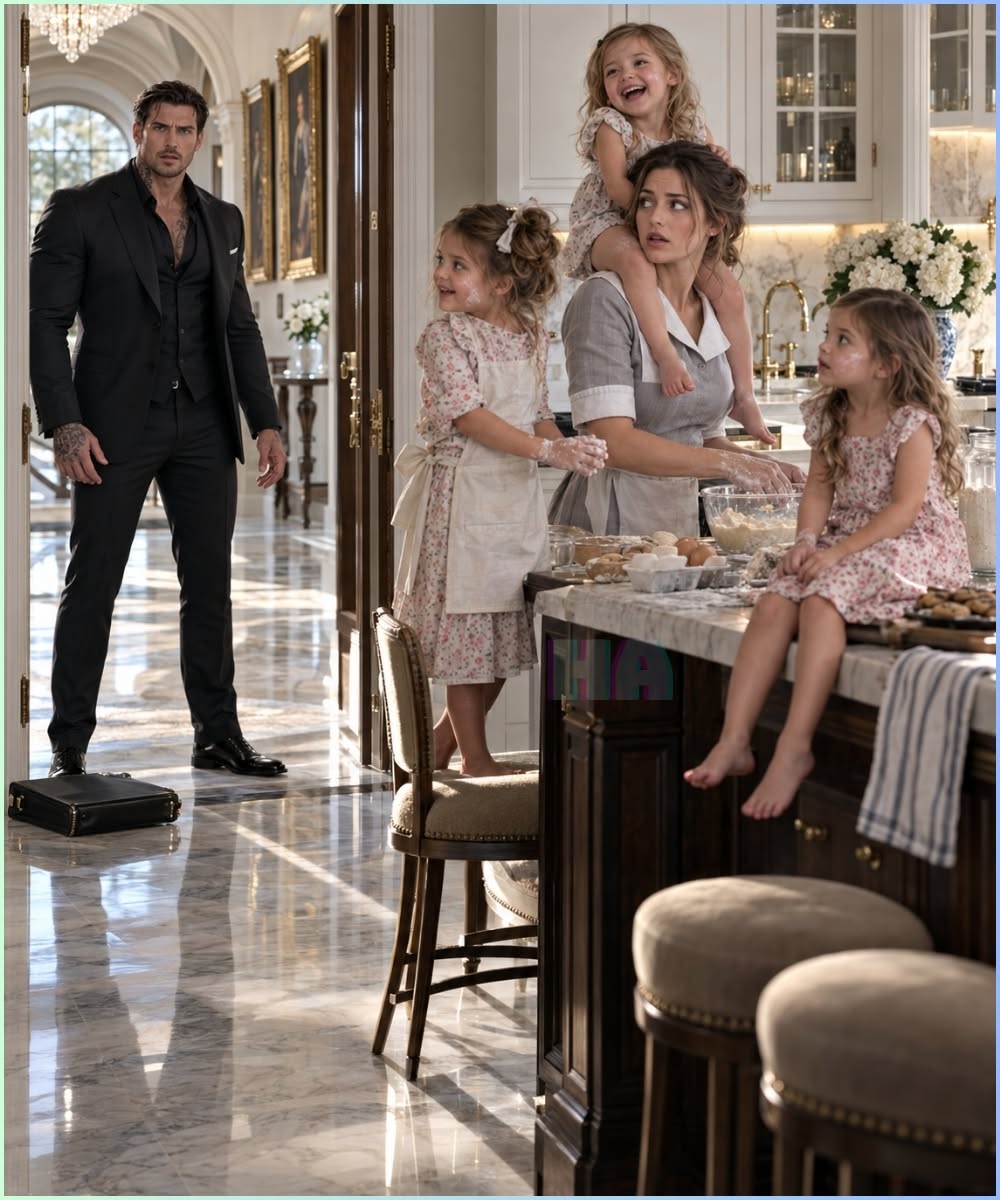
The silence of the Romano estate had never been peaceful; it was an amputation. For four hundred and twenty-six days, the ninety-room estate on the Gold Coast of Long Island had smelled of beeswax, cold marble, and dead flowers. It was a mausoleum disguised as a fortress, where seventy-two security cameras rotated on whisper-quiet servos and armed men patrolled the perimeter with Belgian Malinois whose jaws were trained to crush bone without barking.
Dominic Romano stood in the arched mahogany entrance of the library, his knuckles still raw from the docks at Red Hook, watching his three daughters.
Olivia, seven years old, walked with a deliberate, haunting solemnity that belonged to an old woman. Sophie, six, clung to Grace Bennett’s fingers with a grip that turned her knuckles ivory. Nora, four, trailed just behind, her small thumb lodged in her mouth, her eyes darting toward the corners of the ceiling where the shadows gathered thickest beneath the coffered cypress beams.
Grace did not look back at him. She walked at the children’s pace. She wore no jewelry, no perfume, nothing that marked her as belonging to the world of men who bartered in blood and shipping manifests. Her linen apron was smudged with flour and strawberry jam.
"Show me, sweetheart," Grace whispered to Sophie. Her voice was steady, lacking the nervous, oily deference every tutor, psychiatrist, and maid had used since the morning Isabelle died.
Sophie stopped before the long gallery wall. Here hung the history of Dominic’s rise: black-and-white photographs of grandfathered piers in Brooklyn, municipal groundbreakings, charity galas at the Plaza, and the formal portraits of the Romano family council.
Dominic stepped closer. His Italian leather oxfords made no sound on the Persian runner. His overcoat was gone, but the heavy steel of his custom Kimber .45 pulled slightly at the silk lining of his vest. He forced his breathing down, matching the rhythm he used when negotiating contracts across steel tables with federal prosecutors.
Sophie lifted a trembling finger. She did not point to the photograph of Isabelle laughing beneath an arbor of wisteria.
She pointed to a framed photograph taken three summers ago at the private yacht club in Oyster Bay.
In the frame stood four men in tailored linen suits, flutes of champagne in their hands, the Atlantic sun glinting off their sunglasses. In the center stood Dominic, commanding and unsmiling. To his left was his younger brother, Leo. To his right was Salvatore Gangi, his oldest captain.
And standing directly beside Salvatore, with his arm slung casually across Dominic’s shoulder, was Marcus Vance.
Marcus. Consigliere. Godfather to Olivia. The boy Dominic had pulled out of an orphanage in Bensonhurst when they were both fourteen, who had taken two bullets in Chicago to protect Dominic’s father, who had held Dominic’s trembling hands in the hospital corridor while the surgeons tried and failed to sew Isabelle’s shattered chest back together.
Dominic felt a sudden, icy numbness spread from his collarbones down to his fingertips. "Sophie," he said, and though he tried to soften the gravel in his throat, the girl flinched.
Grace immediately stepped between Dominic and the child, not aggressively, but like a shield sliding into a groove. "Do not use that tone with her, Mr. Romano. She is not one of your dock bosses."
Any man who had spoken to Dominic like that over the past twenty years would have vanished into the furnace pits of a Queens concrete plant before nightfall. Dominic merely stared at Grace, his vision tunneling.
"Did you hear what she said in the kitchen?" Dominic asked, his voice dropping to an ominous register. "Repeat it to me. Exactly as she said it."
"She didn't use the word 'man,'" Grace said quietly, her gray eyes meeting his without a tremor. "She said *Uncle Marcus*. She said, 'Uncle Marcus made Mommy go to sleep, and he sits in our chairs.'"
Dominic turned back to the photograph. Marcus’s smiling face stared out at him behind the polished museum glass. Marcus, who had spent every Sunday dinner since the funeral sitting at the foot of Dominic’s table, carving the roast, pouring the Barolo, and telling the girls bedtime stories about guardian angels.
"Olivia," Dominic called softly.
The oldest girl stepped forward. She looked up at her father. For fourteen months, Dominic had begged God, saints, and neurologists for a single syllable from those lips.
Olivia looked at the photograph. Then she looked Dominic dead in the eyes, lifted both her small hands, and made a twisting motion near her collarbone—the exact gesture Marcus Vance made every time he straightened the silver signet ring he wore on his left pinky finger.
Then, in a voice like dried paper scraping across slate, Olivia spoke her first words in over a year:
"He had the red phone, Daddy. He told the man by the school bus: *Now.*"
***