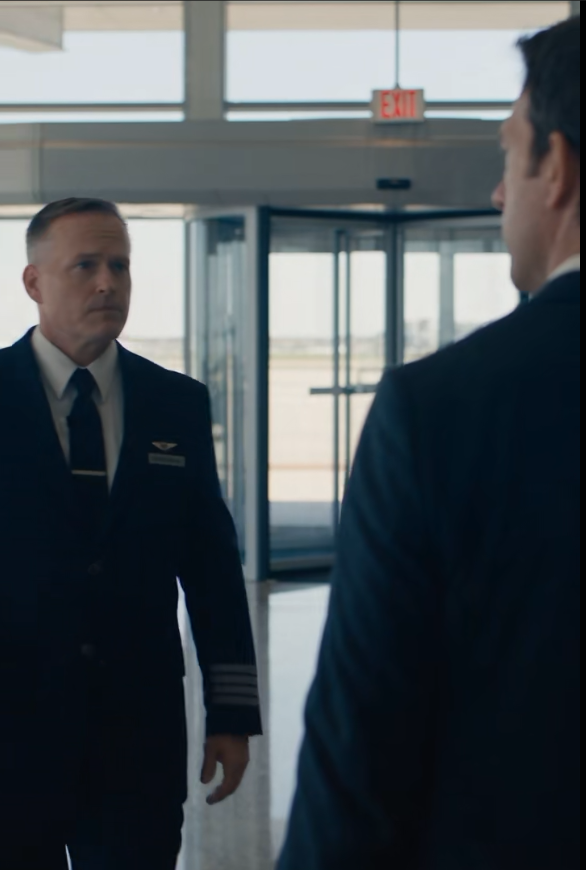
Sarah looked up.
“What thing?”
“The thing where you become so disciplined you stop admitting you’re angry.”
“I’m not required to perform anger for you.”
“Not perform. Acknowledge.”
She held his gaze.
Then looked down at the paper cup of water in front of her.
The silence stretched.
Reed leaned back.
“You could have shown your credential on the roadside.”
“Yes.”
“Why didn’t you?”
Sarah turned the cup slowly between her palms.
“Because he was already wrong.”
“That’s not an answer.”
“It is.”
“No. That’s the answer you give at hearings.”
Sarah stopped moving the cup.
Reed lowered his voice.
“You knew what would happen if he found out who you were.”
“I knew what might happen.”
“You let it continue.”
“I complied.”
“You could have stopped it.”
“And then what?”
Reed said nothing.
Sarah looked toward the observation window.
“If the difference between being arrested and being treated lawfully is whether someone has a star on her shoulder, that is not a functioning safeguard.”
“You weren’t wearing a star.”
“Exactly.”
Reed rubbed a hand over his face.
“You took a risk.”
“I know.”
“You had classified access.”
“The device locks automatically.”
“You were alone.”
“I know.”
“You didn’t know him.”
“That was the point.”
Reed studied her.
Finally he asked, “Was it worth it?”
Sarah looked at the faint cuff marks on her wrists.
“I don’t know yet.”
That answer worried him more than certainty would have.
Part III — The Record
The first crack in Boyd Cleary’s story appeared at 7:14 the next morning.
It came from his own cruiser.
Toby Miller had slept for less than three hours in a chair beside the department server rack because he did not trust the sheriff not to order someone to “clean up storage.”
At 6:40, county counsel arrived.
At 6:52, a federal liaison attorney joined by secure call.
At 7:14, they opened the dash-camera file.
The image showed Sarah’s Malibu traveling through the reduced-speed zone.
A telemetry overlay displayed the sheriff cruiser’s speed and radar readings.
Sarah’s vehicle registered forty-four.
The yellow centerline remained visible beneath the Malibu’s left side throughout the relevant segment.
No crossing.
No drift.
No sudden correction.
The footage continued.
Boyd approached the driver’s window.
His microphone captured every word.
Toby stood behind the county attorney when the phrase arrived.
“You’ve got quite an attitude for somebody standing inside my jurisdiction.”
Then Sarah:
“I am calm. I’m asking whether you intend to issue a citation or detain me.”
The attorney closed his eyes briefly.
The video continued.
“Step out of the vehicle.”
“For a traffic citation?”
“Step out.”
Then the arrest.
Then:
“We’ll call it the attitude package.”
Nobody spoke after that.
The county attorney paused the video.
“Where’s Sheriff Cleary?”
Toby looked toward the door.
“He came in ten minutes ago.”
“Get him.”
Boyd arrived carrying coffee.
He saw the frozen image on the monitor.
Sarah standing beside the Malibu.
Hands visible.
His expression changed.
“Why are you in my system?”
The county attorney turned.
“It is county evidence.”
“It’s my department.”
“It’s the county’s liability.”
Boyd set down the coffee.
“You people going to let Washington roll in here and tell us how to police?”
The attorney pointed at the screen.
“Did Washington make you say ‘attitude package’?”
Boyd looked at Toby.
“You pulled this?”
“I preserved it.”
“I told you not to touch anything.”
“You told me not to delete anything.”
“I told you—”
“Enough,” the attorney said.
Boyd rounded on him.
“You don’t command me.”
“No. But I advise the county that pays judgments when elected officials create them.”
Boyd laughed without humor.
“She was disrespectful.”
Toby looked down.
The attorney said, “Where?”
“You saw it.”
“I saw a driver answer questions.”
“You weren’t there.”
“The camera was.”
Boyd pointed at the screen.
“She challenged my authority.”
“No,” Toby said.
The room shifted.
Boyd slowly turned.
Toby had never contradicted him like that.
Not openly.
Toby felt his mouth go dry but continued.
“She asked what you were doing.”
Boyd stared at him.
“Careful.”
Toby’s hands trembled slightly at his sides.
He folded them to hide it.
“She asked if she was getting a citation or being detained. That’s what she said.”
“I know what she said.”
“Then why does your report say she became verbally aggressive?”
Boyd’s face hardened.
The county attorney looked at the report.
Then at Boyd.
“Sheriff?”
“She was confrontational.”
“That isn’t the same thing.”
“It is when you’re trying to control a roadside stop.”
Toby said, “She complied.”
Boyd stepped closer.
“You want my badge, Miller?”
The question was quiet.
Toby looked at him.
“No.”
“Because you’re working hard to lose yours.”
The county attorney stood.
“Sheriff, stop.”
Boyd ignored him.
“You think because some general comes through here you get to turn righteous?”
Toby’s throat tightened.
He thought about Sarah in the cell.
Preserve the booking footage.
Not save me.
Not call the Army.
Preserve the record.
He looked at Boyd.
“I think the video should stay exactly the way it is.”
The sheriff’s face went still.
That moment, more than the helicopters, changed Oak Haven.
Because institutions did not collapse when outsiders accused them.
They changed when someone inside stopped helping the lie.
Sarah was released on personal recognizance shortly after eight that morning.
She walked out the side entrance rather than the front because reporters had blocked the courthouse steps.
Reed waited beside a black government SUV.
“You could leave now,” he said.
“I know.”
“The airport can be secured.”
“I know.”
“Washington wants you back.”
Sarah looked across the street at the sheriff’s department.
“Not yet.”
Reed sighed.
“You’re still under orders to attend tomorrow’s briefing.”
“I can join remotely.”
“Sarah.”
“I’m staying until I give a full statement.”
“You already gave one.”
“To military security regarding the device. Not to the state investigators.”
“They’re coming?”
“Requested.”
Reed looked at her.
“By you?”
“By the county attorney.”
He raised an eyebrow.
Sarah opened the rear door of the SUV.
“After reviewing the video.”
That stopped him.
“He saw it?”
“Yes.”
“And?”
Sarah climbed in.
“He did not appear enthusiastic.”
Reed entered from the other side.
The vehicle pulled away.
For several blocks neither spoke.
Then Reed said, “Tell me you didn’t know the camera would support you.”
“I assumed there was a dash camera.”
“That isn’t what I asked.”
“No. I didn’t know whether it was active.”
Reed studied her profile.
“You took that chance too.”
“Yes.”
“What if it wasn’t?”
Sarah watched Oak Haven pass outside.
A laundromat.
A church.
A hardware store.
People beginning their day.
“Then it would have been his word against mine.”
“You’re a brigadier general.”
“And he’s the sheriff.”
Reed understood the implication.
Status would not erase the question of credibility.
It would merely alter whose credibility the public preferred.
“What are you trying to prove?” he asked.
Sarah turned from the window.
“Nothing.”
“That’s not true.”
“I’m not trying to prove something about myself.”
“Then about him?”