Part I — The Snap
The plastic broke with a sound so small it should have meant nothing.
Instead, it became the loudest thing on County Road 44.
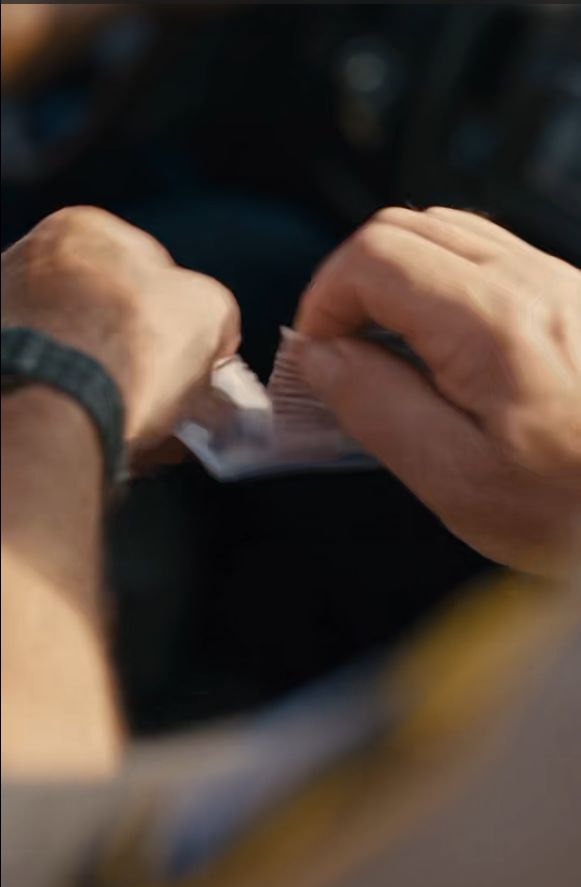
Two jagged pieces of Sergeant First Class Isaiah Brooks’s military retirement identification card dropped through the open window of his silver Ford F-150 and landed across his jeans. One piece carried his photograph. The other held the words U.S. SPECIAL OPERATIONS COMMAND beneath a federal seal that had survived rain, dust, deployments, security checkpoints, and more midnight briefings than Isaiah cared to count.
Now it lay in his lap in two pieces because Sheriff Arthur Cleary had decided it was fake.
For the first time since the blue lights appeared in his rearview mirror, Isaiah’s expression changed.
Not much.
A slight narrowing of the eyes.
A stillness around the mouth.
“You shouldn’t have done that,” he said.
The afternoon heat pressed through the open windows. Cicadas rasped somewhere beyond the dry grass. Behind Isaiah’s truck, the sheriff’s cruiser idled at an angle on the gravel shoulder, its light bar painting silent pulses of blue across the tailgate.
Cleary stood outside the driver’s door wearing mirrored sunglasses and the kind of smile that came from believing the last word belonged to him.
“What are you gonna do about it?”
Isaiah looked at the broken card again.
Forty-eight hours.
That was how long he had been retired.
Not retired in the way civilians imagined it—sleeping late, buying a fishing boat, telling war stories to anyone willing to listen. Forty-eight hours earlier he had walked out of a processing building carrying a manila envelope, a DD-214, a temporary stack of medical paperwork, and a military retirement card he had not yet grown used to seeing.
Twenty-two years in uniform reduced to a date beside the word RETIRED.
He had thought the strangest part would be waking up without formation.
He had been wrong.
The strangest part was sitting on an Alabama county road while a man who knew nothing about him held the remains of those twenty-two years between a smirk and a traffic citation.
Isaiah raised his hands slowly, palms visible.
He had learned long ago that anger was sometimes a luxury.
Cleary’s smile tightened.
“Step out of the vehicle.”
Isaiah opened the door.
Gravel shifted under his boots as he climbed down. Heat hit the back of his neck. He wore a charcoal polo, dark jeans, and the same brown boots he had worn on the long drive south from Illinois. No uniform. No rank. No flag on his shoulder.
For the first time since he was nineteen, there was nothing visible on him that explained where he belonged.
Cleary moved behind him.
“Hands back.”
Isaiah complied.
The cuffs closed with two hard clicks.
He stared down the road.
Flat pavement.
Faded center line.
No houses close enough for anyone to hear much of anything.
“You got anything in the truck I need to know about?” Cleary asked.
“Luggage.”
“Weapons?”
“No.”
“Drugs?”
Isaiah turned his head slightly.
“No.”
Cleary tugged one cuff tighter than necessary.
“Face forward.”
Isaiah did.
He had spent years teaching young soldiers that discipline was not obedience without thought. Discipline was control under pressure. It was knowing what mattered now and what could wait.
This could wait.
The truck could wait.
The card could wait.
His anger could wait.
He let Cleary guide him toward the cruiser.
Two hours earlier, Isaiah had been thinking about gumbo.
His sister Renee had called twice from Mobile asking whether he had crossed into Alabama yet.
“You know Mama’s gonna act like you came back from the dead,” she had said.
“I saw her at Christmas.”
“That was ten months ago.”
“That is not the dead.”
“To Mama, anything past two weeks is neglect.”
Isaiah had laughed.
It had felt good.
He had promised to be at Renee’s house before dinner. His mother had been told only that he was “coming down sometime this week.” Isaiah wanted to surprise her with the retirement news in person.
He had imagined walking into the kitchen while she complained about somebody over-seasoning the rice. He had imagined her looking at him, then at the retirement folder, then immediately asking what he planned to do with the rest of his life.
His mother never wasted time celebrating an ending before demanding a beginning.
Instead, Isaiah was placed in the back of a patrol car.
Cleary opened the rear door.
Isaiah stopped.
“Sheriff.”
Cleary looked at him.
“My phone is in the center console.”
“And?”
“My family is expecting me.”
Cleary gave a small shrug.
“They’ll keep.”
Isaiah watched him for a moment.
Then he ducked into the cruiser.
The door slammed.
Through the safety partition, he watched Cleary return to the pickup. The sheriff leaned through the open driver’s window, moved something on the seat, then walked around to the passenger side.
Isaiah’s attention sharpened.
Cleary opened the passenger door.
Started looking.
Not a glance.
A search.
Isaiah shifted toward the glass.
“Sheriff.”
Cleary ignored him.
He pulled Isaiah’s travel bag onto the seat, opened the zipper, and began moving clothing.
“Sheriff, I do not consent to a search.”
Cleary stopped.
Turned.
Even through the cruiser windows, Isaiah could see the smile return.
“You’re detained.”
“That isn’t consent.”
Cleary shut the passenger door harder than necessary and came back.
He opened the rear door.
“You want to tell me how to do my job?”
“No.”
“Sounds like you do.”
“I told you I don’t consent.”
Cleary leaned closer.
The mirrored lenses reflected Isaiah’s own face back at him.
“You people watch too much television.”
Isaiah’s voice stayed level.
“What am I being arrested for?”
“You’re not arrested.”
“I’m in handcuffs in your car.”
“You’re being detained while I investigate.”
“Investigate what?”
“Fraudulent military identification.”
Isaiah almost laughed.
Not because it was funny.
Because the alternative was something harder to control.
“You destroyed the identification.”
“I confiscated suspected fraudulent property.”
“You snapped it in half.”
Cleary’s jaw shifted.
“I’d watch your tone.”
Isaiah looked past him toward the road.
“My tone is fine.”
Cleary shut the door.
The cruiser drove north.
Isaiah watched his truck disappear in the rear window.
On the passenger seat up front sat the two broken halves of his retirement ID.
Cleary had taken them with him.
That told Isaiah something.
The sheriff understood evidence.
He simply believed he controlled what evidence meant.
County Road 44 gave way to a narrower highway. Pines replaced open fields. After fifteen minutes they entered Coopersville, a town Isaiah might have driven through without remembering if not for the courthouse square, a feed store, a diner with red vinyl booths visible through the windows, and a squat brick sheriff’s office attached to the county jail.
Cleary parked behind the building.
A deputy stepped outside.
Young.
White.
Mid-twenties, maybe.
He looked at Cleary, then at Isaiah in the back seat.
“What we got?”
“Possible stolen valor, fake federal identification, maybe more.”
The deputy frowned.
“Stolen valor?”
Cleary opened Isaiah’s door.
“Get him inside.”
Isaiah stepped out.