Part VII — Aftermath
Arthur Cleary was eventually charged with falsifying public records and obstruction related not only to Isaiah’s detention but to several altered incident entries uncovered during the audit.
The state did not charge him for breaking the military ID.
That remained what it had always been: a small act with a large shadow.
He resigned before trial.
Months later, he entered a plea on two records-related counts.
No dramatic prison sentence.
No cinematic handcuff walk down courthouse steps.
Probation.
Loss of office.
Restrictions on future law-enforcement employment.
Fines.
For many people online, it was not enough.
For Isaiah, enough had stopped being the question.
The civil cases moved separately.
The county settled with Calvin Reed.
Then Marisol Vega.
Then Isaiah.
Isaiah refused a confidentiality clause.
That decision cost him money.
Hart told him exactly how much.
He signed anyway.
The settlement required policy changes, outside auditing for a fixed period, preservation standards for body-camera footage, documented review for any post-incident record modification, and an independent complaint path that did not terminate at the sheriff’s desk.
Pierce returned to duty under an interim sheriff.
Not immediately.
Not triumphantly.
His suspension remained in his personnel file until arbitration.
His wife gave birth to a daughter before the case ended.
Isaiah met the baby once in a coffee shop halfway between Birmingham and Coopersville.
Pierce looked older.
“You told me not to burn my life down,” he said.
“I remember.”
“Almost did.”
Isaiah looked at the baby sleeping against Pierce’s chest.
“You didn’t.”
Pierce smiled faintly.
“My wife disagrees.”
They sat quietly.
Then Pierce reached into his jacket.
“I got something for you.”
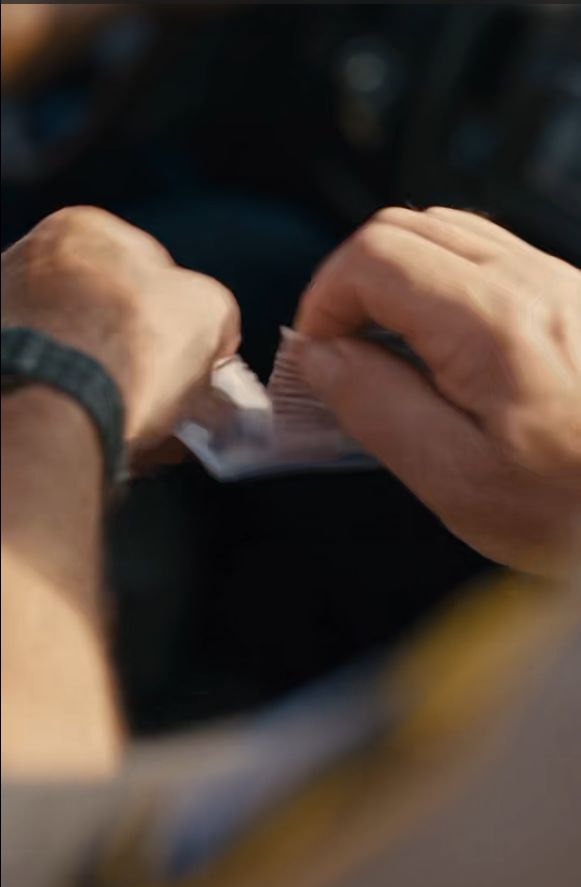
He placed a plastic cardholder on the table.
Inside was a new military retirement ID.
Isaiah stared at it.
“How did you get that?”
“I didn’t. Your sister did.”
Isaiah closed his eyes.
“Of course she did.”
“She mailed it to the station with instructions.”
“What instructions?”
Pierce handed him an envelope.
Isaiah opened it.
Renee’s handwriting.
Since apparently neither of you knows how to end this story like normal people, give him the card.
Isaiah laughed.
Pierce did too.
It was the first easy laugh either of them had shared.
Isaiah took the cardholder.
His replacement ID had arrived weeks earlier through the proper process. Renee must have taken the spare protective sleeve from his paperwork.
Pierce looked at the new card.
“You gonna carry it?”
Isaiah slid it into his wallet.
“Yes.”
“Not worried?”
“About what?”
“Somebody breaking it.”
Isaiah looked at him.
“It’s plastic.”
Pierce nodded slowly.
He understood.
The thing that had mattered was never the card.
Months later, Isaiah finally decided what retirement would look like.
Not consulting for the Army.
Not private security.
Not defense contracting, though the offers came.
He took a teaching position with a community-college public-safety program outside Mobile.
Part-time at first.
His course was called Documentation, Decision-Making, and Public Trust.
Renee laughed for a full minute when she heard.
“You retired from the Army to teach cops paperwork?”
“Apparently.”
“You have become the oldest version of yourself possible.”
“Thank you.”
“That was not praise.”
The first class contained twenty-three students.
Future deputies.
Corrections officers.
Emergency-management workers.
Two veterans.
Three students old enough to have children in college.
On the first day, Isaiah walked in carrying no slides.
He placed a clear evidence bag on the desk.
Inside were two broken pieces of an old military retirement ID.
The room quieted.
He did not tell them the story immediately.
Instead, he wrote one sentence on the board.
WHAT HAPPENS AFTER YOU KNOW YOU WERE WRONG?
He turned.
A student in the front row raised his hand.
“Sir, wrong about what?”
Isaiah looked at the broken card.
“Anything.”
Another student said, “You correct it.”
“Good.”
“What if correcting it gets you in trouble?”
Isaiah leaned against the desk.
“That’s a better question.”
They talked for ninety minutes.
Not about villains.
Not about heroes.
About ego.
Documentation.
Authority.
Fear.
The pressure to defend a colleague.
The pressure to avoid embarrassment.
The danger of letting a mistake become misconduct because admitting the first mistake felt unbearable.
At the end, one student pointed at the evidence bag.
“Is that real?”
Isaiah looked down.
“Yes.”
“What happened?”
He smiled slightly.
“That’s next week.”
The student groaned.
Isaiah gathered his notes.
Outside, late afternoon sunlight spread across the parking lot.
His phone vibrated.
Renee.
You coming to dinner or starting another federal investigation?
Isaiah typed back.
Dinner.
She replied instantly.
Mama says 6 means 6.
He checked the time.
5:18.
Plenty.
He walked toward his truck.
The silver F-150 still carried a faint scratch near the rear wheel from the impound yard.
He had refused to fix it.
Not as a monument.
Just because it was a scratch.
He opened the door and sat.
For a moment, he looked at the wallet in the cup holder.
Then at the road ahead.
Forty-eight hours after retirement, he had believed the hardest adjustment would be learning to live without the structure of service.
He had been wrong.
The harder lesson was accepting that discipline outside uniform did not mean silence.
Sometimes restraint meant waiting.
Sometimes courage meant speaking.
Sometimes the most important thing a person could do after being wronged was not prove how powerful he was.
It was make sure the next person needed less power to be heard.
Isaiah started the engine.
As he pulled onto the road, the late sun flashed briefly across the edge of the replacement ID inside his wallet.
Plastic.
Replaceable.
Ordinary.
Exactly as it should have been.