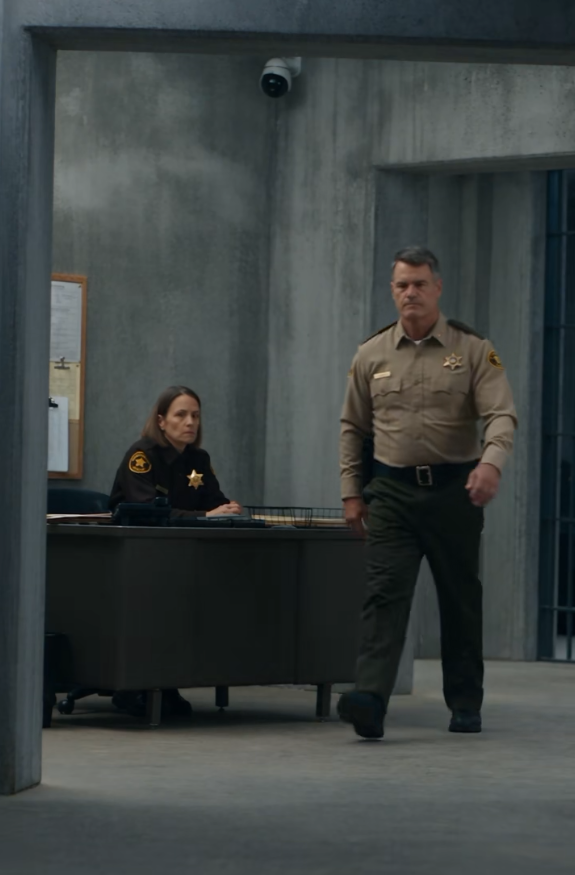
Policies were not guarantees.
Sarah knew that.
People violated policies.
Systems failed.
Authority looked for shortcuts.
But records mattered because memory bent easily under fear, loyalty, pride, and self-protection.
Her phone buzzed.
A message from Jared Miller.
They had exchanged only two messages since trial.
This one read:
Ma’am, department review is done. Thirty-day suspension. Remedial training. Staying on, if that matters. I know I should have acted sooner.
Sarah read it twice.
She started to type:
It matters.
Deleted it.
Typed again.
Tell the truth sooner next time.
She stared at the words.
They sounded like an order.
She deleted them too.
Finally she wrote:
What matters is what you do the next time someone has less power than the person standing over them.
She sent it.
A minute later, three dots appeared.
Then disappeared.
No reply.
Sarah put the phone down.
On the opposite shoulder, a sheriff’s cruiser approached.
Her body tightened before she could stop it.
The cruiser slowed.
For one strange second, the old scene seemed ready to repeat.
Then the vehicle pulled in behind her.
A deputy stepped out.
Not Miller.
A young woman Sarah did not recognize.
She approached cautiously.
Sarah lowered the window.
“Everything okay, ma’am?”
Sarah looked at the nameplate.
Body camera.
Hands visible.
Professional distance.
“Yes.”
“Car trouble?”
“No.”
The deputy glanced toward the road.
“You’re parked pretty close to the curve. If you’re staying a while, there’s a gravel turnout about half a mile ahead. Safer spot.”
Sarah nodded.
“Thank you.”
The deputy started to leave.
Then she stopped.
“Anything else you need?”
“No.”
“All right. Drive safe.”
She returned to her cruiser.
No demand for identification.
No question about where Sarah belonged.
No suspicion created from calmness.
Maybe coincidence.
Maybe training.
Maybe the ordinary version of the encounter that should have happened six months earlier.
Sarah started the engine.
Before pulling away, she looked once into the rearview mirror.
The deputy was already walking back to her cruiser, one hand raised in a small acknowledgment.
Sarah drove north.
Weeks later, the civil suit ended without a dramatic courtroom confrontation.
Oak Haven County admitted the detention and vehicle search lacked lawful justification and agreed to a public settlement whose financial terms Sarah directed largely toward independent county training, records infrastructure, and legal-assistance programs rather than personal damages.
Her attorneys warned her that this would be misunderstood.
Some people would say she was trying to buy reform.
Others would say the county escaped cheaply.
Sarah accepted that.
She kept only the portion necessary to cover her legal expenses and the costs directly associated with the case.
The rest went where she had specified.
Not because money erased anything.
Because consequences should change systems when possible.
At the signing, county counsel slid the final papers toward her.
“No confidentiality clause,” he said.
“I noticed.”
“No non-disparagement.”
“I noticed that too.”
He handed her a pen.
Sarah signed.
Then stopped before closing the folder.
“One thing.”
The attorney looked up.
“What happens to the original footage?”
“Retained under litigation and criminal-evidence rules, then archived.”
“For how long?”
“Permanent archival copy under the revised county policy.”
Sarah nodded.
“That matters.”
The attorney gave a tired smile.
“I had a feeling you’d say that.”
Her last visit to Oak Haven came nearly a year after the arrest.
She was invited, not as a general, but as the plaintiff whose case had helped force procedural changes.
She nearly declined.
Then Brenda called her personally.
“You should come see something.”
So Sarah went.
The sheriff’s office looked almost identical from outside.
Inside, the booking counter had been rearranged.
A new monitor displayed detainee-rights acknowledgments.
Body-camera upload status was visible to records staff, county counsel, and an external compliance server.
Sarah followed Brenda down the hallway.
Cell four stood open.
Sarah stopped.
For the first time since the arrest, the space looked as small as it actually was.
Six feet by ten.
Concrete bench.
Stainless toilet.
Camera in the corner.
Nothing dramatic.
Just a room.
Brenda stood beside her.
“You want it closed?”
“No.”
They remained there.
After a moment, Sarah asked, “Why did you save the file number?”
Brenda smiled faintly.
“I didn’t save the file.”
“You wrote the number down.”
“Yes.”
“Why?”
Brenda considered.
“Because Thomas said it was corrupted too fast.”
Sarah looked at her.
“That’s all?”
“No.”
Brenda leaned against the doorframe.
“I watched you at booking.”
Sarah waited.
“You kept asking people to document things. Time. Property number. Lawyer request. Camera.”
Brenda’s expression changed.
“I realized you weren’t expecting anybody in the building to protect you.”
Sarah looked into the cell.
“I wasn’t.”
“That bothered me.”
Sarah turned.
“Why?”
Brenda gave her a look almost impatient in its simplicity.
“Because that was supposed to be our job.”
No speech followed.
No grand conclusion.
Brenda pushed away from the doorway.
“Come on. I’ll show you the new records room.”
Sarah took one final look inside cell four.
For months, people had treated the Pentagon phone call as the dramatic center of the story.
Five minutes after a sheriff locked a Black woman in a concrete cell, Washington had called and spoken her rank aloud.
That was the part headlines loved.
The moment power answered power.
But Sarah no longer thought that was the important moment.
The important moment had come earlier.
On the roadside.
Before the Pentagon knew.
Before Brenda knew.
Before Ryker knew.
When Sarah had stood with her hands on the roof of a rental car and said, calmly, “I do not consent to a search.”
Everything after that had been a test of whether those words belonged only to people powerful enough to make someone answer for ignoring them.
Sarah left the cell door open and followed Brenda down the hallway.
On the wall outside the new records room, a framed copy of the revised evidence policy hung beneath clear glass.
Sarah stopped to read the final line.
No individual employee, regardless of rank or office, may alter, suppress, overwrite, or restrict access to an original evidentiary record once preservation has been initiated.
Brenda noticed her looking.
“County lawyer wrote that.”
Sarah nodded.
“Good sentence.”
“You want to know something funny?”
“What?”
“The sheriff hated paperwork.”
Sarah looked at her.
Brenda smiled.
“Turns out the paperwork outlasted him.”
Sarah’s expression softened.
Then they kept walking.
Outside, afternoon light filled the lobby through the front windows.
A deputy held the door for an elderly man carrying a stack of forms. Phones rang behind the dispatch counter. Someone laughed in the records room. A printer started and stopped.
Ordinary sounds.
Ordinary government.
That, Sarah understood, was the point.
Justice was rarely one phone call from Washington.
It was the deputy who left his camera running.
The dispatcher who remembered a file number.
The server that preserved an autosave.
The prosecutor who separated what could be proved from what merely felt true.
The jurors who rejected one charge and accepted two others.
The policies rewritten after the cameras left.
And the next traffic stop, involving someone whose missed appointment would not make the Pentagon telephone anyone.
Sarah stepped outside.
No reporters waited.
No convoy.
No uniform.
She walked alone to her rental car, opened the driver’s door, and paused with one hand on the roof.
For a moment she could feel the old metal cuffs again.
Then the sensation passed.
She got behind the wheel and drove away.
This time, nobody needed to know who she was.