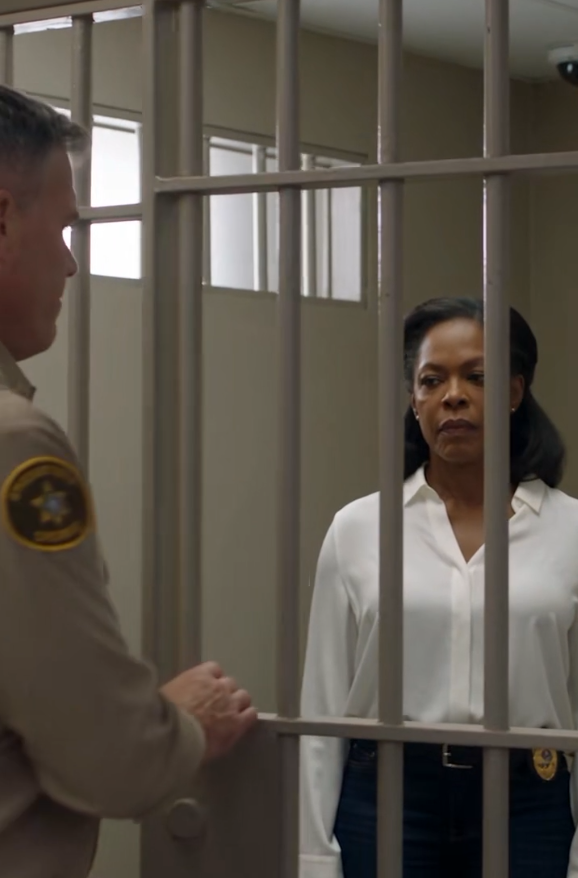
Across the parking lot, Miller stood alone.
He did not approach.
Brenda emerged from the building and joined him.
Two people who had worked under Ryker.
Two people who had chosen, eventually, to contradict him.
Sarah looked at them for a moment.
Then got into the car.
The final consequences came over the next six weeks.
The disorderly-conduct charge was dismissed.
So was resisting arrest.
The county prosecutor stated that available video did not establish lawful grounds to pursue either charge.
The traffic citation was withdrawn after review of the dash footage.
The GBI concluded that records had not been altered, largely because Brenda had refused to make the requested change.
The sheriff’s department adopted mandatory automatic upload procedures for body-camera footage and revised its written policies regarding consent searches and access to counsel.
Then the independent review of earlier complaints came back.
Not a vast conspiracy.
Not dozens of hidden cases.
Something narrower.
And therefore harder to dismiss.
Three previous arrests over four years involved people who had verbally challenged vehicle searches.
Two had disorderly-conduct charges later dismissed.
In one, body-camera footage contradicted language used in the arrest report.
The county prosecutor reopened review of all three.
Ryker resigned two days later.
His letter did not admit wrongdoing.
It said the national attention had made it impossible for him to lead effectively.
Sarah read the statement at her desk in Washington.
Then closed the article.
Whitfield stood across from her.
“That’s it?”
“What?”
“You’re not going to say anything?”
“What would you like me to say?”
Whitfield considered.
“I don’t know.”
Sarah looked back at the logistics briefing on her screen.
“Then we’re in agreement.”
Whitfield almost smiled.
“There’s one more thing.”
She handed Sarah a folder.
Inside was a proposed settlement from the county.
Financial compensation.
Attorney’s fees.
Expungement costs.
Formal written acknowledgment that the charges had been dismissed.
And a confidentiality clause.
Sarah read it twice.
Then looked up.
“No.”
Whitfield raised an eyebrow.
“You expected yes?”
“No, ma’am.”
Sarah called Price.
“I’ll accept the financial terms if they remove confidentiality.”
Price was silent for a second.
“They’ll resist that.”
“Then we don’t settle.”
“Why?”
Sarah looked at the folder.
“Because I’m not going to spend six weeks asking for transparency and then sell mine.”
Price sighed softly.
“That may cost you.”
“I know.”
It did.
The county reduced the offer substantially.
Sarah accepted anyway.
The final agreement was public.
So were the findings.
So were the videos.
Not because Sarah wanted a permanent monument to her worst Friday.
Because secrecy would have turned accountability into another private arrangement made after someone important got hurt.
She refused to let that be the ending.
Part VI — Aftermath
Two months after the stop, Sarah returned to Georgia.
This time she flew into Savannah and rented another car.
Her aunt laughed when she saw the keys.
“You sure about that?”
Sarah placed her bag in the trunk.
“It’s a car.”
“You said that last time.”
“No, last time I said I was coming for dinner.”
“And you were late.”
“I had circumstances.”
Her aunt pointed toward the passenger seat.
“I’m driving.”
Sarah looked at her.
“You don’t trust me?”
“I trust you. I don’t trust your ability to pass through a county without starting a constitutional crisis.”
Sarah laughed.
“Get in.”
They drove north the next morning.
Sarah had one reason for the trip.
Miller had found new work.
Not law enforcement.
A logistics position with a regional emergency-management contractor.
He had sent her a short note through Price thanking her for not publicly attacking him during the hearings.
Sarah had not responded.
She had thought about it.
Now, as she and her aunt passed the turn toward Oak Haven County, she asked to stop for coffee.
The gas station was ordinary.
Two pumps.
A convenience store.
Sunlight on dusty windows.
Sarah stood beside the car while her aunt went inside.
A county patrol vehicle pulled in.
For half a second, Sarah’s body noticed before her mind did.
Shoulders.
Breathing.
Distance to the road.
Camera under the awning.
Then she recognized the response for what it was.
Not fear.
Memory.
The deputy got out.
A woman Sarah did not know.
She walked into the store without looking at Sarah twice.
Sarah exhaled.
Her aunt returned with coffee.
“You okay?”
“Yes.”
“You sure?”
Sarah took the cup.
“Yes.”
They drove on.
At her aunt’s house that evening, Sarah sat on the porch after dinner.
No uniform.
No phone in her hand.
Crickets sounded in the yard.
The sky was going dark.
Her aunt sat beside her.
“Was it worth it?”
Sarah knew what she meant.
The hearings.
The attention.
The photographs.
The weeks of scrutiny.
The accusations that she had used rank.
The accusations that she had hidden rank.
The lawyers.
The reports.
The county meetings.
Miller’s resignation.
Ryker’s resignation.
Everything.
Sarah thought for a while.
“I don’t know.”
Her aunt nodded.
“That’s probably the right answer.”
Sarah looked at her.
“You say that a lot.”
“I’m old. It saves time.”
They sat in silence.
After a minute, her aunt asked, “Did you ever wish you’d just told him?”
Sarah looked out at the dark yard.
“Yes.”
That surprised even her.
“When?”
“In the cell.”
Her aunt waited.
Sarah said, “For about thirty seconds.”
“What stopped you?”
Sarah smiled faintly.
“He already knew by then.”
Her aunt laughed.
The sound drifted into the yard.
Monday morning, back at the Pentagon, Sarah walked into a secure conference room at 6:55.
Whitfield was already there.
Of course she was.
Three officers sat with open briefing books.
A civilian analyst adjusted a display.
The meeting began at seven.
No one mentioned Georgia.
No one mentioned the sheriff.
No one mentioned the booking photo.
For ninety minutes, Sarah was simply doing her job.
Afterward, Whitfield followed her into the corridor.
“There’s a package for you.”
“From?”
“Oak Haven.”
Sarah stopped.
“What kind?”
“Paper.”
“That narrows it down.”
Whitfield handed her a large envelope.
No official seal.
No return address beyond the county.
Inside was a copy of the new departmental policy manual.
Body-camera activation.
Consent searches.
Report amendments.
Requests for counsel.
Evidence retention.
Sarah flipped through it.
Several sections had been revised.
At the back was a handwritten note.
No signature.
Just one sentence.
We’re using the cameras now.
Sarah read it again.
Whitfield waited.
“Good news?”
Sarah closed the manual.
“Maybe.”
She carried it into her office and placed it on the shelf behind her desk.
Not beside awards.
Not beside promotion certificates.
On the lower shelf with training manuals and procedural references.
A working document.
That felt right.
She sat.
On her desk was the white blouse she had worn that Friday, folded inside a dry-cleaning bag.
Her aunt had insisted on having it cleaned before Sarah left Georgia.
Sarah had forgotten to take it home.
Whitfield must have brought it from the package delivery.
Sarah pulled the blouse from the plastic.
For a moment she considered throwing it away.
Instead, she hung it inside the narrow closet behind her office door.
Next to two uniforms.
The contrast stopped her.
White civilian blouse.
Dark military coats.
Stars resting on shoulder boards.
For most of her career, those stars had opened doors before Sarah reached them.
People stood when she entered rooms.
Phones were answered.
Questions were returned.
Requests were logged.
That Friday in Georgia had shown her the opposite side of visibility.
What happened when nobody saw the stars.
The lesson was not that rank protected her.
She had always known that.
The lesson was how quickly systems could confuse status with credibility.
Sarah closed the closet.
At 8:52, Whitfield appeared again.
“Ma’am, your nine o’clock is waiting.”
Sarah picked up her briefing folder.
At the door, Whitfield said, “One question.”
Sarah stopped.
“Still wearing civilian clothes next time you drive through Georgia?”
Sarah looked down at her dark suit.
Then back at the colonel.
“Yes.”
Whitfield smiled.
“Thought so.”
Sarah walked into the conference room.
Seven people rose automatically.
She paused.
“Please sit.”
They did.
She took her place at the table, opened the folder, and looked around at faces waiting for her to speak.
For an instant she remembered the concrete bench.
The buzzing fluorescent light.
The locked door.
Ryker asking why she had not told him who she was.
Sarah finally understood the answer more clearly than she had that afternoon.
Her rank had never been the secret.
The real test had been whether she needed it.
She looked down at the first page of the briefing.
Then she began.
And behind her office door, hidden from everyone in the room, a plain white blouse hung beside a general’s uniform—quiet proof that rights should never need stars on the shoulders before anyone decides they matter.