Part I — The Stop
Sheriff Boyd Cleary knew the silver Chevrolet was legal before he ever turned on his lights.
That was the part he would later try hardest to forget.
The afternoon heat over Oak Haven shimmered above Interstate 89, flattening the horizon into wavering bands of asphalt, pine, and washed-out sky. Boyd sat in his cruiser behind a weather-beaten billboard advertising a motel that had closed three summers ago. His radar gun rested against the steering wheel.
Forty-four.
The speed limit had dropped from sixty-five to forty-five just before the town boundary. The Chevrolet Malibu had slowed before reaching the sign.
No violation.
Boyd watched it pass anyway.
Washington, D.C., rental plates. One driver. Black woman. Alone.
He lowered the radar gun.
There were drivers who came through Oak Haven tense and apologetic, already reaching for their wallets before he reached their windows. There were others who arrived with out-of-state confidence, the kind Boyd interpreted as disrespect before a word was spoken.
The woman in the Malibu had committed a smaller offense.
She had looked composed.
Boyd started the cruiser.
His lights came alive in the rearview mirror of the Chevrolet.
Inside the rental car, Brigadier General Sarah Hayes saw them and felt no surprise.
She checked the speedometer.
Forty-four.
Lane position centered.
Turn signal.
Shoulder.
Park.
Engine off.
Window down.
Hands at ten and two.
She did each movement slowly, visibly, exactly as her father had taught her when she was sixteen and first learning to drive.
Calm doesn't guarantee safety, he had told her.
She could still hear his voice after all these years.
But don't ever give a stranger an excuse to describe you as something you weren't.
Sarah had spent the previous four days in secure meetings where colonels waited outside locked doors and senior officials surrendered their phones before entering. She had briefed commanders who controlled assets scattered across continents. She had missed sleep, eaten two dinners from paper containers, and changed her flight once already.
All she wanted now was to reach the airport.
In the mirror, she watched the sheriff leave his cruiser.
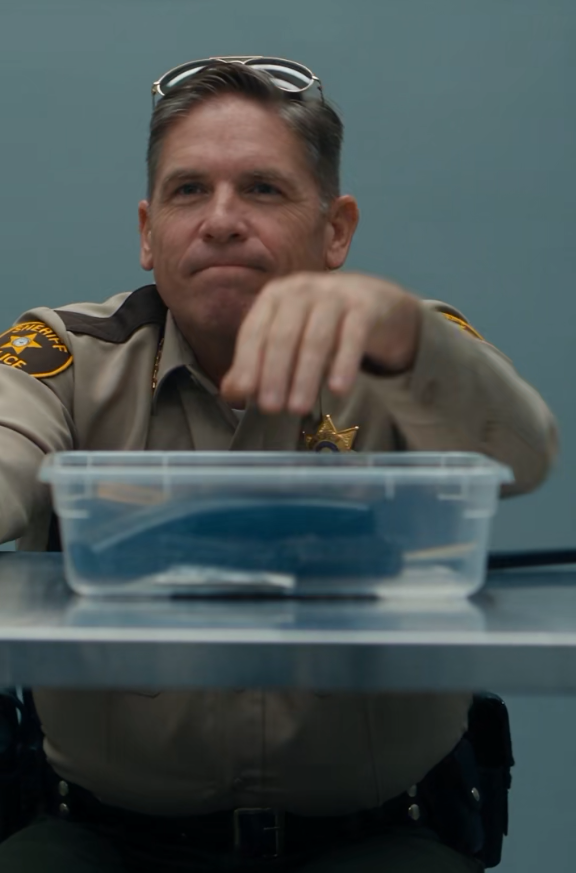
Heavy steps. Mirrored sunglasses. Tan uniform stretched tight across a broad torso. His thumbs hooked beside his gun belt.
He stopped at her window.
“License and registration.”
Sarah looked straight ahead.
“My wallet is in my purse on the passenger seat. The rental agreement is in the glove compartment. May I reach for them?”
The sheriff's mouth shifted slightly.
“Go ahead.”
She took out the documents and handed them over.
He studied the license longer than necessary.
“Sarah Hayes.”
He made her name sound like a question he had already decided she was answering incorrectly.
“Long way from D.C.”
“I’m on my way to the airport, Sheriff.”
“I didn’t ask where you were going.”
Sarah turned her head toward him.
There it was.
Not confusion.
Not caution.
A test.
She knew the type. Rank produced them. Bureaucracy produced them. Institutions produced them. So did tiny rooms where one person possessed authority and wanted everyone else to feel it.
She had met versions of Boyd Cleary wearing expensive suits, combat uniforms, and congressional visitor badges.
The difference here was that Boyd had a gun and no one standing behind him.
He glanced toward the highway.
“You know why I stopped you?”
“No.”
“You crossed the center line back there.”
Sarah paused.
“No, Sheriff. I did not.”
His chin lifted.
“You calling me a liar?”
“I’m telling you what occurred.”
“You were weaving.”
“I was not.”
“You know how fast you were going?”
“Forty-four miles per hour after the posted reduction to forty-five.”
That answer irritated him more than denial would have.
Boyd bent lower toward the window.
“You’ve got a lot of attitude for somebody driving through my jurisdiction.”
Sarah's face remained still.
“I am calm. I am asking whether you intend to issue a citation or detain me.”
The word detain changed something.
It made the encounter formal.
It reduced Boyd’s authority from something personal and theatrical into something that could be measured later.
His lips compressed.
“Step out of the vehicle.”
Sarah held his gaze for half a second.
“For a traffic violation?”
“Step out.”
She could have asked more questions.
She could have identified herself.
She could have reached into the legal vocabulary that had been drilled into officers and commanders for decades.
Instead, she unbuckled her seat belt.
“Understood.”
She stepped into the heat.
The highway shoulder radiated upward through the soles of her shoes. A truck passed, pushing hot air against them.
Boyd pointed at the car.
“Turn around. Hands on the roof.”
Sarah did not move immediately.
“Sheriff Cleary, I strongly suggest you reconsider what you are about to do.”
He stepped closer.
“Are you threatening me?”
“No.”
“Sure sounded like one.”
“I am providing you with a factual assessment.”
His expression hardened.
There were moments in Sarah’s military career when she had recognized an irreversible decision before the person making it did.
A commander dismissing intelligence because retreat would embarrass him.
An officer hiding a logistical failure because admitting it might damage promotion prospects.
A junior soldier lying because fear felt easier than consequence.
This was the same thing in smaller clothes.
Boyd reached for her arm.
“Turn around.”
Sarah turned.
He pulled her right wrist behind her back.
Metal closed around it.
Then the left.
Too tight.
She flexed her fingers once.
“Resisting arrest,” Boyd said. “Disorderly conduct. Failure to comply.”
Sarah looked sideways.
“I complied with every instruction.”
He gave the cuffs an unnecessary tug.
“We’ll call it the attitude package.”
For the first time, something changed in her face.
Not fear.
Not anger.
Recognition.
She looked at him the way she looked at a damaged bridge on a planning map.
Something had failed.
Now the question was how far the failure extended.
“Very well, Sheriff.”
That calm response unsettled him.
He pushed her toward the cruiser.
“You’ll figure it out.”
Sarah said nothing.
As he opened the rear door, she glanced once toward the rented Malibu.
Her secure communications device remained inside the inner pocket of her travel jacket.
She had considered identifying herself before being handcuffed.
She had decided against it.
That decision was no accident.
Her father had once told her that power revealed people twice—first when they believed they had none, and again when they believed they had all of it.
Sarah already knew who Boyd Cleary was when confronted by resistance.
Now she wanted to know who he was when he believed there would be no resistance at all.
The cruiser door slammed.
Boyd walked back toward her rental car.
From behind the glass, Sarah watched him search it.
He had not asked permission.
He opened the glove compartment, then the center console. He lifted her purse, rifled through it, and examined the back seat.
When he returned, he carried her jacket.
He opened the rear door.
“What’s this?”
In his hand was a matte-black device roughly the size of a thick smartphone.
No logo.
No conventional keypad.
A recessed biometric seal crossed its side.
Sarah’s eyes moved from the device to Boyd.