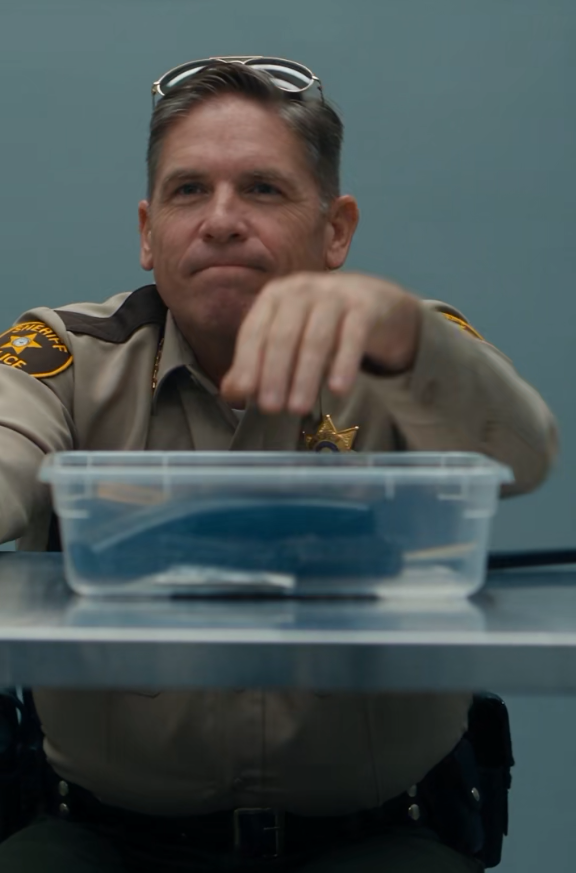
She had refused to pretend he was right.
And he had punished her for it.
Boyd looked at Sarah.
“You wanted this.”
The hearing officer warned him.
Boyd ignored it.
“You wanted me sitting here.”
Sarah held his gaze.
“No.”
“Then why'd you come back?”
The hearing officer started to speak again.
Sarah answered first.
“Because you keep mistaking accountability for revenge.”
Boyd laughed bitterly.
“Easy for you. You’ll leave. Go back to Washington. Everybody salutes you.”
Sarah’s face changed almost imperceptibly.
There was something in that accusation that reached deeper than the rest.
Because part of it was true.
She would leave.
She had power.
She had resources.
She had the Pentagon answering her call.
That difference was exactly what had troubled her since the beginning.
She looked at Boyd.
“When you stopped me, you thought none of that existed.”
He said nothing.
“And you were comfortable with what you did.”
The hearing officer ordered the exchange to end.
But Sarah had already said what mattered.
The panel recessed for deliberation.
Outside, the sky had darkened.
A storm rolled toward Oak Haven from the west.
Sarah stood beneath the courthouse awning.
Toby joined her.
Neither spoke for a while.
Cars passed through the wet-looking afternoon light.
Finally Toby said, “You think they remove him?”
“I don't know.”
“You always say that?”
“When I don't know.”
He nodded.
“You could guess.”
“I could.”
Another silence.
Toby looked toward the road.
“I keep thinking about all the stops.”
Sarah turned toward him.
“Which ones?”
“The ones before yours.”
He rubbed the back of his neck.
“You start wondering what you missed.”
“That’s probably worth wondering.”
“Doesn't tell you what to do with it.”
“No.”
He glanced at her.
“What do you do?”
“With what?”
“When you realize you were part of something you should’ve noticed sooner.”
Sarah watched rain begin in scattered dark marks on the courthouse steps.
“You stop asking whether noticing late excuses noticing late.”
Toby frowned.
“That sounds like a general answer.”
“It is.”
“So what’s the human answer?”
Sarah looked at him.
“You do better next time.”
Toby nodded.
A car door closed behind them.
Boyd emerged from the courthouse.
His lawyer walked several steps ahead.
Boyd paused when he saw them.
Toby straightened automatically.
An old reflex.
Boyd noticed.
For a second, the former arrangement returned—the sheriff and the deputy, authority and obedience.
Then Toby relaxed his shoulders.
He did not salute.
Did not look away.
Did not apologize for standing beside Sarah.
Boyd walked past.
The rain grew heavier.
The panel called them back inside.
Part VII — Aftermath
The county panel recommended Boyd Cleary’s removal from office.
The finding did not rest on one accusation of racial bias.
It did not need to.
It cited an unsupported traffic stop, unjustified arrest, inaccurate charging, failure to preserve evidence, improper handling of secured government property, interference with records, and conduct inconsistent with the duties of his office.
Separate matters were referred for further state review.
Sarah read the decision alone.
General Reed called five minutes later.
“You saw it.”
“Yes.”
“How do you feel?”
“Tired.”
“That’s disappointingly normal.”
“I can invent something more dramatic.”
“Please don't.”
Sarah looked at the final page.
“You know what people will say.”
“Which people?”
“All of them.”
Reed laughed softly.
“Very military answer.”
“Some will say he was destroyed because he arrested a general.”
“And?”
“Some will say the racial question was ignored because the findings focused on records and process.”
“And?”
“Some will say the military intimidated local government.”
“And?”
“Some will say this proves every allegation anybody ever made about policing.”
“And?”
Sarah leaned back.
“And none of those summaries is the story.”
“What is?”
She looked at the marks that had finally faded from her wrists.
“He stopped someone who hadn't committed the violation he claimed. She questioned him. He punished the question. Then he tried to make the record fit the punishment.”
Reed was quiet.
“That’s less viral.”
“Yes.”
“Probably more important.”
“Yes.”
Boyd resigned before the formal removal process concluded.
His statement described the investigation as politically driven.
Sarah never responded.
Toby remained with the department.
For several months, he worked under an interim sheriff appointed by the county.
Policies changed.
Dash-camera shutdowns required automated supervisor alerts.
Traffic-stop recordings were uploaded to systems local administrators could not independently alter.
Evidence access generated external audit logs.
Complaint review no longer remained entirely inside the sheriff’s office.
None of the changes were revolutionary.
That was what Sarah appreciated about them.
Real reform was often boring on paper.
A permission removed.
A second signature required.
An audit stored somewhere the subject could not erase it.
Small barriers placed between authority and temptation.
Months later, Toby called her.
Sarah was in her office finishing a briefing.
She almost did not recognize the number.
“Hayes.”
“General, this is Toby Miller.”
She leaned back.
“Deputy.”
“Hope I’m not bothering you.”
“You already called.”
He laughed nervously.
“Right.”
“What can I do for you?”
There was a pause.
“We had a stop today.”
Sarah waited.
“Young guy. Out-of-state plates. New deputy thought he smelled alcohol. Kid got nervous. Started talking fast. New deputy got impatient.”
Sarah said nothing.
“I watched the footage.”
“And?”
“No alcohol. Nothing illegal. Kid was scared.”
“What happened?”
“I told the deputy to slow down and ask questions again.”
“And?”
“We let the driver go.”
Sarah looked through her office window.
Evening had settled over the city.
“That’s good.”
Toby hesitated.
“That's it?”
“What were you expecting?”
“I don't know.”
“A medal?”
He laughed.
“No.”
“Good.”
Another pause.
Then Toby said, “I guess I just wanted you to know.”
Sarah understood.
“Thank you.”
They ended the call.
She returned to her paperwork.
There was no ceremony.
No speech.
No dramatic satisfaction.
Just one ordinary traffic stop that ended differently because somebody had learned something.
That was enough.
Almost.
Sarah returned to Oak Haven one final time the following spring.
She had no hearing.
No investigation.
No official reason.
She was driving to another airport after an inspection and realized the route would take her within twenty miles.
Reed, when she told him, said, “You have strange hobbies.”
She ignored him.
The old billboard was still there.
A little more faded.
The speed sign approached.
Sixty-five.
Then forty-five.
Sarah reduced speed.
Forty-eight.
Forty-six.
Forty-four.
The town line passed.
A patrol vehicle sat near the shoulder.
Not hidden.
Visible.
Sarah saw the deputy inside.
Not Toby.
Someone younger.
The cruiser did not move.
She continued.
For several miles, she wondered why she had come.
Closure was a word people liked because it suggested experiences could be packed away neatly.
Sarah did not believe that.
Some things stayed open.
Not painfully.
Just permanently.
A reminder.
She stopped at a gas station near the edge of town and bought coffee she did not need.
When she returned to the car, an older Black man stood beside an aging pickup at the next pump.
He nodded.
“Afternoon.”
“Afternoon.”
He looked at her rental.
“D.C.?”
Sarah followed his glance to the plate.
“Rental.”
“Ah.”
He finished pumping gas.
Then he looked toward the highway.
“Town’s different lately.”
Sarah said nothing.
The man continued.
“Sheriff situation.”
She kept her expression neutral.
“What about it?”
He shrugged.
“People think cameras are watching now.”
There was humor in his voice.
Sarah looked toward the patrol car in the distance.
“Are they?”
“Probably.”
He replaced the nozzle.
“Maybe that’s not the worst thing.”
He climbed into his pickup and drove away without ever recognizing her.
Sarah stood beside the rental.
That conversation stayed with her longer than the hearing.
People think cameras are watching now.
Not justice.
Not trust.
Not safety.
But perhaps a beginning.
She got into the Malibu and placed her coffee in the cup holder.
Before starting the engine, she noticed something in the center console.
A small sticker from the rental fleet company.
VIDEO SAFETY SYSTEM ACTIVE.
Sarah stared at it.
Then laughed once.
Quietly.
The same system had existed in her first car.
She had simply never seen the label.
She started the engine.
At the highway entrance, she waited for an opening.
A patrol cruiser approached.
The deputy slowed and waved her into traffic.
Sarah lifted two fingers from the steering wheel in thanks.
The cruiser continued past.
No lights.
No siren.
Nothing extraordinary.
She merged onto Interstate 89.
Behind her, Oak Haven shrank in the mirror.
Ahead, the road opened under a clear sky.
Sarah thought again of her father.
Hands visible.
Move slowly.
Stay calm.
She had followed his rules because he had known the world might require them.
For most of her life, she had understood those instructions as protection.
Now she saw something else inside them.
Evidence.
A way of keeping the truth intact when someone with more immediate power tried to rewrite it.
Her father had taught her to survive the moment.
He could not have known he was also teaching her how to preserve the story afterward.
Sarah settled both hands on the steering wheel.
The speed limit rose to sixty-five.
She accelerated.
In the rearview mirror, the sheriff’s cruiser grew smaller until it disappeared.
And for the first time since Boyd Cleary switched on his lights, Sarah Hayes did not check behind her again.