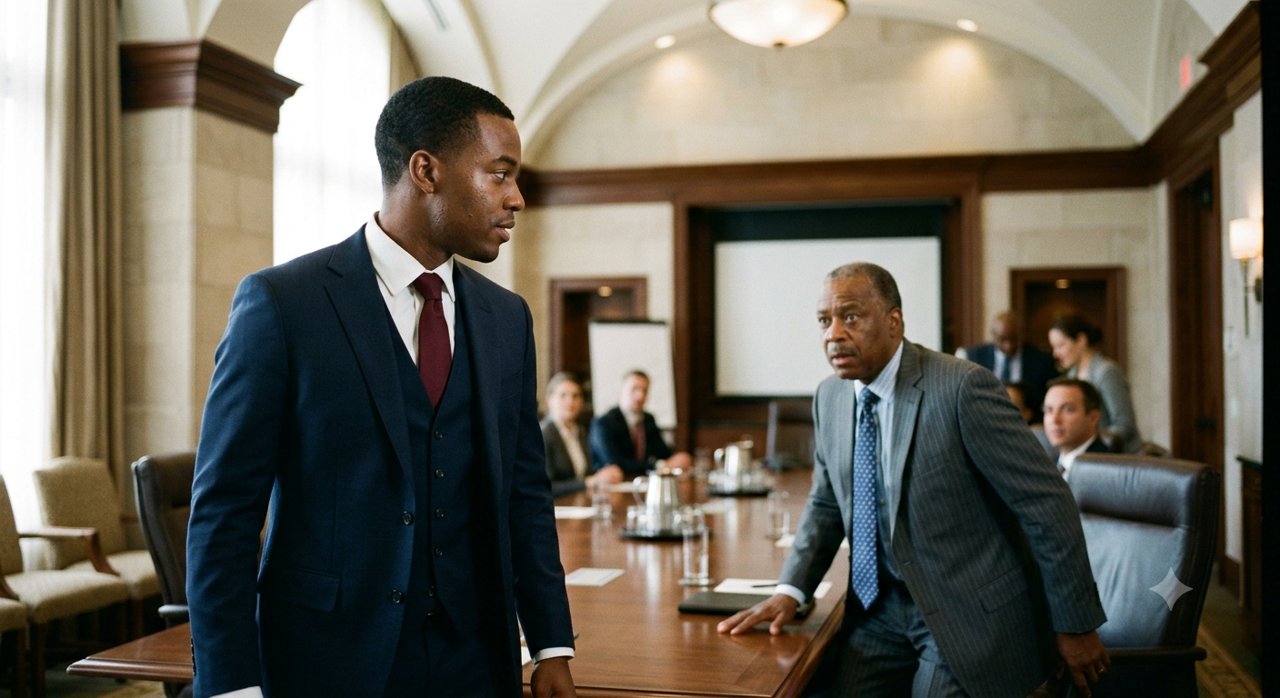
They released me from the courthouse at half past noon with my badge back, a temporary administrative hold on my sidearm, and a written notice that a formal review board had been scheduled for the following Thursday.
Miller's status was listed as "detained pending federal consultation." Whatever that meant, it was above my pay grade and, for the moment, above my concern.
I drove back to the precinct in a department vehicle because mine was still tagged as part of the scene.
The radio stayed off.
I needed to think.
Judge Warren had said: *someone ran my personal security schedule through an unauthorized terminal.*
That meant someone with courthouse access.
Someone who knew the system well enough to pull restricted data and believed they wouldn't be caught — or didn't care.
I pulled into the precinct lot and sat in the car for a moment.
My sergeant, Holt, was waiting inside the door.
He had the look of a man who had already received several phone calls he hadn't enjoyed.
"My office," he said.
I followed him in.
He closed the door, which he rarely did.
"Federal oversight is involved," he said.
"You know that."
"I was there."
"Then you know this is out of my hands procedurally." He sat down heavily.
"The review board Thursday is standard.
You'll be fine.
Miller—" He stopped.
"Miller is a different situation."
"What kind of different situation?"
Holt looked at his desk.
"His father called the precinct this morning."
"His father."
"Raymond Miller." Holt said the name like it tasted wrong.
"He's a city councilman.
Third district.
He wanted to know what protections were being extended to his son."
I felt something harden in my chest.
"Protections."
"That's the word he used."
"Miller sl*pped a federal judge across the face in front of security cameras and a plaza full of witnesses."
"I know what he did."
"Then what protections is his father imagining?"
Holt looked up.
"The kind that come with phone calls to the right people.
The kind that get review boards quietly restructured." He held my gaze.
"I'm telling you this so you're not surprised.
Not so you'll accept it."
I leaned forward.
"Is someone trying to bury this?"
"Someone is trying to *manage* it," Holt said.
"There's a difference.
For now." He stood.
"Go home, Reyes.
Write your statement.
Be precise.
Every detail, every timestamp, every word Miller said.
Write it like someone is going to try to contradict it.
Because they will."
I left his office and walked to my desk.
My computer showed three new emails.
The first two were administrative.
The third was from an address I didn't recognize — a string of letters and numbers, no name.
The subject line read: *You were standing next to him when he made the call.*
I stared at it.
I hadn't told anyone — not Reeves, not Garza, not Holt — that Miller had been on his phone before we took up our positions that morning.
I'd barely registered it myself.
He was always on his phone.
But someone knew I'd seen it.
I reached for my mouse — and my desk phone rang.
I picked up.
"Officer Reyes." A woman's voice.
Controlled, professional.
"My name is Special Agent Diane Cho.
FBI, Public Corruption Unit." A brief pause.
"Don't open that email.
Don't forward it.
Don't delete it.
I'll be at your precinct in twenty minutes."
The line went quiet.
I set the phone down and looked at the email on my screen.
*You were standing next to him when he made the call.*
Miller had been on his phone at 8:09 AM.
Six minutes before the woman in the gray coat had appeared at the VIP entrance.
I thought about the man in the gray jacket.
The unauthorized access log.
The security schedule pulled at 6 AM.
And then I thought about something I hadn't thought about until that exact moment: Miller hadn't been surprised when the Marshals came through those doors.
He'd been relieved.