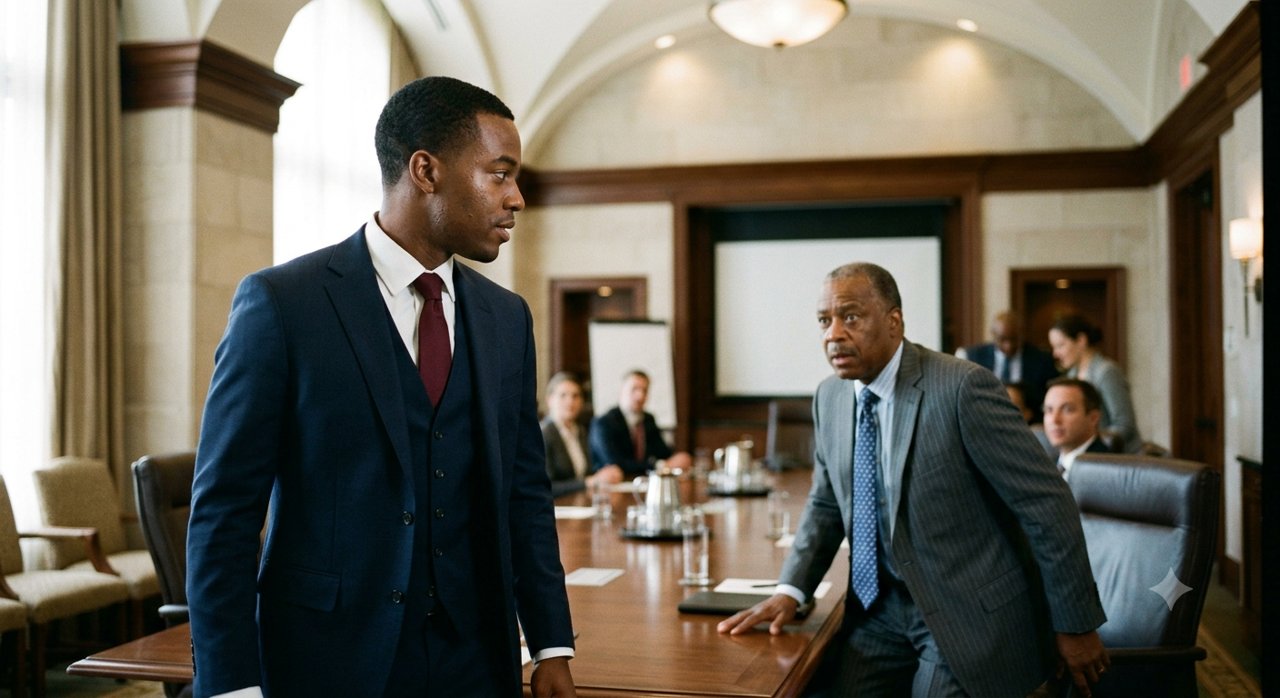
Vincent brought the six council members into the great room at half past midnight.
They came in separately and stood in a loose group near the windows.
The rain had stopped again.
The lake was still.
Gerald Fitch stood slightly apart from the others, his hands at his sides, his face carrying the particular weight of a man who has already paid something and knows the full bill hasn't arrived yet.
Arthur was not in the room.
He was in the east study with two of Vincent's people and a corporate attorney who had been on the phone for the past forty minutes.
Dominic stood at the center of the room without his cane.
He had not used it since the moment Mercer loosened the strap.
He did not make a speech.
He placed three items on the table in front of them.
The USB drive.
Angela Pierce's twelve photographs, printed and arranged in order.
The transcript of Arthur's phone call, with the timestamp at the top.
He gave them four minutes to read.
Nobody spoke during those four minutes.
One of the men — a younger council member named Royce, who had been with the organization for six years — set down the transcript and looked at the photographs and then looked at Dominic with an expression that was not quite shock and not quite anger but something between the two that had no clean name.
"How long?" Royce asked.
"The restructuring plan is dated fourteen months ago," Dominic said.
"The approach to Mercer appears to have started around the same time.
The brace interference began three weeks after my surgery."
"He was waiting for the right moment."
"He was creating the right moment."
Another council member — a man named Harlan, who had said almost nothing all evening — placed his copy of the transcript face-down on the table.
"What do you need from us?"
"Written statements.
Tonight.
Everything Arthur said to you about my condition, about the vote, about the documents.
Every conversation, every suggestion, every reassurance." Dominic looked at each of them in turn.
"If he approached you privately about anything related to the transfer, I need to know what he said and when."
Three of the six men exchanged a look.
Royce spoke first.
"He came to me six weeks ago.
He said your doctors had given him a private assessment that wasn't in the official reports.
He said the official reports were being softened to protect your position." He paused.
"He said the organization needed people who were prepared to act decisively if the vote went the way it needed to go."
"Did he tell you what decisively meant?"
"He said it meant supporting the transfer without delay and without public questions."
"Did you agree?"
Royce was quiet for a moment.
"I told him I'd consider it.
I didn't say yes." He looked at the photographs.
"I didn't say no either."
Dominic nodded.
He didn't make it easier than it was.
Harlan spoke without looking up.
"He told me the shell companies were a tax structure.
That the asset reorganization was standard estate planning and that you had approved it informally before the accident." He paused.
"I believed him."
"Why?"
"Because he's been at this table longer than most of us.
Because he spoke about you with what sounded like genuine concern." Harlan finally looked up.
"Because it's easier to believe a man you've trusted for fifteen years than to believe he's been lying to you for most of them."
The room was quiet.
Gerald had not spoken.
He stood near the window with his eyes on the floor and his hands still at his sides.
Dominic looked at him.
"Gerald."
Gerald looked up.
"You have something to add."
It was not a question.
Gerald walked to the table.
He placed a second USB drive beside the first — one Dominic hadn't seen before.
"There are three other files on Arthur's encrypted drive," Gerald said.
"I didn't give you those tonight because I needed to verify what was in them first." He looked at Dominic.
"I verified them an hour ago while you were with Arthur."
"What are they?"
"Correspondence.
Between Arthur and two men outside the organization.
One is a property developer who has been trying to acquire the Lake Shore construction portfolio for four years.
The other is a shipping broker who lost a Vale contract two years ago and filed a complaint that went nowhere." Gerald paused.
"Arthur has been negotiating the sale of both divisions for eight months.
The sale was contingent on him having executive authority."
The room shifted.
Royce stood up from his chair.
"He wasn't just taking control," Dominic said.
"He was selling."
"The combined sale value is approximately two hundred and forty million dollars," Gerald said.
"Arthur's personal commission in the agreement is listed at eleven percent."
Nobody spoke.
Harlan pushed his chair back slowly.
He didn't stand.
He just pushed it back, as if he needed a few more inches between himself and the table.
"He was going to dismantle it," Royce said.
"He was going to sell the pieces and walk away," Dominic said.
"And everyone in this room would have been out of a position within eighteen months."
One of the other council members — a quiet man named Sutton who had said nothing all evening — reached forward and picked up the transcript again.
He read the last three lines.
Set it down.
"What happens to Arthur now?" Sutton asked.
"That depends on how complete the evidence is and how cooperative he decides to be." Dominic looked at the table.
"But he's not leaving this estate tonight, and he's not making any more phone calls."
Sutton nodded once.
"The vote," Royce said.
"The one scheduled for tonight."
"Cancelled."
"And the transfer documents?"
Dominic picked them up from the side table where they had sat all evening, unsigned, waiting.
He held them for a moment.
Then he set them in the center of the table.
"Shred them," he said.
Gerald picked them up.
And in the east study, behind a closed door, Arthur Voss sat with his attorney and said nothing, because there was nothing left to say that would change what was already in motion.