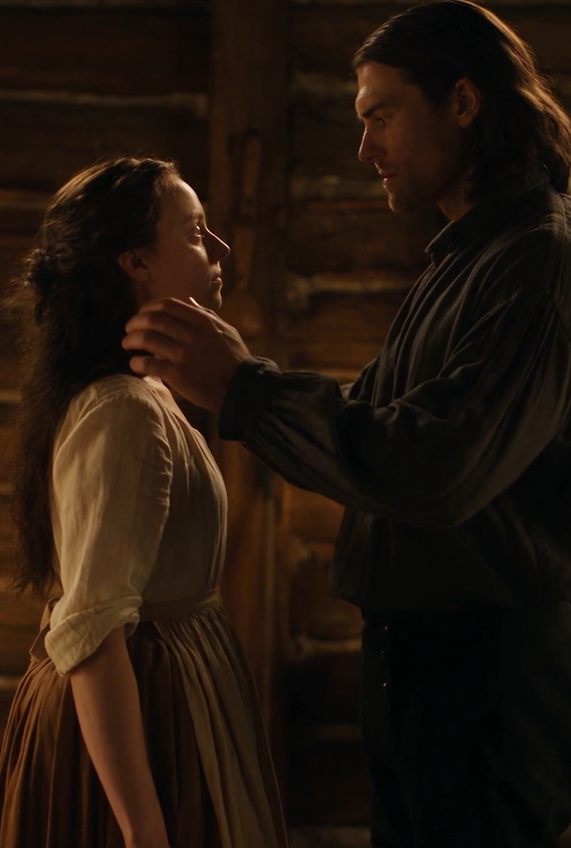
“I married you because an alliance between our valleys will prevent fifty boys from dying in the river mud over Silas Crowley’s greed,” Adrian whispered, his gray eyes searching hers in the firelight. “I did not marry you because I needed an unwilling concubine in my bed. You are safe under this roof, Evelyn. From Crowley. From the valley. And from me.”
He turned, walked to the wooden chest beneath the window, and retrieved a thick woolen blanket and a feather pillow. Without another glance at her, he walked to the wide leather sofa beside the hearth, stretched his massive frame across the cushions, and pulled the wool up to his chest.
“Blow out the lamp when you are ready,” he muttered into the dark. “Sleep, Evelyn. You have had a long march.”
Evelyn stood beside the great bed, her hand hovering over her temple where his fingers had rested. The cabin was warm. The embers crackled softly in the grate. The breathing of the giant across the room settled into a deep, rhythmic calm.
She should have felt an overwhelming rush of relief. She should have dropped to her knees and thanked God for her miraculous deliverance from the horrors her mother had promised.
Instead, as she undressed in the dark and crawled beneath the heavy buffalo robes alone, Evelyn Hartwell stared up at the rough-hewn pine rafters for hours, her heart pounding with a strange, infuriating ache.
Because deep in the darkest, most secret corner of her soul, she realized with terrifying certainty that part of her had wanted him to stay.
Part III: The Ledger and the Stallion
The weeks that followed were a subtle, exquisite torment.
If Adrian Blackwood had been a brute, Evelyn could have fortified her heart behind walls of contempt. If he had been cruel, she could have found pride in her suffering. But Adrian refused to give her an enemy to fight.
On her second morning as mistress of Silverwater, she walked down to the main ranch house—a long, sprawling building of adobe and timber that served as the administrative heart of the valley—and found three ranch foremen arguing furiously over missing grain shipments and water distributions.
Adrian sat at the head of the long oak table, rubbing his temples, surrounded by stacks of disordered paper, receipts scrawled on butcher’s wrap, and half-filled calfskin ledgers.
Evelyn stood in the doorway for five minutes, listening.
“The third irrigation ditch is leaking into the lower alkali beds,” she said, her voice cutting cleanly through the men’s shouting. “You’ve allocated forty percent more water to the south pastures than the acreage requires, while your hay meadows are parched. And your grain tallies don't match your freight receipts because your clerk in Fort Laramie is billing you in short tons while your teamsters are delivering in long hundredweights.”
The room went dead silent. The three foremen turned, staring at the slender, pale woman in the simple cotton dress as though a barn owl had suddenly begun reciting Latin.
Adrian did not scoff. He looked up, his silver eyes sweeping over her face, a slow, appreciative gleam igniting in their depths.
He pushed the heavy leather-bound ledger down the length of the table.
“Fix it,” he said simply.
From that hour forward, the accounts of Silverwater belonged to Evelyn. She established an office in the corner of the main hall, trading her bridal silks for practical aprons and ink-stained sleeves. She organized the payroll, corrected three years of sloppy bookkeeping, renegotiated the winter salt contracts with the Santa Fe traders, and saved the settlement four thousand dollars before the end of her first month.
Adrian treated her not as an ornament, but as a sovereign partner. When they rode the perimeter fences, he did not relegate her to the rear; he rode beside her, pointing out the grazing rotation, the timber lines, and the hidden spring heads that sustained the valley during droughts. When she offered an opinion on cattle breeding or grain storage, he listened with that deep, unnerving focus, nodding slowly, implementing her suggestions without a trace of masculine condescension.
Yet, the danger of Adrian Blackwood was not in his mind. It was in his proximity.
He touched her constantly—never with improper haste, never with force, but with a deliberate, casual familiarity that made Evelyn’s blood run like hot syrup beneath her skin.
He offered his hand when they crossed the slick limestone boulders of the creek, his massive fingers closing warm and firm around hers, holding her balance long after the footing was secure. When he guided her through a crowded bunkhouse or a noisy horse corral, his large palm would settle against the small of her back—a heavy, burning brand through the cotton of her dress that seemed to guide her entire body by its heat alone. When he taught her to handle a heavy Colt revolving carbine, he stood directly behind her, his broad chest pressed against her shoulder blades, his arms encircling hers, his rough jaw brushing her cheek as he whispered instructions on sight alignment and trigger pressure.
Every time he drew away, leaving her skin cold in the mountain breeze, Evelyn had to suppress a disgraceful, desperate urge to lean back into him.
The climax of her endurance arrived on a Tuesday in late July.
The afternoon sun was sinking behind the western bluffs, painting the corrals in streaks of liquid copper and long, blue shadows. Evelyn had walked down from the main house to deliver the monthly blacksmith tally when a thunderous crash of splintering wood echoed from the round pen.
She stopped by the rail, the breath instantly leaving her lungs.
In the center of the corral, Adrian was breaking a wild, four-year-old black stallion that had been brought down from the high mesas three days prior. The beast was magnificent—a creature of pure fury, black as coal, with wild white eyes and hooves that struck the cedar posts with the force of iron sledges.
And Adrian was bare-chested.
His linen shirt was tossed carelessly over the top rail. His skin, bronzed to the color of dark saddle leather by years of frontier sun, gleamed with a fine sheen of sweat. Thick, powerful muscles rippled across his broad back and shoulders with every wrench of the lead rope. A long, pale scar cut diagonally across his left ribs—the mark of an old saber cut—and another jagged line crossed his shoulder blade. He moved with a terrifying, fluid grace, his boots planted deep in the churned dust, matching the stallion’s frantic lunges with an iron stillness that was breathtaking to behold.
He did not use a whip. He did not beat the animal into submission. He used his weight, his voice, and the relentless, hypnotic pressure of his strength, talking to the horse in that low, musical dialect until the stallion’s frantic bucking slowed to a trembling halt.
Adrian stepped forward, his bare chest heaving, steam rising from his skin in the cooling air. He reached out and stroked the stallion’s foam-flecked neck, blowing softly into the beast’s flared nostrils until the wild ears twitched forward in surrender.