Part I — Gate C
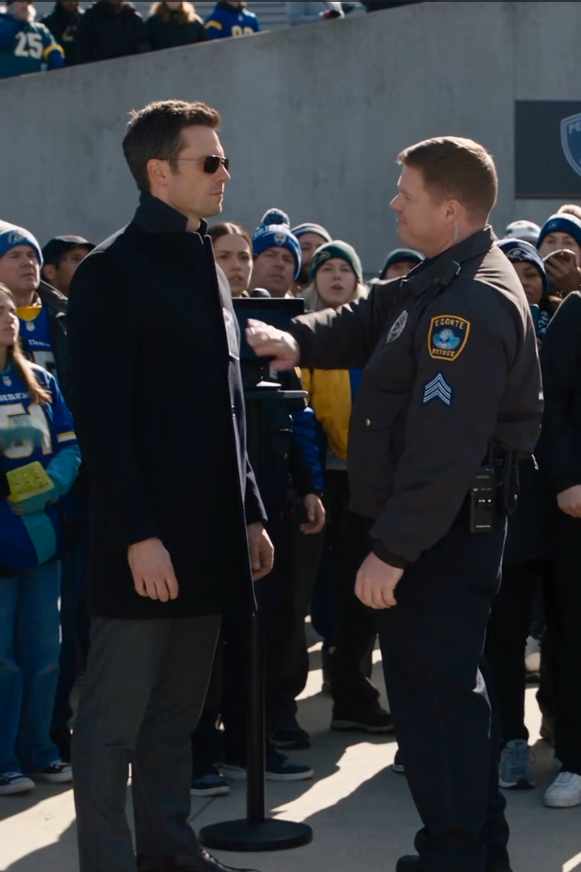
The plastic credential struck Caleb Stone’s chest hard enough to snap against the buttons of his black wool coat.
“Nice try,” the stadium officer said.
He said it loudly.
Not because Caleb had failed to hear him the first time, but because nearly two hundred football fans were packed behind the steel barricades outside Gate C, and the officer clearly wanted an audience.
For one strange second, the restless morning seemed to contract around them.
Fans in jerseys turned their heads. Coffee cups stopped halfway to mouths. A boy carrying a foam finger leaned around his father’s shoulder. Somewhere farther back, someone laughed before anything funny had happened.
Caleb looked down at the credential hanging from the black lanyard around his neck.
Then he looked at the officer.
“Scan it again.”
The officer gave a short laugh.
He was in his late forties, broad through the shoulders, with a square face reddened by the cold. His stadium security jacket was zipped to the chin. A radio sat high on his chest, and the silver badge clipped beneath it had been polished enough to catch the gray morning light.
He carried himself like the gate belonged to him.
Behind them, the professional football stadium trembled with pregame energy. Bass from the sound system rolled through concrete. Turnstiles clicked. Handheld scanners chirped. Fans shuffled forward in thick coats, clear bags, knit hats, and the particular impatience of people who had paid too much money to spend another minute outside.
Caleb stood at the front of the line in a plain black coat, charcoal trousers, polished shoes, and dark glasses.
Nothing about him looked ceremonial.
That was intentional.
“Federal event authorization,” the officer read from the credential, stretching the words with theatrical disbelief. “You actually expect me to believe this?”
A few fans chuckled.
Someone behind Caleb raised a phone.
The person pretended to be checking a message.
The camera lens was pointed directly at him.
Caleb heard a woman whisper, “That poor guy.”
A teenager beside her murmured, “He tried to get in with a fake federal badge.”
Caleb let the comments pass.
“I’m here to conduct the security inspection.”
The officer smiled wider.
“Sure. And I’m starting at quarterback.”
The crowd laughed more comfortably now that the officer had told them who the joke was.
He caught Caleb’s credential between two fingers.
“Listen carefully. This entrance is for authorized personnel. Fake credentials, fake lanyards, people pretending they’re somebody—we get this every season.”
His eyes traveled over Caleb’s coat and glasses.
Then his voice changed.
“People like you always think confidence is enough.”
The laughter weakened.
Caleb turned his face fully toward him.
No anger showed.
That made the officer less comfortable than anger would have.
“Your name?” Caleb asked.
“What?”
“Your name and badge number.”
The officer stared at him.
“You don’t ask questions at this gate. I do.”
He stepped closer until only a narrow space remained between them.
“Now you can leave voluntarily, or I can make this a very long afternoon.”
A cold gust pushed through the concrete entrance tunnel.
Caleb’s coat moved.
His credential swung once.
At the scanner station beside them, a younger security employee glanced over.
She had been working steadily for the last five minutes, checking bags, matching credentials, and sending staff through a side entrance. She looked at Caleb’s badge more carefully now.
Her expression shifted.
“Brent,” she said quietly.
The older officer did not turn.
She tried again.
“Officer Mallory, maybe you should—”
He looked at her sharply.
“I’ve got it.”
So now Caleb had the name.
Brent Mallory.
Caleb filed it away with everything else he had observed since arriving.
At 9:17 that morning, Mallory had waved through a catering employee whose bag had not been opened after the man complained he was late.
At 9:21, Mallory had required an elderly contract cleaner to empty two pockets and remove her winter gloves before allowing her through.
At 9:24, another stadium employee had entered using a credential whose photo was so badly worn that the face was barely visible.
No secondary verification.
At 9:29, a young man carrying broadcast equipment had been forced aside for nearly six minutes because his name was difficult to pronounce and Mallory did not like the way it appeared on the roster.
Caleb had not intervened.
He had watched.
That was why he was there.
For six months, the stadium’s security operation had been under quiet review.
The complaints looked small when separated.
Selective screening.
Incomplete incident documentation.
Contradictory enforcement between entrances.
Supervisors overriding scanner alerts without written justification.
Temporary personnel being given verbal instructions that differed from official policy.
Any one of those things could be blamed on a bad shift.
Together, they formed a pattern.
The league had requested outside oversight after a threat assessment identified vulnerabilities serious enough that management could no longer dismiss them as customer-service problems.
The stadium had been told only this:
An evaluator could arrive at any time.
No escort.
No ceremony.
No advance call.
Valid official credentials would be the only warning.
Caleb Stone was that evaluator.
And Gate C had managed to tell him more in twelve minutes than three months of internal reports.
He looked at Mallory.
“Scan it again.”
Mallory’s mouth tightened.
Then he smiled.
“Fine.”
He pulled the credential toward himself.
“Let’s embarrass you properly.”
He raised it so the people nearest them could see.
“Everybody watch. This is what happens when somebody thinks a printer and a plastic sleeve can fool stadium security.”
Phones came higher.
The younger employee looked toward Caleb, then toward Mallory.
“Brent—”
“I said I’ve got it.”
Mallory pressed the badge against the scanner.
One clean electronic tone sounded.
He looked at the monitor.
The smile left his face.
He leaned closer.
The younger employee read over his shoulder.
Her posture changed immediately.
Caleb waited.
The words on the monitor glowed in a white field bordered by red:
FEDERAL OVERSIGHT — PRIORITY ACCESS.
Nobody laughed.
Mallory stared at the screen for several seconds.
Then he looked at Caleb’s credential again, as if hoping the plastic itself might offer an explanation.
Caleb removed his dark glasses.
His eyes were calm.
“That scan should have happened the first time.”
Mallory opened his mouth.
Nothing came out.
The phone behind Caleb was still recording.
Caleb turned slightly toward the younger employee.
“Your name?”
“Lena Ortiz.”
“You recognized the authorization?”
“Yes, sir.”
“From the credential?”
She hesitated.
“Partly. The security bulletin described the authorization format. We were told an evaluator might arrive.”
Mallory turned toward her.
“You never said—”
“I tried.”
The words were quiet.
That made them harder to dismiss.
Mallory’s face flushed darker.
Caleb looked toward the gate.
Fans were still waiting.
“I’m not shutting down your line for this conversation.”
Then he looked at Mallory.
“But you’re no longer making access decisions until I finish my initial inspection.”
Mallory stared.
“You can’t just—”
Caleb raised the credential between two fingers.
Mallory stopped.
Caleb continued.
“Ms. Ortiz, call your shift supervisor. Tell them federal oversight is on site and Gate C is under procedural review.”