“Like you.”
“Yes.”
That unsettled him.
Caleb continued.
“He may have seen staff entering through service lanes. Seen people waved through after phone calls. Seen bad scans become conversations instead of denials. If you watch long enough, behavior becomes a map.”
Vane’s expression tightened.
“So he found what I taught everyone to ignore.”
Caleb said nothing.
He did not need to.
Vane leaned back.
After a long silence he said, “I deleted Ortiz’s report because I knew she was right.”
Caleb watched him.
“I figured that.”
“No.”
Vane shook his head.
“You think I deleted it because it threatened my exception.”
“Didn’t you?”
“Partly.”
He looked at his hands.
“But when I read it, I knew exactly how bad it looked. Wrong photo. Repeated scan failure. No secondary ID. I knew what the correct response was.”
“Then why delete it?”
Vane’s voice became quieter.
“Because if I admitted she was right, I had to admit I’d been wrong every time before that.”
There it was.
The same thing Mallory had done at Gate C.
Different scale.
Different office.
Same human weakness.
Once a person committed publicly to being right, evidence became an enemy.
Caleb stood.
Vane looked at him.
“That going in the report?”
“No.”
“Why not?”
“Because the report is about what you did.”
Caleb opened the door.
“Not the explanation you finally found afterward.”
Three weeks later, Gate C looked almost exactly the same.
That was what Caleb noticed when he returned for a follow-up inspection.
Same barricades.
Same concrete tunnel.
Same winter air.
Same electronic chirps.
But the procedures had changed.
Every manual override generated an immediate supervisory alert and required a reason before the gate reopened.
Vendor substitutions required secondary identity verification.
Incident reports could no longer be deleted; corrections created visible amendments.
Random access audits ran during events instead of days later.
And every security employee had been told something Caleb considered more important than any software change:
No supervisor could order an undocumented exception.
If one tried, the employee was required to record the instruction.
Lena Ortiz was working Gate C.
She saw Caleb approaching and smiled.
“No escort again?”
“Would ruin the test.”
She held out her hand.
“Credential.”
Caleb handed it over.
She scanned it.
Green.
Then she looked at the photo.
Then at him.
“Secondary visual match.”
Caleb raised an eyebrow.
“Seriously?”
“Policy.”
Behind him, someone in line laughed.
Caleb removed his glasses.
Lena compared his face to the credential.
“Good.”
She handed it back.
“You’re cleared.”
Caleb put his glasses on again.
“Very impressive.”
“I had a good evaluator.”
“Don’t say that where he can hear you.”
A voice behind the adjacent station said, “Too late.”
Caleb turned.
Brent Mallory stood there.
For a moment Caleb thought the stadium had ignored the findings.
Then he noticed the different credential.
TRAINING OBSERVER.
Mallory saw him reading it.
“Restricted duties.”
Caleb nodded.
“For how long?”
“Depends.”
“On?”
“Whether I can learn to do the job without performing it for an audience.”
Lena covered a smile.
Mallory looked at Caleb.
“I appealed the termination recommendation.”
“I didn’t recommend termination.”
Mallory blinked.
“You didn’t?”
“No.”
“Who did?”
“Your employer.”
Mallory considered that.
“And you?”
“I recommended retraining, probation, and removal of independent access authority pending evaluation.”
Mallory stared at him.
“Why?”
“Because you admitted what you did before you knew whether the admission would help you.”
Mallory looked away.
Caleb continued.
“Don’t make me regret it.”
“I’m trying not to.”
A service worker approached Lena’s lane with a rolling case.
The scanner flashed red.
The worker sighed.
“Come on. I’m here every week.”
Lena did not move.
“Secondary ID, please.”
“I’m already late.”
“I understand.”
“Call your supervisor. He knows me.”
Lena glanced toward Mallory.
Mallory folded his arms.
The worker looked between them.
“This is ridiculous.”
Mallory gave him a calm smile.
“No.”
He pointed toward the scanner.
“That’s a red light.”
The worker stared.
Mallory continued.
“And red means we check.”
No sarcasm.
No humiliation.
No speech for the people waiting nearby.
Just procedure.
The worker sighed, pulled out his wallet, and handed over identification.
Lena checked it.
A minute later, the issue was resolved.
The case was screened.
The man entered.
The line kept moving.
Caleb watched Mallory.
Mallory noticed.
“What?”
“Nothing.”
“That look wasn’t nothing.”
Caleb adjusted the credential hanging against his coat.
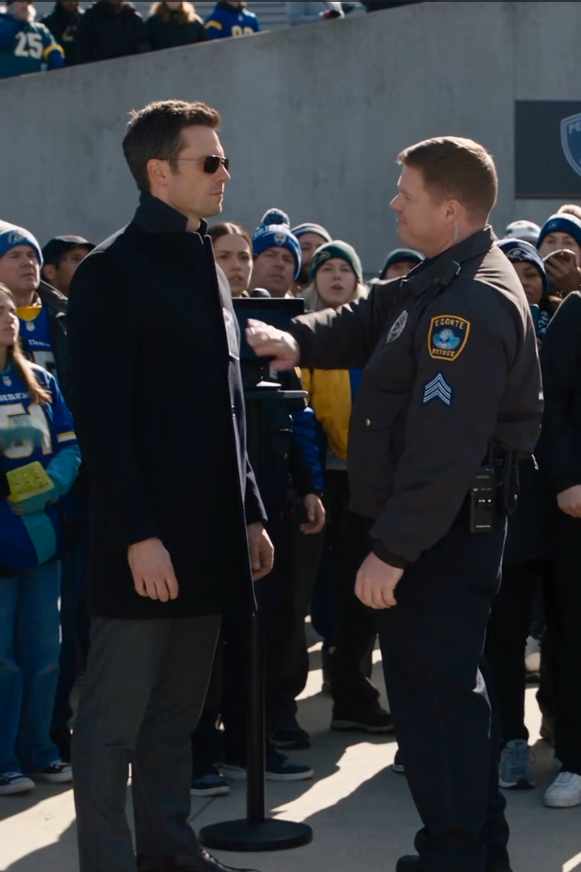
Three weeks earlier, Mallory had struck that same badge against Caleb’s chest and invited a crowd to laugh at him.
Now he stood beside the scanner and let a red light mean exactly what it was supposed to mean.
Not guilt.
Not status.
Not an excuse to dominate someone.
A question requiring an answer.
Caleb walked toward the interior corridor.
Behind him, another scanner beeped.
Then another.
A thousand small decisions, invisible to almost everyone, determining whether the building was actually secure.
At the entrance, Lena called after him.
“Mr. Stone.”
He turned.
She pointed to his badge.
“You forgot something.”
Caleb looked down.
The credential had twisted backward on the lanyard, photo facing his coat.
Lena smiled.
“Credentials must remain visible at all times.”
Mallory looked at Caleb.
For one dangerous second, the old grin returned.
Then he said, perfectly straight-faced, “People like you always think confidence is enough.”
Lena burst out laughing.
Caleb stared at Mallory.
Then, despite himself, he laughed too.
He turned the credential around.
Visible.
Valid.
Verified.
And this time, before Caleb Stone took another step inside, everyone at Gate C checked.