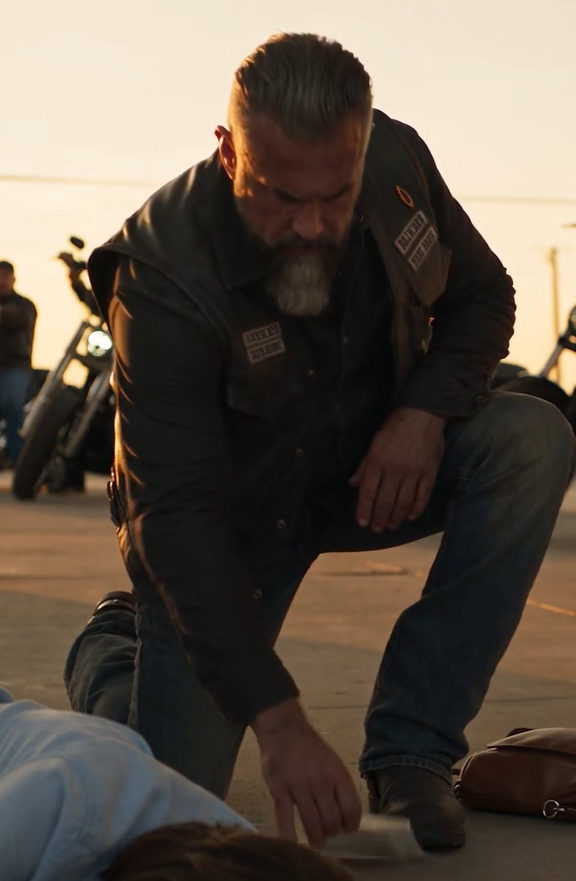
The Texas Gas Station Biker Incident began on an evening that felt too calm to ever become memorable. The sky above Waco County stretched wide and gold, the air still warm from a long Texas day, and the small roadside gas station sat quietly between stretches of highway where travelers stopped only long enough to refuel and disappear again. Nothing about that evening hinted at urgency. Nothing suggested fear. People moved slowly, comfortably, wrapped in routine.
Liam Patterson was arguing with the gas pump that refused to read his credit card. A retired couple shared a milkshake near the ice freezer. Inside the store, clerk Mason Doyle watched baseball highlights on a small television while pretending to organize receipts. Life unfolded in ordinary fragments — predictable, forgettable.
Then Rachel Monroe pulled into the station.
Her white crossover SUV rolled unevenly toward pump number four, stopping slightly crooked as if the driver had misjudged distance. Rachel was thirty-one years old and eight months pregnant, returning home after visiting her sister two towns away. The drive had felt longer than usual. Pressure built behind her ribs. Her doctor had warned her to rest more, but life rarely paused for warnings.
She stepped out slowly, one hand pressed against the lower curve of her stomach. For a moment she stood still, breathing carefully, blinking as though the world had tilted slightly off balance.
A man nearby noticed her hesitation.
“You alright, ma’am?”
Rachel tried to answer, but the words never came. Her vision blurred. Sound dulled into a distant hum. The water bottle she held slipped from her fingers and rolled across the concrete, spinning lazily before stopping beneath another car.
Her knees buckled.
She collapsed without catching herself.
The impact echoed sharply, louder than expected, instantly pulling attention from every corner of the parking lot.
For two seconds, nobody moved.
Then chaos erupted.
“Someone call 911!”
“She’s pregnant!”
“Give her space!”
People rushed forward with good intentions and no coordination. A woman dropped her shopping bag and knelt beside Rachel, unsure whether to touch her. A teenage employee ran inside searching for a first-aid kit he had never used before. Phones appeared, recording instinctively as modern witnesses often did when uncertainty met urgency.
Rachel lay unconscious, one hand curled protectively over her abdomen, breathing shallow and uneven.
And then the sound came.
Motorcycles.
Deep engines rolled into the station, heavy and synchronized, vibrations humming through the pavement before the riders even appeared. Six bikes entered slowly, their presence instantly shifting the atmosphere. Conversations faded. Movement slowed. People watched.
The riders parked in a loose line. They did not rush. They did not ask questions. They simply observed.
The largest among them stepped forward — a towering man with broad shoulders, sun-worn skin, and a gray-streaked beard that framed a face carved by years rather than age. His name was Caleb “Stone” Mercer. His leather vest bore no flashy symbols, only quiet wear from thousands of miles traveled.
He walked directly toward Rachel.
People assumed relief had arrived. Instead, Caleb stopped in front of her and raised one hand calmly.
“Don’t come closer.”
The words were low, almost gentle. But absolute.
A woman wearing hospital scrubs pushed forward immediately. “I’m a nurse. She needs help right now.”
Caleb shook his head once. “No.”
The crowd reacted instantly. “What do you mean no?!” “She needs medical attention!” “Move out of the way!”
Anger rose faster than understanding. Several people began filming more aggressively, whispers spreading that the bikers were interfering. Someone accused them of stealing. Someone else shouted for police.
Caleb didn’t respond. He watched Rachel’s breathing with intense focus, counting silently. Then a small voice pierced through the shouting.
“Mom?”
A little boy, barely four years old, stood near the SUV, clutching a stuffed dinoNextr, barefoot on the warm concrete. Tears streamed down his face.
The crowd’s frustration exploded. “You’re scaring her kid! Let the nurse through!”
Caleb’s jaw tightened slightly. He crouched beside Rachel and reached for her purse lying open nearby. Gasps rippled through the crowd. “He’s stealing!”
Caleb rose instantly, blocking a man who tried to intervene. “Step back.”
He opened the purse and searched quickly until he found a folded medical document tucked inside a clear plastic sleeve. The moment he read it, his expression changed — not panic, but recognition.
He closed his fist around the paper. Sirens wailed faintly in the distance. Caleb Mercer realized that if anyone moved her now, she might not survive long enough to hear them arrive.
### PART 2 — The Hidden Clock
The air at the gas station turned frigid despite the Texas heat. The nurse in scrubs, a woman named Sarah, tried one last time to push past Caleb. "Sir, I am a trained professional. If she is having a seizure or a stroke, every second counts. You are obstructing medical aid!"
Caleb looked her directly in the eyes. His gaze was hauntingly steady. "She’s not having a stroke. Look at her ankles. Look at the way her hands are curling." He held up the medical sleeve he had pulled from her purse. "It’s called **Amniotic Fluid Embolism**. If you move her onto her back or try to perform standard CPR without knowing how to displace the uterus, you’ll cause a cardiac arrest that neither of them will wake up from."
The nurse stopped dead. Her face went pale. It was a rare, catastrophic complication she had only read about in textbooks—a "silent killer" of mothers.
"How do you know that?" she whispered.
Caleb didn't answer. He turned to his fellow bikers. "Circle up! Keep the sun off her and keep the cameras back! Give her air!"
The six massive men moved with military precision. They parked their bikes in a tight perimeter, creating a wall of chrome and leather that shielded Rachel from the prying eyes of the crowd and the glare of the setting sun.
Caleb knelt in the oil-stained dust, not touching her, but hovering close. He began to speak. His voice wasn't the roar of a biker anymore; it was the soft, rhythmic hum of a protector.
"Rachel," he murmured. "I know you can't answer me, but listen to my voice. The ambulance is two minutes out. Your boy is right here. Toby is safe. My friend Boxcar has him. Just keep that heart beating, Rachel. Stay in the shade."
### PART 3 — The Weight of the Past
As the sirens screamed closer, a man from the crowd—the one who had filmed the whole thing—lowered his phone. He saw the way Caleb’s hand was trembling, even as his face remained like stone.
The paramedics from Waco Fire & Rescue skidded to a halt. They jumped out, ready to fight their way through the "scary" bikers, but Caleb was already standing, holding the medical sleeve out like a peace offering.
"Rachel Monroe," Caleb announced to the lead medic. "Eight months pregnant. Suspected AFE. She collapsed four minutes ago. No one has moved her. I’ve kept her left-lateral to keep the pressure off the vena cava."
The lead paramedic grabbed the paper, read it, and looked at Caleb with pure shock. "You just saved two lives, brother. Most people would have flipped her over and killed her instantly."
As the medics took over, working with frantic but controlled energy, the crowd fell silent. The anger was gone, replaced by a heavy, humbling shame. They had seen a "thug," a "thief," and a "threat." They hadn't seen the man who knew the exact medical terminology because he had watched his own wife die of the same condition on a roadside fifteen years ago.
### PART 4 — The Final Word
Before the ambulance doors slammed shut, the little boy, Toby, ran to his mother's side. One of the paramedics caught him, but Caleb stepped forward and gently took the boy’s hand.
"Your mama is a fighter, Toby," Caleb said, crouching down to the boy's level. He reached into his leather vest and pulled out a small, silver St. Christopher medal—the patron saint of travelers. He pressed it into the boy's tiny palm. "You keep this for her. You tell her a man named Stone was watching the road tonight."
The ambulance sped away, lights blurring into the dusk.
The gas station returned to its quiet hum. The nurse, Sarah, walked up to Caleb as he prepared to mount his bike. "I'm sorry," she said softly. "I thought I knew better."
Caleb pulled on his worn leather gloves. He looked up at the Texas stars beginning to peek through the gold sky.
"People see the leather and the beard, and they think they know the ending of the story," Caleb said, his voice thick with an emotion he finally allowed to surface. "But sometimes, the biggest monsters are the ones we carry inside—the ones we failed to save before."
He kicked his engine to life. The roar was a beautiful, thunderous thing.
"Tonight," he whispered to the wind, "the story ended differently."
With a nod to the silent crowd, the massive biker and his crew rode out into the dark, disappearing into the vast Texas night, leaving behind the legend of the man who said "No" so that a mother could finally say "Yes" to life.
Please follow us if you like this story 💞💞🙏