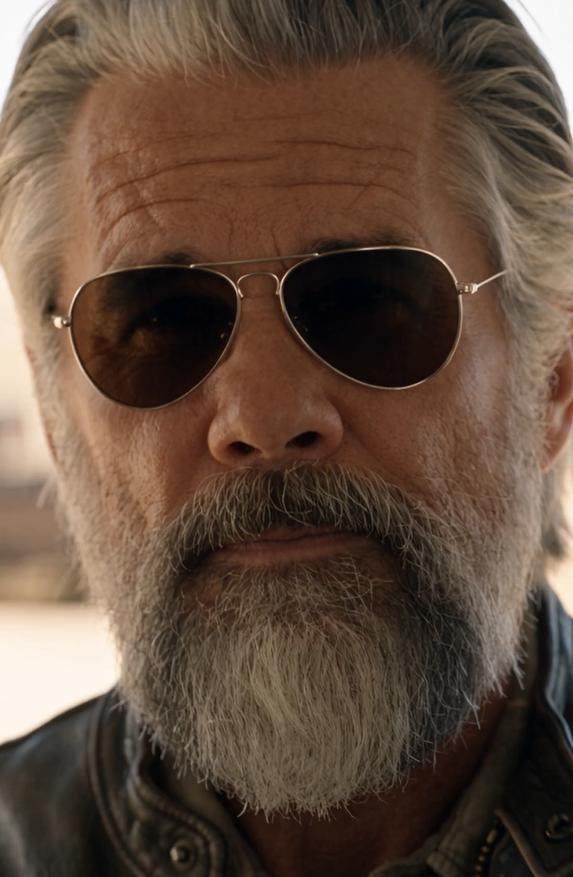
The trailer’s porch sagged under my boots like it was giving up. Four months of hunting, and this was where the kid ended up. A patch of dead grass, a busted screen door, and the kind of silence that sticks to your skin.
I was still healing. Ribs wired, 60 pounds lighter, beard hiding a face even I didn’t recognize anymore. Every breath still felt borrowed. I made myself knock.
The door scraped open three inches. A young man in a stained t-shirt stared out, holding a beer at two in the afternoon. Officer Daniel Reyes. 26 years old. Married eight weeks the day he found me in that ditch. His wife was six months pregnant then. I didn’t know any of that when he pressed his bare hand inside my chest and told me to look at his eyes, not the blood.
Now those same blue eyes had nothing in them. Just hollow. He didn’t recognize me at first.
— Can I help you.
It wasn’t a question. It was a wall.
I pulled off my sunglasses so he could see the scar splitting my collarbone.
— Officer Reyes. My name is Wayne Kohler. You saved my life on October 14th, 2003. I came to say thank you.
His face twisted through something I’ll never forget. Shock. Shame. And something worse — like I was a ghost he’d been begging to leave him alone. He stepped back from the door. Didn’t invite me in. His knuckles went white around the beer can.
— I don’t regret it, sir. I want you to know that. Whatever happens to me… I don’t regret it.
His voice cracked hard on regret. And I understood then — this boy had been saying that sentence to his reflection every morning for months, trying to survive his own conscience.
Behind him, I saw it. A baby seat in the corner of the trailer. Empty. No infant. No wife. Just dust and old takeout containers and the ghost of a family that used to live here.
He saw me looking. His jaw locked and he turned his face away, shoulders caving inward like he was bracing for a blow.
I didn’t wait for an invitation. I stepped inside anyway. The air smelled like cigarettes and spoiled milk. That empty baby seat was right next to the kitchen table like someone couldn’t bring themselves to move it.
I sat down slow. Looked him dead in those hollow blue eyes.
— Son. Tell me everything. From your side.
He laughed, but it wasn’t a laugh. It was the sound a man makes when he’s got nothing left to lose. And then he started talking.
The department didn’t just fire him for breaking procedure. They made an example of him. A young cop with a perfect record destroyed in one afternoon because he chose a bleeding old biker over the rulebook. His wife couldn’t carry it. The fights, the shame, the bills. She took their daughter to her mother’s place in Phoenix. She wasn’t coming back. He hadn’t seen his baby girl in two months.
His hands shook as he spoke. I watched a 26-year-old boy tell me how saving my life cost him everything he loved. His job. His marriage. His child. His future.
There aren’t words for that kind of guilt. It just sits in your chest like wet concrete.
I leaned forward until he had no choice but to meet my eyes.
— Son. I’m going to fix this.
He laughed that not-a-laugh again. Tired. Empty.
— Nobody can fix this. The department made up its mind. There’s nothing a beat-up old biker can do about it.
I pushed back from that sticky table and stood up. My legs were still weak, but my voice wasn’t.
— You watch me.
Outside, the wind kicked up dust across that dead lawn. I didn’t know yet what it would take. I didn’t know if my brothers would answer the call. I didn’t know if a man like me — tattooed, leather-bound, invisible to polite society — could ever beat City Hall.
But I knew one thing. That boy threw his whole future into a ditch to pull me out of one. And I would die before I let him drown there alone.
I didn’t go to the mayor, and I didn’t go to the papers. When a system is broken, you don’t ask the pieces to put themselves back together. You go to the people who know how to survive in the cracks.
I rode straight to the clubhouse.
It was a Tuesday night. The bar was thick with smoke, cheap whiskey, and men who had spent their whole lives being looked at like they were the dirt on humanity’s shoes. Cops were our natural enemies. We didn't break bread with them, and we sure as hell didn't fight their battles.
I walked to the front of the room, killed the jukebox, and climbed up onto a pool table. It took thirty seconds for the grumbling to stop. I unbuttoned my flannel, pulled down the collar of my shirt, and let them look at the angry, jagged scar running from my collarbone down to my ribs.
"You all know I almost died in October," I yelled, my voice scraping against the quiet room. "You know a rookie cop found me. What you don't know is that the department told him to wait for paramedics. They told him not to contaminate the scene. Instead, that kid ripped his own uniform apart, shoved his bare hands into my chest to clamp my artery, and held me together while his bosses screamed at him over the radio."
I looked around. Tough men. Hard men. Men with rap sheets and bad reputations. And every single one of them was dead silent.
"They fired him for it," I said, the anger finally boiling over. "They stripped his badge, ruined his name, and ran him into the dirt until his wife packed up their newborn baby and left. He traded his whole life for mine." I pointed a heavy, calloused finger at the crowd. "We owe a debt. And this club pays its debts."
It started as a murmur, then a rumble, and then the whole room erupted. Society might have given up on us, but outcasts know loyalty better than anyone in a tailored suit ever could.
The next morning at 7:00 AM, the ground outside Daniel Reyes’s trailer began to shake.
Daniel stumbled out onto his sagging porch, baseball bat in hand, eyes wide with panic. What he saw wasn't a threat. It was an army.
Seventy-five Harley-Davidsons were parked on his dead lawn, spilling out into the street. One hundred and fifty bikers were standing in his yard. Big Mike, a guy with face tattoos and arms the size of tree trunks, walked up and dropped a heavy envelope onto the porch railing.
"That covers the back rent, the late fees, and the electricity," Big Mike grunted. "Compliments of the Iron Hounds."
Before Daniel could even stammer out a word, three guys were up on his roof with toolbelts. Five more were tearing out the rotted boards of his porch. A woman named Sarah, whose own son was serving time, walked past Daniel into the kitchen with three bags of fresh groceries and started scrubbing his counters.
I walked through the crowd, parting the sea of leather, and stopped at the base of his steps.
"Wayne," Daniel choked out, tears finally breaking through the numbness in his eyes. "Wayne, you can't... you guys can't do this."
"We're just getting started, son. Put on a clean shirt. We're going for a ride."
We didn't just go to City Hall. We shut it down. One hundred and fifty motorcycles blockaded the plaza. We didn't shout, we didn't riot. We just stood there, a silent wall of leather and steel, holding up banners that told the truth. *OFFICER REYES SAVED A LIFE. THE CITY RUINED HIS.*
By noon, the local news crews were swarming. By 2:00 PM, it was on the national broadcast. The visual of heavily tattooed outlaws peacefully defending a disgraced police officer was a story the media couldn't resist. I stood in front of a dozen microphones and told the world exactly what kind of cowards were running their police department, and exactly what kind of hero they had thrown away.
The public outcry was like a tidal wave. The station's switchboards melted down. The mayor, terrified of the PR nightmare, forced the police chief to hold a press conference that very evening. Sweating under the lights, the chief publicly apologized, citing a "miscommunication in disciplinary protocols," and offered Officer Reyes his badge back with full back pay.
The reporters shoved microphones into Daniel's face, expecting a tearful acceptance.
Daniel looked at the chief, then looked at the badge resting on the podium. He reached out, picked it up, and felt the weight of it in his hand. He looked back at me, standing in the crowd, and then faced the cameras.
"I became a cop to save lives," Daniel said, his voice steady for the first time in months. "When the moment came to actually do it, this department told me a piece of paper was more important than a dying man's heartbeat." He dropped the badge onto the podium. It landed with a heavy, final clatter. "Keep it. I’ve found better men in a biker bar than I ever did in this precinct."
He walked away from the podium, leaving the chief speechless, and the crowd of bikers parted to let him through. We rode back to the trailer, but Daniel didn't go inside. He grabbed a duffel bag he’d packed while the guys were fixing the roof.
"Ready?" I asked him, kicking my bike into gear.
"Ready," he said.
We didn't ride as a pack this time. It was just me and Daniel, driving straight through the night, across the desert, all the way to Phoenix.
We pulled up to a small, neat house with a white picket fence just as the sun was rising. Daniel got off my bike, his hands shaking again, but not from guilt this time. He walked up to the door and knocked.
When the door opened, a beautiful, exhausted-looking young woman stood there. She froze, dropping the burp cloth in her hand. Behind her, a baby’s cry drifted from the living room.
"Elena," Daniel whispered. "I'm so sorry. I’m so sorry I lost everything."
Elena looked at him, taking in the clean shirt, the steady eyes, the man who had finally come back to life. Then she looked past him, at me.
I took off my sunglasses, tipped my head respectfully, and unbuttoned the top of my shirt to show her the scar.
"Ma'am," I said gently. "Your husband didn't lose everything. He traded it. He bought my life with it. And I brought him here to tell you that the man standing in front of you is the bravest soul I have ever met."
Elena burst into tears. She didn't yell, she didn't ask questions. She just threw her arms around Daniel’s neck, burying her face in his chest, as the two of them collapsed onto the porch steps, holding each other like they were drowning and had finally found the shore.
I didn't stick around for the rest. Some moments belong to the family. I fired up my engine and headed back to the highway.
It’s been five years since that day in Phoenix. I’m an old man now, mostly retired from the road, spending my days sitting on my own porch, drinking bad coffee.
Daniel never went back to the police force. He went back to school. He’s a paramedic now in Maricopa County. Every day, he goes out into the world and pulls people back from the edge, working for a department that actually values the sanctity of a human heartbeat above all else.
Elena and Daniel are stronger than they ever were. And that little baby girl who wasn't in the trailer that day? Her name is Maya. She just turned five.
I know, because yesterday she came running across my yard, pigtails flying, and jumped into my arms, calling me 'Grandpa Wayne.' Daniel and Elena were right behind her, smiling in the afternoon sun.
Society has a funny way of deciding who the good guys and the bad guys are. They look at badges, they look at tattoos, and they think they know everything about a man's soul. But the truth is, heroes don't always wear uniforms, and family isn't always the blood you're born with.
Sometimes, family is the kid who rips his shirt to stop your bleeding. And sometimes, salvation comes riding in on the backs of the outcasts the world tried to throw away.
.
.
Please follow us if you like this story 💞🙏✨