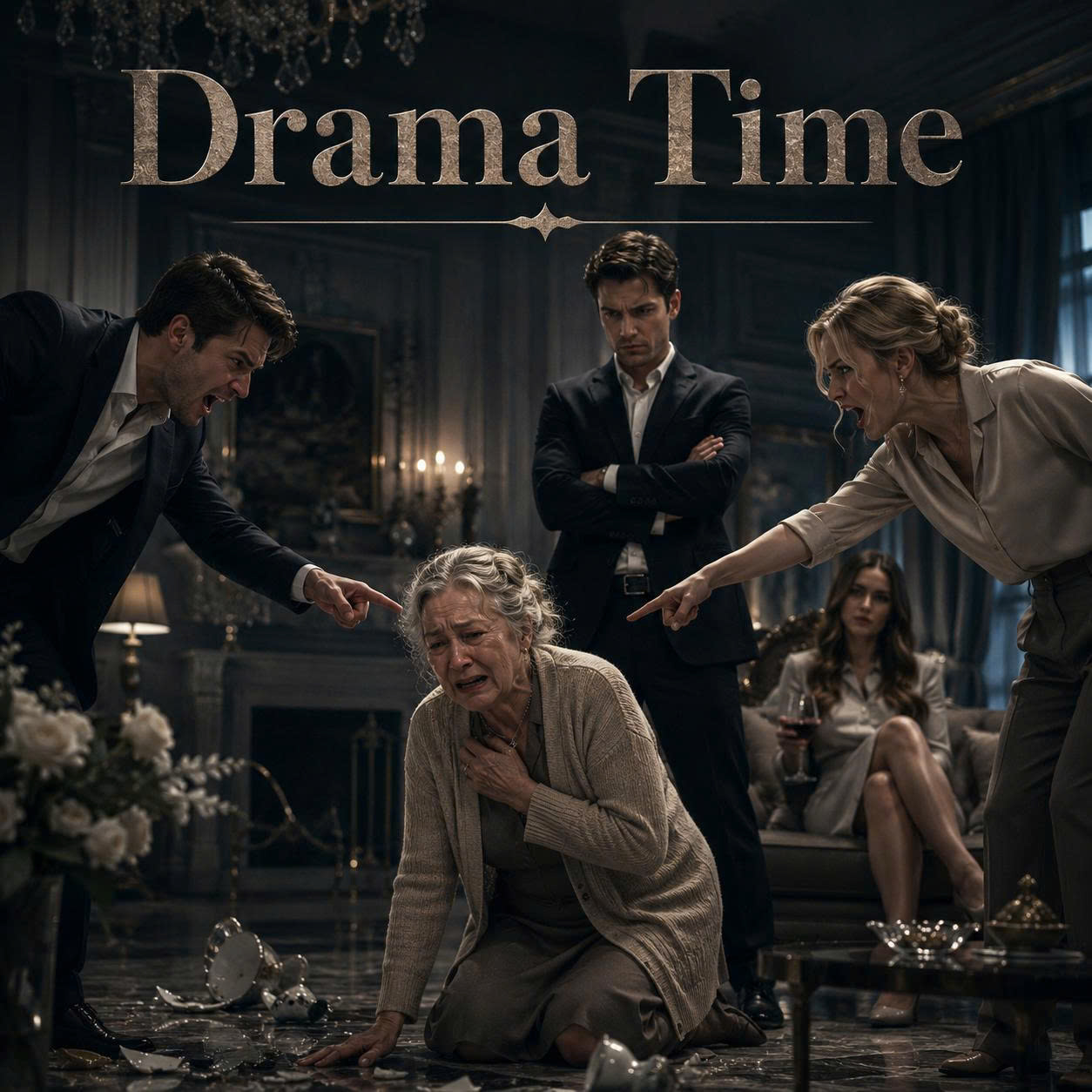
The wedding was already d.e.a.d before the champagne ever reached a single glass. It did not collapse because of a runaway bride, a last-second confession, or some trembling doubt whispered behind the doors of a church. It came apart beneath the white lilies of St. Mary’s, before 260 guests dressed in silk and diamonds, when the woman I was meant to marry looked at my mother as though she were something dragged inside from the mud.
My mother, Margaret Hartwell, had only wanted to hug her. She stood there in her hand-sewn blue dress, her gray hair pinned carefully in place, her eyes glowing with the gentle hope of a woman who had spent her whole life loving others quietly. At sixty-nine, she still carried the faint scent of soil and cool morning air on her skin, the kind that came from feeding animals before sunrise and caring for land that had belonged to our family for generations.
She took one small step forward. Stephanie moved back—not gently, and not by accident. She recoiled as if my mother had carried something contagious into the church.
And then she laughed.
Stephanie spoke loudly enough for half the pews to hear. “Please don’t hug me. You smell like manure. Keep that peasant away from me.”
The silence that followed felt worse than shouting. My mother’s arms froze halfway through the motion. Her smile stayed on her face for one awful second longer than it should have, as though her heart had not yet understood what had just been said to her. Then, slowly, her hands lowered to her sides.
And people laughed—quietly, politely, the way wealthy people laugh when c.r.u.e.l.t.y has been wrapped in expensive perfume. I watched my mother fight to keep smiling through the h.u.m.i.l.i.a.t.i.o.n, and something inside me finally broke loose.
For forty-four years, I had been Charles Hartwell: engineer, son of Willowbrook Farm, future groom, and fool. For months, I had convinced myself that Stephanie’s family simply did not understand the world I came from. I told myself her father’s remarks about “farm boys” were harmless jokes, and that her mother saying my mother might be “out of place” at the country club was only snobbery, not h.a.t.r.e.d.
Stephanie would always tell me. “They don’t mean it that way.”
But they did. They had meant it exactly that way from the very beginning.
My mother had raised me by herself after my father passed away when I was twelve. She sold vegetables before sunrise, repaired fences until her hands b.l.e.d, paid for my education through sacrifice after sacrifice, and somehow still ended up apologizing whenever other people treated her like dirt. Now, on my wedding day, the woman standing beside me had turned her into a joke.
I looked directly at Stephanie. “Apologize to my mother.”
Stephanie stared at me as if I were the one who had embarrassed her. She rolled her eyes. “Oh my God, Charles. It was a joke.”
Her cousin laughed again. My mother looked toward me with fear in her eyes, silently asking me not to create a scene. That expression broke something inside me more deeply than anything Stephanie had said.
Because in that instant, I understood something: my mother had spent her entire life making c.r.u.e.l people comfortable. And I had been helping them do it.
I slipped a hand into my jacket pocket and felt the thick cream-colored envelope I had carried for two weeks—documents sent by my late father’s lawyer, papers I had been too afraid to open. Then I turned back toward Stephanie.
I kept my voice steady. “Take the ring off.”
The polished smile disappeared from her face. “What?”
I did not look away. “This wedding is over.”
The quartet stopped playing. For a moment, it seemed as though the church itself had forgotten how to breathe.
Stephanie’s perfect features tightened as she hissed. “Charles, don’t do this here.”
But it had already been done. I took the ring from her, folded the seating card in half, and walked my mother out of St. Mary’s.
By midnight, my phone was overflowing with t.h.r.e.a.t.s, apologies, and one single message from Stephanie’s younger sister, Emma.
Emma’s message read. “Charles, I think you need to know what Stephanie has really been planning.”
The following morning, I stood inside Stephanie’s apartment, staring down at a marble desk buried beneath paperwork carrying my mother’s name. There were forged power-of-attorney documents, false medical evaluations claiming she had dementia, guardianship papers, and a private elder-care placement plan. Beside them were blueprints showing luxury homes planned across Willowbrook Farm.
Then Emma handed me her phone.
One email read. “Wedding in June. Guardianship proceedings begin in July. Property transfer by fall.”
My phone rang. It was Stephanie’s father.
I answered and turned on speaker.
He spoke carefully. “Charles, there are things about this situation you don’t understand.”
I looked down at the forged signatures, the nursing home agreement, and the development maps.
I answered quietly. “No. I understand perfectly now.”
Then someone knocked on the apartment door.
Emma’s face lost its color.
The knock came again.
Not loud.
Three measured taps against the polished wood.
I looked at Emma. She tightened both hands around her phone.
“Were you expecting anyone?”
She shook her head.
Before either of us moved, a key scraped inside the lock.
Stephanie stepped through the door.
She stopped so abruptly that the door struck her shoulder on the way back.
For several seconds, none of us spoke.
She was still wearing yesterday’s wedding makeup. The mascara beneath one eye had been scrubbed away badly, leaving a gray shadow against her skin. Her hair, so perfect beneath the veil less than twenty-four hours earlier, was twisted into a loose knot. She wore black trousers, yesterday’s pearl earrings, and the expression of someone who had come home expecting privacy and found the walls waiting to testify.
Her gaze moved first to me.
Then Emma.
Then the desk.
The color drained from her face.
“What are you doing here?”
Emma’s fingers trembled around the phone.
I did not move away from the papers.
“Looking at your plans for my mother.”
Stephanie shut the door slowly behind her.
“Charles.”
“No.”
The word came out quieter than I expected.
She took one step toward me.
“Whatever Emma told you—”
“Don’t.”
Another step.
“This is not what it looks like.”
I looked down at the page nearest my hand.
My mother’s name was typed across the top.
Margaret Anne Hartwell.
Beneath it was a signature that looked close enough to hers to fool someone who had never watched her sign birthday cards at the kitchen table.
I had.
The second loop in the M was wrong.
My mother always lifted her pen there.
Stephanie did not know that.
I touched the paper with one finger.
“You forged her name.”
Stephanie’s eyes flicked toward Emma.
“She doesn’t understand the context.”
Emma gave a small, stunned laugh.
“The context?”
Her voice cracked.
“You wrote that Margaret was confused, Charles.”
Stephanie’s jaw tightened.
Emma stepped forward.
“You said she wandered off her property.”
Stephanie stared at her.
“You said she couldn’t manage her finances.”
“Emma.”
“You said she was dangerous to herself.”
“Enough.”
Emma flinched.
That single word told me more about their relationship than months of family dinners ever had.
Stephanie had not shouted.
She had used the tone of someone accustomed to obedience.
Emma lowered her eyes for half a second.
Then she raised them again.
“No.”
Stephanie stared at her.
Emma’s breathing was shallow, but her voice held.
“No. It’s not enough.”
My phone was still on the desk, Stephanie’s father’s call glowing on the screen.
He had not disconnected.
A faint sound came through the speaker.
“Stephanie.”
All three of us turned toward it.
His voice had changed.
The smooth reassurance was gone.
“What have you shown him?”
Stephanie rushed toward the desk.
I picked up the phone before she reached it.
“Everything I needed to see.”
Her father inhaled sharply.
“Charles, listen to me.”
I ended the call.
Stephanie stared at the dark screen.
Then at me.
Her face seemed to harden one muscle at a time.
“You have no idea what you just destroyed.”
I thought of my mother standing beneath white lilies while strangers laughed.
“I destroyed a wedding.”
Stephanie’s mouth tightened.
“You destroyed your future.”
Emma made a quiet sound behind me.
I looked at Stephanie.
“What future?”
She pointed toward the development plans.
“That land could change everything.”
There it was.
Not denial.
Not horror that I believed she had betrayed us.
The land.
I watched her realize what she had admitted.
Her fingers curled against her palm.
She tried to recover.
“Charles, Willowbrook is hundreds of acres sitting in one of the most desirable development corridors in the county. Your mother is nearly seventy. She cannot run it forever.”
“She runs it now.”
“That isn’t the point.”
“It is exactly the point.”
Stephanie’s eyes sharpened.
“She was going to leave it to you eventually.”
I felt something cold move through my chest.
“And marrying me wasn’t fast enough.”
Silence.
Emma turned away.
Stephanie’s voice softened.
It was almost worse.
“You think I didn’t love you?”
I looked at her.
For one painful instant, I wanted her to say something that would make the last year understandable.
Something human.
Something I could mourn.
Instead, she gestured toward the documents.
“I was trying to protect what would eventually be ours.”
Ours.
I looked at the false medical evaluations.
The nursing home brochure.
The guardianship application.
“My mother is not an obstacle between you and a piece of property.”
Stephanie pressed her lips together.
“You’re emotional.”
The phrase landed with almost surgical precision.
Yesterday she had called my mother a peasant.
Today I was emotional.
Different words.
Same purpose.
Make the other person smaller until their resistance looked unreasonable.
Emma walked to the desk and picked up one of the printed emails.
“Tell him about July.”
Stephanie froze.
Emma looked at me.
“She told Dad the marriage had to happen before they filed anything.”
Stephanie moved toward her.
“Emma.”
But Emma kept reading.
“‘Once Charles is legally family, he’ll support whatever doctors recommend.’”
My stomach turned.
I looked at Stephanie.
“You thought I would help you.”
“No.”
“You thought I would sign something.”
“It wasn’t like that.”
“You thought if enough people in expensive offices told me my mother was confused, I’d believe them instead of her.”
Stephanie’s face finally cracked.
Only slightly.
But I saw it.
Because she knew I had.
Not about dementia.
Not about guardianship.
But for months I had believed every small insult came with an innocent explanation.
She had studied that weakness.
And she had planned around it.
A sudden buzzing came from downstairs.
Emma glanced toward the intercom.
Stephanie’s eyes widened.
“Who did you call?”
Emma said nothing.
“Emma.”
The intercom buzzed again.
Then my own phone rang.
An unfamiliar number.
I answered.
“Mr. Hartwell?”
“Yes.”
“This is Daniel Mercer.”
The name hit me before the next sentence did.
My father’s lawyer.
The man whose cream-colored envelope was still inside my jacket.
“I received a message from Emma this morning,” he said. “She told me you found documents concerning Margaret.”
Emma looked at me.
“I didn’t know who else to call,” she whispered.
Mercer continued.
“Do not remove or alter anything. I’m downstairs.”
Stephanie went perfectly still.
I felt the unopened envelope against my chest.
Two weeks.
I had carried it for two weeks because anything connected to my father still had the power to turn me into a twelve-year-old boy standing beside a coffin.
I had told myself I was too busy with the wedding.
That was a lie.
I had been afraid.
“Come up,” I said.
Stephanie crossed the room.
“No.”
I looked at her.
“You don’t get to decide who comes through doors anymore.”
The words silenced her.
Minutes later Daniel Mercer entered with a leather briefcase tucked beneath one arm. He was older than I remembered, his shoulders slightly rounded, his white hair thinner, but his eyes were exactly the same—patient, observant, impossible to hurry.
He saw the desk.
Then me.
Then Stephanie.
He did not touch a single page.
“My office will arrange for these materials to be preserved properly,” he said.
Stephanie folded her arms.
“You can’t simply take documents from my apartment.”
Mercer looked at her.
“No one said we would.”
Then he turned toward me.
“Charles, do you still have the packet I sent?”
I reached inside my jacket.
The envelope emerged creased at one corner from yesterday’s ceremony.
Mercer looked at it for a long moment.
“You haven’t opened it.”
“No.”
Stephanie laughed once.
A brittle little sound.
“Of course he hasn’t.”
Mercer’s eyes shifted toward her.
Then back to me.
“Perhaps now would be a good time.”
My fingers would not cooperate at first.
The envelope had been sealed with ordinary adhesive, but I opened it as carefully as if my father himself had closed it.
Inside were several legal documents and a letter.
My name was written across the front in handwriting I recognized instantly.
Not my father’s.
My mother’s.
I stared at it.
Mercer spoke gently.
“Read the legal documents first.”
The first page was dated nineteen years earlier.
I read the heading twice.
Willowbrook Agricultural Preservation Trust.
My eyes moved faster.
Then slower.
Then stopped.
I looked at Mercer.
“What is this?”
Stephanie stepped closer.
Mercer answered without looking at her.
“Your father began the process before his death. Your mother completed it several years later.”
I looked back down.
The farm had been placed into a permanent preservation structure.
The acreage could remain agricultural.
It could pass within the family under the trust’s terms.
But it could not simply be carved into a luxury housing development.
Not by Stephanie.
Not by her father.
Not by me.
I looked toward the blueprints on the desk.
Perfect roads.
Perfect houses.
Perfect little rectangles drawn across land my parents had protected before Stephanie ever learned my name.
Emma covered her mouth.
Stephanie snatched the nearest page from the envelope.
Her eyes raced across it.
“No.”
Mercer remained still.
Stephanie read another paragraph.
“No, this can’t—”
She turned toward me.
“You told me you would inherit Willowbrook.”
“I told you the farm had been in my family for generations.”
“You said it would pass to you.”
“I thought it would.”
Her face changed.
Not grief.
Calculation collapsing.
She turned toward Mercer.
“There must be a way to dissolve this.”
Mercer’s expression did not move.
“Not for the purpose you appear to have intended.”
The silence afterward seemed to strip every expensive thing in the apartment of value.
The marble desk.
The framed art.
The silk curtains.
The wedding gifts stacked unopened along one wall.
Stephanie slowly looked at the development plans.
Then the guardianship forms.
Then me.
And I finally understood the size of the mistake she had made.
She had tried to remove my mother from a piece of land that my parents had already placed beyond her reach.
Emma sat down.
Stephanie remained standing.
Her shoulders were rigid.
“This proves nothing about me.”
Mercer glanced toward the desk.
“I did not say it did.”
“You’re all standing here acting like I committed some crime.”
I looked at the forged signature.
Mercer’s voice stayed measured.
“The appropriate professionals can determine what these documents represent.”
For the first time, fear appeared fully on Stephanie’s face.
Not embarrassment.
Not anger.
Fear.
She looked at Emma.
“You did this.”
Emma stared back at her.
“No.”
Stephanie’s voice rose.
“You went through my private things.”
“I found my own name in your email.”
That stopped her.
Emma swallowed.
“You wanted me listed as the person who would ‘help Margaret transition’ after the guardianship.”
Stephanie said nothing.
Emma’s eyes filled, but no tears fell.
“You were going to use me so she would trust the process.”
Stephanie looked away.
Emma’s voice dropped.
“I loved you.”
Those three words changed the room.
Stephanie’s shoulders lowered slightly.
Emma continued.
“I defended you to Charles.”
She looked toward me.
“I told him you were stressed about the wedding. I told Margaret not to take things personally when Stephanie ignored her at Christmas.”
She wiped beneath one eye angrily.
“I kept explaining you to good people.”
I understood exactly what she meant.
So did my mother.
Later that afternoon, when I finally drove back to Willowbrook, she was waiting on the porch.
She had changed out of the blue wedding dress.
It hung from the laundry-room door behind her, carefully covered in clear plastic, as though yesterday had been an ordinary event worth preserving.
She wore work pants and one of my father’s old flannel shirts.
A basket of green beans sat beside her chair.
She looked at my face.
Then at the envelope in my hand.
“Oh,” she said.
I stopped at the bottom of the steps.
“You knew.”
Her fingers became still over the beans.
“About the trust?”
I nodded.
“Yes.”
“For nineteen years?”
“Most of it.”
I climbed the steps.
“Why didn’t you tell me?”
She looked toward the fields.
The evening sun lay low across Willowbrook, turning the fence posts gold.
“Because your father wanted you to choose your life without feeling chained to this place.”
I sat beside her.
The porch boards creaked beneath my weight.
She picked up another bean and snapped the end off.
“Your father loved this farm,” she said. “But he loved you more.”
I looked down at the letter.
“You wrote this.”
“Yes.”
“Why send it through Mercer?”
She smiled faintly.
“Because every time I tried to talk about the future, you told me we’d discuss it after the wedding.”
Shame climbed my throat.
“Mom.”
“I’m not scolding you.”
“That makes it worse.”
She set the bean aside.
I looked at her hands.
The same hands Stephanie had made people laugh at.
Small scars.
Thickened knuckles.
A thumbnail permanently split near the corner.
Hands that had paid my tuition one market morning at a time.
“I’m sorry.”
She glanced at me.
I could barely finish.
“I’m sorry I kept asking you to ignore things.”
Her mouth opened.
I continued before she could protect me from the truth.
“I’m sorry I told you Stephanie didn’t mean it. I’m sorry I watched people make you uncomfortable and kept calling it misunderstanding because admitting the truth would have made my life harder.”
My mother looked down at her hands.
A breeze moved through the maple trees.
“I taught you some of that.”
I frowned.
“No.”
“Yes.”
Her voice was quiet.
“I taught you peace mattered more than confrontation because confrontation frightened me.”
She looked toward the driveway.
“After your father died, I needed everyone. Neighbors. Buyers. The bank. The feed supplier. I learned to smile through insults because sometimes I still needed the person insulting me to come back tomorrow.”
She took a breath.
“But surviving that way too long can make you forget you’re allowed to stop.”
I felt my eyes burn.
She touched the back of my hand.
“You stopped.”
“No.”
I turned my hand beneath hers.
“We stopped.”
That evening we opened her letter together.
It was not about money.
That was the final surprise.
My mother had written it months earlier because she intended to retire from daily farm management after the wedding.
Not because she was sick.
Not because she was incapable.
Because she was tired.
She wanted mornings when an alarm did not ring before sunrise.
She wanted to visit Maine.
She wanted to take a pottery class in town she had been quietly looking at for three years.
And she wanted me to understand that preserving Willowbrook did not mean sacrificing myself to it.
At the bottom, she had written one sentence twice.
A farm is supposed to give a family roots, Charles. It is not supposed to become a chain.
I cried then.
Not dramatically.
I simply sat at the kitchen table holding the page while tears dropped silently onto my hands.
My mother pretended not to notice for exactly ten seconds.
Then she pulled her chair closer.
The investigation that followed was neither quick nor theatrical.
Truth rarely moves that way.
It arrived through interviews, document examinations, archived emails, financial records, and long hours in rooms where no one cared how expensive anyone’s clothes were.
The medical professional named on Margaret’s evaluation stated that he had never examined her.
The elder-care facility confirmed that Stephanie had requested information about admission procedures months before the wedding.
The development group acknowledged conversations with Stephanie’s father about Willowbrook, though no transfer had ever occurred.
Emma provided the emails she had preserved.
Mercer provided the trust records.
My mother provided handwriting samples.
I provided everything else.
Stephanie’s father stopped calling me.
Stephanie did not.
At first came apologies.
Then accusations.
Then bargaining.
Then one message at 2:13 in the morning.
I loved you before I knew about the farm.
I stared at those words for a long time.
Maybe she had.
That was the hardest truth.
People are rarely made of only one thing.
Perhaps Stephanie had loved me in whatever way she understood love.
Perhaps greed had entered later.
Perhaps entitlement had.
Perhaps her father’s plans had turned possibility into strategy.
None of it changed what she had done.
Love that requires another person to surrender their dignity is not enough.
I never replied.
Months later, Stephanie and her father faced the consequences of the documents, statements, and planning they had created themselves.
Their development arrangement collapsed completely.
The guardianship effort never reached the point where it could touch my mother.
The false documents were exposed for what they were.
Stephanie’s father lost business partners who had no interest in being tied to the scandal.
Stephanie fought every accusation until the evidence became impossible to explain away.
There was no dramatic scene where she begged me from behind a courtroom table.
No satisfying speech.
No applause.
Just one quiet morning when Mercer called and told us the last remaining claim against Willowbrook had been withdrawn and the protective orders concerning my mother would remain in place.
I hung up.
Mom was standing at the sink rinsing strawberries.
“Well?” she asked.
I placed the phone on the counter.
“It’s over.”
She did not cheer.
She closed the faucet.
Water dripped from her fingers.
“Really?”
“Really.”
She held the edge of the sink.
For one second, I thought she might collapse.
Instead, her shoulders dropped.
Not much.
Maybe an inch.
But I realized I had never seen my mother’s body without some invisible weight resting across it.
She dried her hands.
Then she walked outside.
I followed.
She crossed the yard toward the old red barn.
The afternoon was warm, cicadas vibrating in the trees.
At the gate, she stopped.
“This hinge still sticks.”
I almost laughed.
“Mom.”
“What?”
“We just finished months of legal hell and your first thought is the hinge?”
“It still sticks.”
So I got my toolbox.
That became the beginning of our life after Stephanie.
Not victory parties.
Repairs.
Breakfasts.
Ordinary days reclaimed one at a time.
Emma came to Willowbrook for the first time that autumn.
She parked at the end of the gravel drive and sat inside her car for nearly five minutes before getting out.
My mother watched from the porch.
“She’s frightened of me,” she said.
“She’s ashamed.”
“That’s different.”
Emma walked toward us carrying a pie.
A terrible pie, as it turned out.
The crust was nearly black on one side.
She held it like an offering.
“I made this.”
Mom studied it.
“On purpose?”
Emma stared at her.
Then my mother smiled.
Emma laughed so suddenly she started crying.
The pie almost slipped from her hands.
Mom caught the plate.
And then Emma said the thing she had probably practiced the entire drive.
“I’m sorry I laughed at the church.”
My mother became still.
Emma looked down.
“I didn’t laugh loudly.”
“That doesn’t matter.”
“I know.”
Emma nodded.
“I laughed because everyone else did, and because Stephanie was my sister, and because I was a coward.”
Mom waited.
Emma forced herself to look up.
“You didn’t deserve that.”
“No.”
“You don’t have to forgive me.”
“No.”
Emma blinked.
My mother handed the pie to me.
Then she stepped down from the porch.
“Forgiveness isn’t pretending something didn’t happen.”
Emma’s mouth trembled.
Mom opened her arms.
“It’s deciding what happens next.”
Emma covered her face.
My mother hugged her.
And for the first time since St. Mary’s, I saw my mother offer someone that embrace without hesitation.
Emma became part of our lives slowly.
No declarations.
No replacement-family speeches.
She helped Mom build shelves in the old equipment room for her pottery supplies.
She learned not to wear white shoes around livestock.
She brought better pies.
At Christmas, she placed a small framed photograph on my mother’s kitchen shelf.
It had been taken outside St. Mary’s.
Not during the humiliation.
Afterward.
Someone had captured the moment I was leading Mom toward the car.
Her blue dress moved in the wind.
My hand rested at her back.
Her face was turned toward me.
We both looked devastated.
But we were walking in the same direction.
Mom stared at the photograph for a long time.
“I hated that dress for a while,” she said.
I looked at the blue fabric she had eventually shortened into a simple summer dress.
“I know.”
She touched the frame.
“Not anymore.”
The following spring, we held a gathering at Willowbrook.
Not a wedding.
Nothing formal.
Long wooden tables stood beneath the maple trees.
Neighbors brought casseroles, bread, pies, flowers, and folding chairs.
Mercer came with his wife.
Emma brought a strawberry cake she had wisely purchased from a bakery.
Mom wore the altered blue dress.
The same fabric Stephanie had mocked.
Only now the hem fell just below her knees, and there was a small embroidered willow branch along the collar where my mother had repaired a snag from the wedding day.
I watched her move between tables while people hugged her.
Really hugged her.
No one recoiled from the scent of earth on her hands.
At sunset, Mercer tapped a spoon gently against his glass.
Mom groaned.
“No speeches.”
“Not a speech,” he promised.
He looked toward me.
“Charles, there is one final document.”
I laughed.
“If you pull out another cream envelope, I’m leaving.”
People smiled.
Mercer reached into his jacket.
Of course the envelope was cream.
He handed it to my mother.
She handed it immediately to me.
“No.”
I pushed it back.
“You open this one.”
She narrowed her eyes.
Then tore it cleanly across the top.
Inside was a single page.
She read it.
Stopped.
Read it again.
Then looked at Mercer.
“What did you do?”
Mercer smiled.
“I followed your instructions.”
Mom looked at me.
I knew immediately.
“You planned something.”
She shook her head.
“Not exactly.”
She gave me the page.
Willowbrook’s unused south barn and five adjoining acres had been designated for a community agricultural education program under the preservation trust.
My father’s name was listed first.
My mother’s second.
And beneath them was mine.
I looked at her.
“What is this?”
She twisted the wedding ring she still wore after thirty-two years of widowhood.
“Your father used to say children shouldn’t have to grow up thinking food begins in supermarkets.”
I laughed softly.
I remembered him saying it.
Mom continued.
“We talked about making a place where schoolchildren could come. Learn about soil. Animals. Growing things.”
Her eyes moved toward the south field.
“Then he died.”
For decades, I had believed every dream my mother possessed had been buried beside my father.
I was wrong.
Some had simply waited.
“You kept this too?”
“I kept a lot of things.”
I read the page again.
The program would be funded partly through income from a small portion of the trust.
The farm would remain intact.
The land would keep producing.
And Willowbrook would become something larger than an inheritance.
It would become a place people entered because my parents had opened the gate.
That was the beautiful truth Stephanie had never understood.
The value of Willowbrook had never been what could be built after destroying it.
Its value was that it had survived.
I folded the page carefully.
Mom watched me.
“You don’t have to run it.”
“I know.”
“You can live wherever you want.”
“I know.”
“You can keep engineering.”
“I know.”
She frowned.
“Then stop saying that like you’re about to do something foolish.”
I smiled.
“I want to help.”
Her expression softened.
“Help is different.”
“I finally learned that.”
The first group of children arrived that September.
A yellow school bus rolled down the gravel lane just after nine.
Twenty-three third graders spilled into the yard wearing bright backpacks and impossible amounts of energy.
My mother stood beside the barn in work boots and her blue summer dress.
One boy stared at the mud near the sheep pen.
“Does it smell like that all the time?”
I froze.
Mom looked at me.
For half a second, St. Mary’s existed between us again.
White lilies.
A bride recoiling.
Polite laughter.
Then my mother looked at the boy.
“Only when we’re lucky.”
He frowned.
“Why?”
“Because it means the animals are healthy and the farm is working.”
The child considered this.
Then nodded seriously.
“Cool.”
Mom looked toward me.
We both started laughing.
Not because the past was funny.
Because it no longer owned the moment.
Years of shame can make a person believe dignity arrives when everyone finally understands them.
It doesn’t.
Sometimes dignity is simply waking before sunrise because you choose to.
Sometimes it is leaving mud on your boots.
Sometimes it is refusing to explain your worth to people committed to misunderstanding it.
And sometimes it is walking away from a church with the person who taught you how to love, even when 260 people are watching.
That evening, after the children had gone, Mom and I sat on the porch.
The repaired gate no longer squeaked.
The fields moved beneath a soft September wind.
Inside the kitchen, Emma was washing mugs and singing badly along with the radio.
Mom rested her feet on the porch rail.
“I think I’m going to Maine next month.”
I smiled.
“Good.”
“Two weeks.”
“Make it three.”
She looked suspiciously at me.
“Who’s feeding the chickens?”
“I am.”
“Who’s checking the north fence?”
“I am.”
“The irrigation timer sticks.”
“I know.”
She studied me.
“You have a job.”
“I also have vacation days.”
She leaned back.
For several minutes, neither of us spoke.
The sun lowered behind Willowbrook, spreading amber light across the same fields Stephanie’s blueprints had divided into numbered lots.
No numbered lots existed now.
There were tomatoes growing near the east fence.
Children’s painted signs hung beside the barn.
A pottery mug my mother had made sat between us, crooked and slightly too heavy, filled with tea.
I picked it up.
Stamped into the clay beneath the handle were three tiny words.
Roots, not chains.
I looked at her.
She pretended not to notice.
“You made this for me.”
“I made forty-seven mugs.”
“This one has my name underneath.”
“Coincidence.”
I smiled.
She smiled too.
Then my mother reached over and rested her soil-worn hand on mine.
The same hand Stephanie had been ashamed to touch.
I turned my palm upward and held it.
Beyond the porch, Willowbrook settled into evening.
The barn lights came on.
A horse shifted softly behind the fence.
Emma laughed at something inside the kitchen.
And for the first time in my life, home did not feel like something I needed to defend, inherit, earn, or explain.
It was simply the place where my mother’s hand rested safely in mine while the last light moved across the fields, and neither of us needed to make ourselves smaller for anyone ever again.